

ASEAN-India Summit
Prime Minister Narendra Modi attended three consecutive multilateral summits in Manila, Philippines—the 23rd ASEAN-India Summit, the 21st East Asia Summit (EAS), and the Quad Leaders’ Summit—amid heightened global volatility triggered by the U.S.–Israel strikes on Iran, Iran’s Strait of Hormuz blockade, and Gulf energy disruptions.
UPSC Syllabus Mapping:
General Studies Paper II (International Relations): Bilateral, regional and global groupings and agreements involving India and/or affecting India’s interests; Effect of policies and politics of developed and developing countries on India’s interests; India and its neighbourhood- relations.
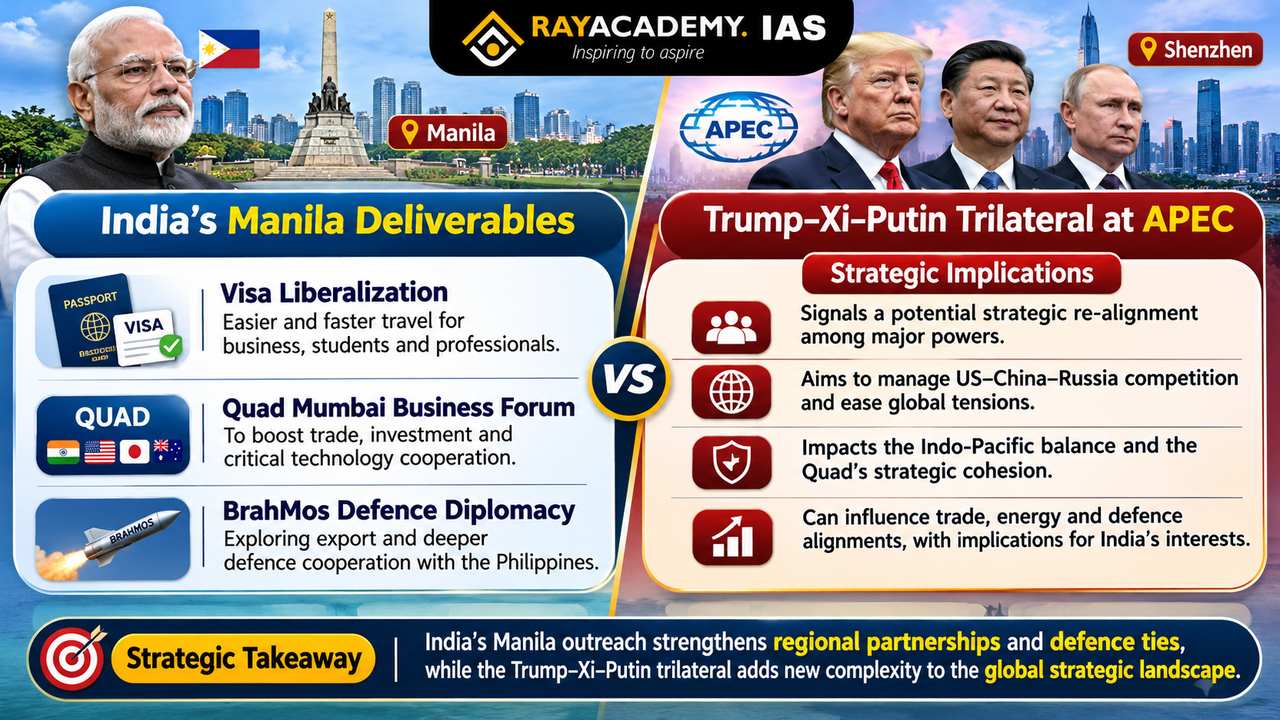
While the Manila engagements yielded key deliverables—including free tourist visas for ASEAN citizens, disaster management and cyber-crime pacts, and the first-ever Quad Summit hosted in a non-Quad nation—strategic attention quickly shifted toward Shenzhen, China, where U.S. President Donald Trump, Russian President Vladimir Putin, and Chinese President Xi Jinping convened an unprecedented three-way superpower summit on the sidelines of the Asia-Pacific Economic Cooperation (APEC) meeting. Indo-Pacific Diplomacy
Static-Current Linkage: Act East Policy, ASEAN Centrality, and Multipolar Balancing
India’s diplomatic posture in Manila reflects the maturation of its Act East Policy (upgraded from the 1991 Look East Policy in 2014) and its commitment to strategic autonomy within an evolving Indo-Pacific security architecture.
1. ASEAN-India Comprehensive Strategic Partnership & East Asia Summit (EAS).Indo-Pacific Diplomacy
ASEAN Expansion to 11 Members: With Timor-Leste integrated as ASEAN’s 11th member, the Association of Southeast Asian Nations (ASEAN) serves as the institutional core of India’s Indo-Pacific Oceans Initiative (IPOI) and MAHASAGAR maritime vision.
East Asia Summit (EAS) Architecture: Established in 2005 (with India as a founding member), the 18-member EAS (10/11 ASEAN states plus India, China, Japan, South Korea, Australia, New Zealand, the U.S., and Russia) remains the premier leaders-led forum for addressing strategic, geopolitical, and non-traditional security threats across the Indo-Pacific.
2. Bilateral Synergy with the Philippines & Quad Plurilateralism
India–Philippines Defence Convergence: Following Philippine President Ferdinand "Bongbong" Marcos Jr.’s visit to New Delhi in August 2025—which elevated ties to a Strategic Partnership—bilateral cooperation has expanded across maritime domain awareness and negotiations for additional BrahMos supersonic cruise missile batteries amid South China Sea tensions.
Quad Institutional Evolution: Comprising India, the United States, Japan, and Australia, the Quadrilateral Security Dialogue (Quad) has evolved from an ad-hoc tsunami relief group (2004) into a public-goods and maritime security coalition anchored in UNCLOS (1982) and respect for ASEAN centrality.
Prelims Focus: High-Yield Objective Facts
Manila Summits (November 2026): Hosted by the Philippines (ASEAN Chair for 2026) under the theme "Navigating the Future"; chairmanship transitions to Singapore in 2027.
Key Manila Outcomes:
ASEAN-India Summit: Launch of new disaster management cooperation and India’s announcement of free tourist e-visas for all ASEAN citizens to boost people-to-people and trade linkages.
East Asia Summit (EAS): Focused action framework on countering cyber-crime and preserving regional stability.
Quad Leaders’ Summit: First time held in a non-Quad country (Manila); announced the inaugural Quad Business Leaders Forum (to be hosted in Mumbai in 2027) and the first Quad naval exercises with maritime patrol aircraft.
APEC (Asia-Pacific Economic Cooperation):
Established in 1989; comprises 21 Pacific Rim member economies (accounting for >60% of global GDP).
India is NOT a member of APEC (holds Observer status), making close diplomatic monitoring of the 2026 Shenzhen APEC Summit vital for New Delhi.
Chokepoint Geography — Strait of Hormuz: Narrow waterway connecting the Persian Gulf with the Gulf of Oman and the Arabian Sea (bordered by Iran to the north and Oman/UAE to the south), critical for global crude oil and LNG transit.
Mains Analytical Breakdown
Significance for India’s Foreign Policy and Regional Security
Reaffirming ASEAN Centrality & Non-Coercive Order: PM Modi’s emphasis on a future shaped "not by competition, but by cooperation" and "peace, stability, and predictability" positions India as a stabilizing, non-hegemonic partner for Southeast Asian nations wary of great-power polarization.
Revitalizing the Quad Without Alienating ASEAN: Hosting the Quad Leaders’ Summit on the sidelines of ASEAN meetings in Manila—coupled with the 2027 Mumbai Quad Business Leaders Forum and joint patrol aircraft exercises—overcame doubts regarding U.S. commitment under President Trump while embedding Quad initiatives within ASEAN’s diplomatic ecosystem.
Deepening Defence Diplomacy & Indigenization: Expanding BrahMos missile negotiations and maritime exchanges with the Philippines operationalizes India’s Act East Policy in the South China Sea, bolstering defence exports and deterrence against unilateral maritime coercion.
Soft Power & Economic Connectivity: Granting free tourist visas to ASEAN citizens alongside disaster management and cyber-security cooperation strengthens people-to-people ties, service-sector exports, and non-traditional security resilience.
Multi-Dimensional Challenges
Great-Power Accommodation & G2/G3 Risks (Geopolitical): The unprecedented Trump–Xi–Putin trilateral summit in Shenzhen raises concerns of transactional deals among Washington, Beijing, and Moscow—potentially softening U.S. balancing against Chinese assertiveness along the Line of Actual Control (LAC) and in the Indo-Pacific.
Energy & Trade Vulnerability from West Asia Conflict (Economic): Iran’s Strait of Hormuz blockade and Gulf strikes threaten India’s energy security (over 85% crude import dependence), inflate freight and insurance costs, and disrupt supply chains linking West Asia with South and Southeast Asia.
Exclusion from Regional Trade Architectures (Trade & Institutional): India remains outside both APEC and the Regional Comprehensive Economic Partnership (RCEP), while the review of the ASEAN-India Trade in Goods Agreement (AITIGA) faces slow progress due to persistent trade deficits and rules-of-origin concerns.
Intra-ASEAN Divergence & Myanmar Crisis (Regional): Differing threat perceptions among ASEAN members regarding China’s South China Sea claims and the stalled Five-Point Consensus on Myanmar constrain collective regional action.
Way Forward
Maintain Calibrated Multi-Alignment & Strategic Autonomy: Leverage plurilateral platforms like the Quad (for maritime domain awareness, critical minerals, and Mumbai’s 2027 Business Forum) while preserving independent diplomatic channels with Moscow and Washington to hedge against U.S.–China–Russia shifts.
Expedite AITIGA Review & Supply-Chain Integration: Conclude the ASEAN-India Trade in Goods Agreement (AITIGA) modernization with strict rules of origin to prevent third-country routing while integrating Indian manufacturing into China-Plus-One Southeast Asian value chains.
Institutionalize Bilateral Maritime & Defence Partnerships: Operationalize the India–Philippines Strategic Partnership through joint coast guard patrols, hydrographic cooperation, and defence line-of-credit mechanisms across littoral ASEAN states.
Diversify Energy Sourcing & Chokepoint Resilience: Mitigate Strait of Hormuz vulnerabilities by expanding Strategic Petroleum Reserves (SPR), diversifying crude/LNG contracts toward the Americas and Africa, and accelerating domestic green-energy transitions.
Pursue Pragmatic Engagement with APEC & Connectivity Corridors: Strengthen observer-level working-group participation in APEC while fast-tracking the India–Myanmar–Thailand Trilateral Highway and Kaladan Multi-Modal Transit Transport Project to physically anchor India in Southeast Asia.
Value Addition for Mains
Foreign Policy Doctrine Anchor: India’s Manila diplomacy operationalizes Article 51 of the Constitution (promotion of international peace, security, and respect for international law) through plurilateralism—balancing maritime deterrence (Quad and BrahMos diplomacy) with inclusive regionalism (ASEAN centrality and IPOI).
Economic Context: ASEAN is one of India’s largest trading partners (accounting for roughly 11% of India’s global trade), while APEC’s 21 economies represent over 60% of global GDP, underscoring why India must deepen bilateral FTAs and plurilateral economic ties even while outside APEC.
Practice Questions for Active Recall
Prelims Practice MCQ
Consider the following statements regarding regional groupings in the Indo-Pacific:
India is a founding member of the East Asia Summit (EAS), whereas it is not a member of the Asia-Pacific Economic Cooperation (APEC) forum.
The 2026 Quad Leaders’ Summit in Manila marked the first time the summit was hosted in a country that is not a member of the Quad.
Timor-Leste is the 11th member of the Association of Southeast Asian Nations (ASEAN).
Which of the statements given above are correct?
(a) 1 and 2 only
(b) 2 and 3 only
(c) 1 and 3 only
(d) 1, 2, and 3
Correct Answer: (d) 1, 2, and 3
Explanation:
Statement 1 is correct: India has been a member of the East Asia Summit (EAS) since its inception in 2005, whereas APEC comprises 21 Pacific Rim economies and India is not a member.
Statement 2 is correct: The 2026 Quad Leaders’ Summit was held in Manila, Philippines, on the sidelines of the ASEAN summits—marking the first time the Quad summit took place in a non-Quad country.
Statement 3 is correct: Following Timor-Leste’s accession, ASEAN expanded into an 11-member regional bloc.
Mains Practice Question (GS Paper II — 150 Words | 10 Marks)
"While regional plurilateralism strengthens India’s Indo-Pacific footprint, shifting alignments among major global powers test New Delhi’s strategic autonomy." Examine this statement in light of the 2026 Manila ASEAN-Quad summits and emerging great-power trilateral diplomacy.
Answer Structure Hints:
Introduction: Contextualize PM Modi’s back-to-back participation in the ASEAN-India Summit, East Asia Summit, and Quad Summit in Manila alongside the U.S.–China–Russia trilateral at APEC Shenzhen and West Asian energy disruptions.
Body Part 1 (Strengthening Regional Footprint): Highlight India’s commitment to ASEAN centrality, free tourist visas, cyber/disaster pacts, India–Philippines BrahMos defence ties, and the Manila Quad Summit (Mumbai 2027 Business Forum and joint maritime patrols).
Body Part 2 (Challenges from Major-Power Shifts): Analyze risks of a Washington–Beijing–Moscow accommodation diluting Indo-Pacific balancing, Strait of Hormuz energy shocks, and India’s exclusion from APEC/RCEP.
Conclusion: Conclude with calibrated multi-alignment, expediting the AITIGA review, and bolstering domestic defence and energy resilience to safeguard strategic autonomy.
Take this article with you
Save a reading copy for offline study.


