

Birth anniversary of Birsa Munda
Nationwide commemorations marking the birth anniversary of Birsa Munda (observed annually on November 15 as Janjatiya Gaurav Divas) have been rolled out across India, featuring over 1,000 outreach programmes across 240 tribal-dominated districts from November 11 to 18.
UPSC Syllabus Mapping:
General Studies Paper I (Modern Indian History): Significant events, personalities, and issues from the middle of the eighteenth century until the present; Tribal and peasant uprisings against British colonial rule.
General Studies Paper II (Governance & Social Justice): Welfare schemes for vulnerable sections of the population by the State and the performance of these schemes; Mechanisms, laws, institutions and bodies constituted for the protection and betterment of Scheduled Tribes (Fifth and Sixth Schedules, PESA, FRA).
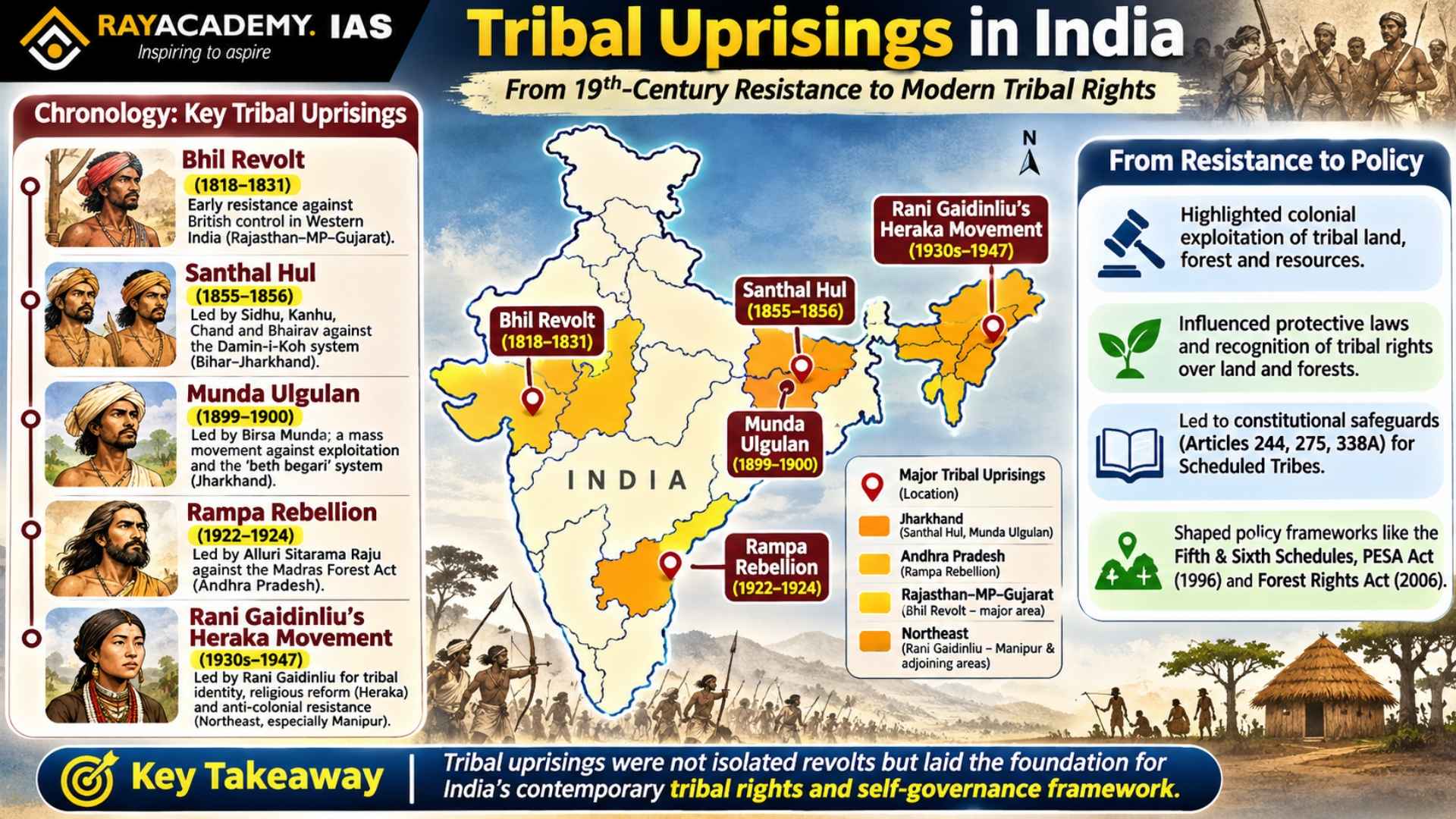
Instituted by the Union Government in 2021 to honor the sacrifices of Adivasi freedom fighters, the observances spotlight the legacy of Bhagwan Birsa Munda’s Ulgulan (Great Tumult) alongside regional tribal heroes—such as Tilka Manjhi, Sidhu-Kanhu, Rani Durgavati, Alluri Sitarama Raju, Komaram Bheem, and Rani Gaidinliu—while reviewing the impact of targeted tribal development missions.
Static-Current Linkage: Colonial Agrarian Disruption, Ulgulan (1899–1900), and Constitutional Safeguards
Analyzing the historical and administrative significance of Janjatiya Gaurav Divas requires linking 19th-century tribal resistance against colonial land alienation with India’s post-independence constitutional protections for Scheduled Tribes.
Socio-Economic Roots of the Munda Ulgulan (1899–1900)
Born on November 15, 1875, in Ulihatu village (Khunti district, Jharkhand), Birsa Munda emerged as a socio-religious reformer and anti-colonial leader in the Chotanagpur Plateau. The Munda tribe traditionally practiced Khuntkatti—a collective, lineage-based land ownership system where the original forest clearers held communal rights over land.
British colonial administration dismantled this egalitarian structure by introducing the Zamindari system, revenue monetization, and begar (forced labor), enabling outside landlords, moneylenders, and traders—collectively termed Dikus—to dispossess Adivasis of their ancestral lands.
From Birsait Reform to "Abua Dishum, Abua Raj"
Socio-Religious Purification: Birsa Munda founded the Birsait faith, urging the Munda community to abandon superstition, animal sacrifice, and intoxicants, while reviving indigenous cultural pride and resisting coercive religious conversions.
The Ulgulan (Great Tumult): Between 1899 and 1900, Birsa organized armed guerrilla resistance against British police stations, colonial courts, and oppressive landlords under the rallying cry “Abua Dishum, Abua Raj” (Our Country, Our Rule).
Martyrdom and Legislative Aftermath: Captured by British forces, Birsa Munda died in Ranchi Jail on June 9, 1900, at the age of 25. His sacrifice compelled the colonial government to enact the Chotanagpur Tenancy (CNT) Act, 1908, which restricted the transfer of tribal land to non-tribals and recognized Khuntkatti rights.
Constitutional & Statutory Architecture for Tribal Empowerment .Birsa Munda Birth Anniversary
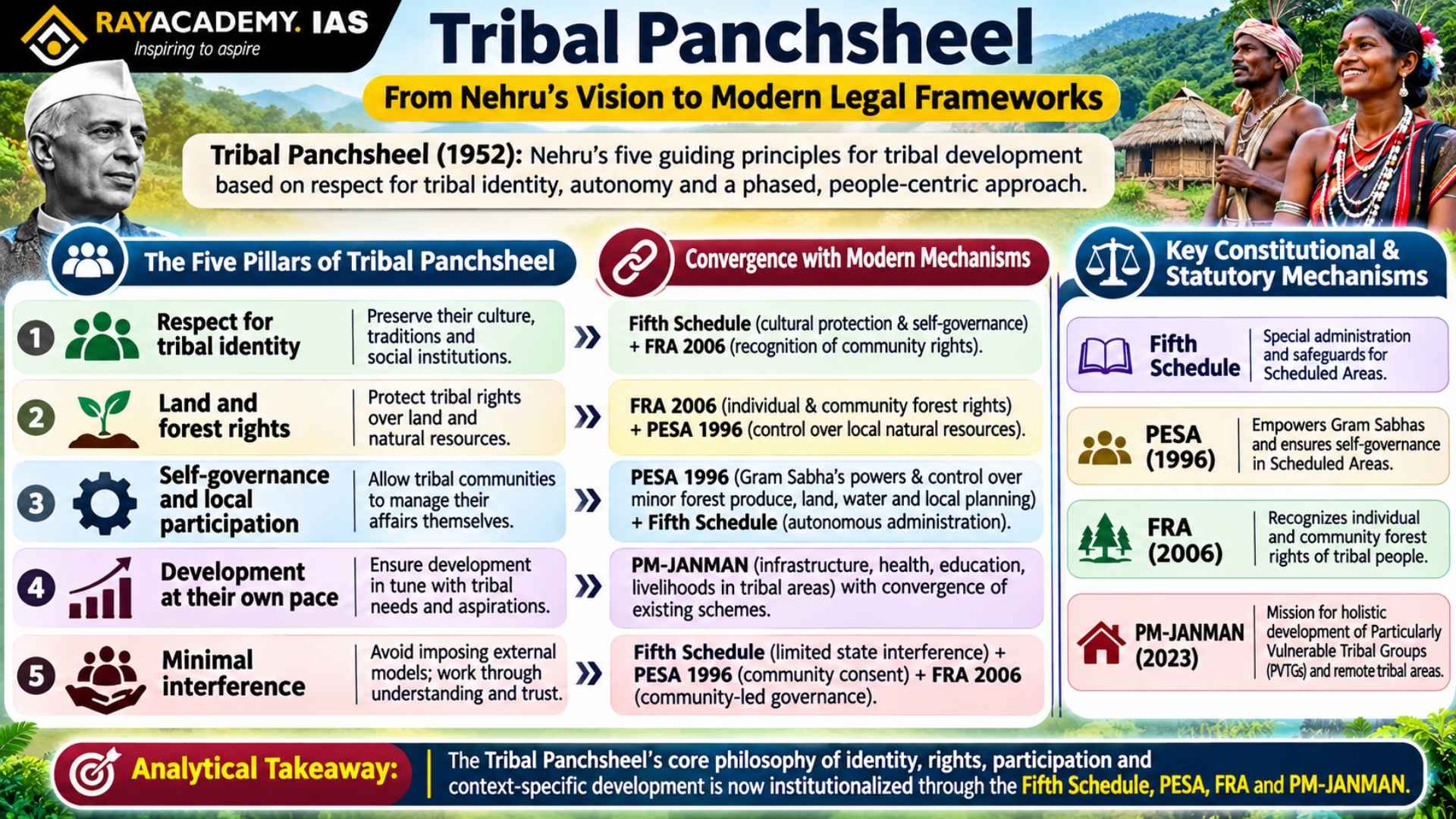
Fifth Schedule (Article 244(1)): Governs the administration and control of Scheduled Areas and Scheduled Tribes in states other than Assam, Meghalaya, Tripura, and Mizoram, empowering the Governor to restrict land transfers and establish Tribes Advisory Councils (TACs).
Sixth Schedule (Article 244(2)): Provides autonomous administrative governance through Autonomous District Councils (ADCs) in Assam, Meghalaya, Tripura, and Mizoram.
PESA Act, 1996: The Provisions of the Panchayats (Extension to the Scheduled Areas) Act empowers Gram Sabhas in Fifth Schedule areas to manage community resources, minor forest produce, and land alienation.
Forest Rights Act (FRA), 2006: Recognizes individual and community forest rights of forest-dwelling Scheduled Tribes and other traditional forest dwellers.
         HISTORICAL LEGACY TO MODERN TRIBAL GOVERNANCE
   ┌──────────────────────────────────────────────────────────────┐
   │ Colonial Dispossession: Destruction of Khuntkatti system     │
   │ by British revenue laws & Dikus (outsider landlords)          │
   └──────────────────────────────┬───────────────────────────────┘
                                  ▼
   ┌──────────────────────────────────────────────────────────────┐
   │ Birsa Munda's Ulgulan (1899–1900) & Birsait Reform Movement  │
   │ • Slogan: "Abua Dishum, Abua Raj" (Our Country, Our Rule)    │
   └──────────────────────────────┬───────────────────────────────┘
                                  ▼
   ┌──────────────────────────────────────────────────────────────┐
   │ Legal & Constitutional Shields: CNT Act (1908), 5th & 6th    │
   │ Schedules, PESA Act (1996), & Forest Rights Act (2006)       │
   └──────────────────────────────┬───────────────────────────────┘
                                  ▼
   ┌──────────────────────────────────────────────────────────────┐
   │ Contemporary Saturation Missions (Janjatiya Gaurav Divas)    │
   │ • PM-JANMAN (PVTGs) & Dharti Aaba Janjatiya Gram Utkarsh     │
   └──────────────────────────────────────────────────────────────┘
Prelims Focus: High-Yield Objective Facts
Personality / Framework | Key Details & Specifications for UPSC Prelims |
Birsa Munda (1875–1900) | Born Nov 15, 1875 in Ulihatu (Khunti, Jharkhand); led the Ulgulan (1899–1900); founded the Birsait sect; died in Ranchi Jail on June 9, 1900; honored as Dharti Aaba (Father of the Earth). |
Janjatiya Gaurav Divas | Declared by the Union Cabinet in 2021 to be celebrated annually on November 15 to commemorate the contributions of tribal freedom fighters. |
Chotanagpur Tenancy Act, 1908 | Enacted in the aftermath of the Munda Rebellion; prohibits transfer of tribal land to non-tribals without Deputy Commissioner's permission and protects Khuntkatti tenure. |
Prominent Tribal Revolutionaries | • Tilka Manjhi (1784): Led Paharia uprising against British in Bhagalpur. |
• Sidhu-Kanhu, Chand-Bhairav, Phulo-Jhano (1855–56): Led the Santhal Hul.
• Budhu Bhagat (1831–32): Led the Kol Mutiny.
• Alluri Sitarama Raju & Komaram Bheem: Led the Rampa Rebellion (1922–24) and Gond uprising (Jal, Jungle, Zameen) respectively.
• Rani Gaidinliu: Naga spiritual-political leader who led the Heraka movement against British rule in Manipur/Nagaland. | | PM-JANMAN & DA-JGUA | • PM-JANMAN (2023): Focuses on 11 critical interventions for 75 Particularly Vulnerable Tribal Groups (PVTGs).
• Dharti Aaba Janjatiya Gram Utkarsh Abhiyan (2024): Targets holistic saturation across 63,000+ tribal-majority villages. |
Mains Analytical Breakdown
Significance of Commemorating Tribal Heritage and Welfare
Decolonizing and Democratizing Indian Historiography: Elevating Janjatiya Gaurav Divas corrects elite-centric narratives of the Indian National Movement by recognizing that Adivasi communities waged sustained, organized resistance against British imperialism decades before mainstream urban nationalism.
Affirming Constitutional Representation and Dignity: Milestones such as the election of Droupadi Murmu as India’s first tribal President in 2022, alongside the establishment of Tribal Freedom Fighter Museums across states, strengthen symbolic and substantive inclusion.
Catalyzing Targeted Last-Mile Saturation: Associating national observances with mission-mode schemes—such as Eklavya Model Residential Schools (EMRS), PM-JANMAN, and the National Sickle Cell Anaemia Elimination Mission—accelerates infrastructure delivery in remote forest and hilly habitations.
Multi-Dimensional Challenges
Land Alienation and Dilution of PESA/FRA: Despite constitutional protections under the Fifth Schedule, PESA (1996), and the Forest Rights Act (2006), illegal land transfers, acquisition for mining/infrastructure without genuine Free, Prior, and Informed Consent (FPIC), and high rejection rates of Individual and Community Forest Rights claims persist.
Human Development and Health Deficits: Tribal districts continue to lag national averages in maternal/infant mortality, nutritional stunting, and specialized healthcare access, compounded by genetic burdens like Sickle Cell Disease.
Educational Dropout and Linguistic Barriers: High secondary-school dropout rates among Scheduled Tribe students stem from long distances to schools, teacher absenteeism, and a lack of early childhood instruction in indigenous mother tongues.
Livelihood Vulnerability in Minor Forest Produce (MFP): Adivasi forest gatherers frequently face distress sales and middleman exploitation due to weak cold-storage infrastructure and uneven implementation of Minimum Support Price (MSP) for Minor Forest Produce and Van Dhan Vikas Kendras.
Balancing Cultural Preservation with Modernization: Rapid assimilation and poorly planned displacement threaten endangered tribal languages, traditional ecological knowledge, and community cohesion—violating the spirit of Jawaharlal Nehru’s Tribal Panchsheel.
Way Forward
Enforce Gram Sabha Primacy under PESA and FRA (Xaxa Committee Framework): Implement the Virginius Xaxa High-Level Committee (2014) recommendations by ensuring mandatory Gram Sabha consent prior to land acquisition, expediting pending Forest Rights Act claims, and penalizing unauthorized alienation of tribal lands.
Scale Multi-Lingual Education and Eklavya Schools: Aligning with the National Education Policy (NEP) 2020, institutionalize foundational literacy in local tribal dialects alongside expanding Eklavya Model Residential Schools (EMRS) equipped with digital connectivity and sports/skill academies.
Strengthen Forest-Based Value Chains via TRIFED: Expand Van Dhan Vikas Kendras and enforce fair MSP for Minor Forest Produce (MFP) through TRIFED, enabling tribal self-help groups to capture value addition in honey, lac, tamarind, and medicinal herbs.
Deploy Mobile Healthcare and Sickle Cell Screening: Universalize genetic screening, counseling, and mobile medical units across Fifth Schedule districts to achieve the target of eliminating Sickle Cell Anaemia by 2047.
Enhance Participatory Governance in Tribes Advisory Councils: Revitalize Tribes Advisory Councils (TACs) under the Fifth Schedule to conduct regular social audits of the Development Action Plan for Scheduled Tribes (DAPST / Tribal Sub-Plan), ensuring funds are non-divertible and outcome-oriented.
Value Addition for Mains
Demographic & Constitutional Benchmark: According to the 2011 Census, Scheduled Tribes constitute 8.6% of India’s total population (over 10.4 crore citizens), predominantly inhabiting forested and mineral-rich regions. Safeguarding their rights operationalizes Article 46 (DPSP), which mandates the State to promote with special care the educational and economic interests of Scheduled Tribes and protect them from social injustice and all forms of exploitation.
Historical Slogan for Ethics & Essay: Birsa Munda’s twin call of moral self-reform (abstaining from intoxicants and preserving cultural dignity) and political self-determination (“Abua Dishum, Abua Raj”) demonstrates that sustainable socio-political empowerment requires both ethical regeneration from within and structural justice from without.
Practice Questions for Active Recall
Prelims Practice MCQ
With reference to Birsa Munda and the tribal resistance movements in India, consider the following statements:
Birsa Munda led the Ulgulan movement in the Chotanagpur region against the erosion of the traditional Khuntkatti communal land system by colonial authorities and outsider landlords.
The Chotanagpur Tenancy Act of 1908 was enacted following the Munda uprising to restrict the transfer of tribal land to non-tribals.
Rani Gaidinliu, a prominent tribal freedom fighter honored during Janjatiya Gaurav Divas, led the Rampa Rebellion in the Eastern Ghats.
Which of the statements given above are correct?
(a) 1 and 2 only
(b) 2 and 3 only
(c) 1 and 3 only
(d) 1, 2, and 3
Correct Answer: (a) 1 and 2 only
Explanation:
Statement 1 is correct: Birsa Munda spearheaded the Ulgulan (1899–1900) to protect the traditional Munda Khuntkatti land tenure system against British revenue policies and exploitation by Dikus.
Statement 2 is correct: In direct response to the Munda rebellion, the British government passed the Chotanagpur Tenancy (CNT) Act, 1908, prohibiting the sale or transfer of Adivasi land to non-tribals without official sanction.
Statement 3 is incorrect: Rani Gaidinliu led the Heraka socio-religious and anti-colonial movement in Manipur and Nagaland (Northeast India). The Rampa Rebellion (1922–24) in the Eastern Ghats (Andhra Pradesh) was led by Alluri Sitarama Raju.
Mains Practice Question (GS Paper I & II — 150 Words | 10 Marks)
"Birsa Munda’s Ulgulan was simultaneously a movement for socio-religious self-purification and an anti-colonial struggle for land and self-rule." Discuss the historical significance of Birsa Munda’s movement and examine how far modern statutory frameworks have succeeded in protecting tribal land and autonomy.
Answer Structure Hints:
Introduction: Contextualize Janjatiya Gaurav Divas (November 15) commemorating Birsa Munda (1875–1900), who combined the Birsait socio-religious reform movement with the Ulgulan (“Abua Dishum, Abua Raj”).
Body Part 1 (Historical Significance): Highlight his campaign against intoxicants and colonial land alienation (destruction of Khuntkatti tenure), which culminated in the Chotanagpur Tenancy Act, 1908 and inspired later anti-colonial tribal movements.
Body Part 2 (Modern Statutory Frameworks & Gaps): Evaluate post-independence safeguards—Fifth Schedule, PESA (1996), and Forest Rights Act (2006)—noting achievements in Gram Sabha empowerment alongside persistent gaps like illegal land transfers, FRA claim rejections, and displacement.
Conclusion: Conclude with the Xaxa Committee recommendations and Article 46, emphasizing that true tribute to Birsa Munda lies in upholding Gram Sabha consent and inclusive tribal development.
Take this article with you
Save a reading copy for offline study.


