

India-Bangladesh Relations
India-Bangladesh relations have entered a delicate diplomatic phase after ousted Bangladeshi Prime Minister Sheikh Hasina, currently residing in exile in New Delhi since August 2024, applied to the Bangladesh High Commission in New Delhi for a new Bangladeshi passport and National Identity Card (NID) ahead of her announced plan to return to Dhaka in December 2026.
UPSC Syllabus Mapping:
General Studies Paper II (International Relations): India and its neighbourhood- relations; Bilateral, regional and global groupings and agreements involving India and/or affecting India’s interests; Effect of policies and politics of developed and developing countries on India’s interests.
The Bangladesh Nationalist Party (BNP) government led by Prime Minister Tarique Rahman summarily rejected the application, labeling Ms. Hasina a “terrorist” and reiterating demands for her return via the India-Bangladesh Extradition Treaty following her death sentence by a domestic tribunal. This political friction—intensified by Ms. Hasina’s August 5 virtual press conference in Delhi—has stalled high-level diplomatic engagements, including Prime Minister Rahman’s scheduled visit to India and crucial negotiations to renew the 1996 Ganga Water Sharing Treaty, which is set to expire in December 2026.
Static-Current Linkage: Extradition Jurisprudence, Asylum Norms, and Transboundary Water Governance
Navigating this bilateral impasse requires examining three foundational pillars of international law and India’s neighbourhood policy: bilateral extradition treaties, customary asylum frameworks, and transboundary river governance.
The India-Bangladesh Extradition Treaty (2013) & Political Offence Exception.India-Bangladesh Diplomatic Dilemma
India and Bangladesh signed a bilateral Extradition Treaty in 2013 (amended in 2016 to simplify evidentiary requirements by removing the need for prima facie evidence of guilt, requiring only an arrest warrant from a competent court).
Dual Criminality: Under international extradition law, the alleged offence must be punishable under the laws of both the requesting and requested states.
Political Offence Exception (Article 6): Crucially, Article 6 of the treaty permits the requested state to refuse extradition if the offence is of a “political character” or if the request is not made in good faith in the interests of justice. While the 2016 amendment excluded terrorism and murder from the political offence exception, New Delhi retains sovereign legal discretion to evaluate whether domestic tribunal convictions meet international standards of fair trial and non-persecution.India-Bangladesh Diplomatic Dilemma
Asylum & Non-Refoulement in International and Indian Law
India is neither a signatory to the 1951 UN Refugee Convention nor its 1967 Protocol, nor does it possess a standalone domestic asylum statute. Instead, refuge is granted through executive discretion grounded in constitutional morality (Article 21), civilizational hospitality (Atithi Devo Bhava), and customary international norms of non-refoulement (prohibiting the return of individuals to jurisdictions where they face execution or persecution). Historically, India sheltered Ms. Hasina between 1975 and 1981 following the assassination of Sheikh Mujibur Rahman, establishing a deep precedent of personal protection for historic allies.
The 1996 Ganga Water Sharing Treaty & Joint Rivers Commission (JRC)
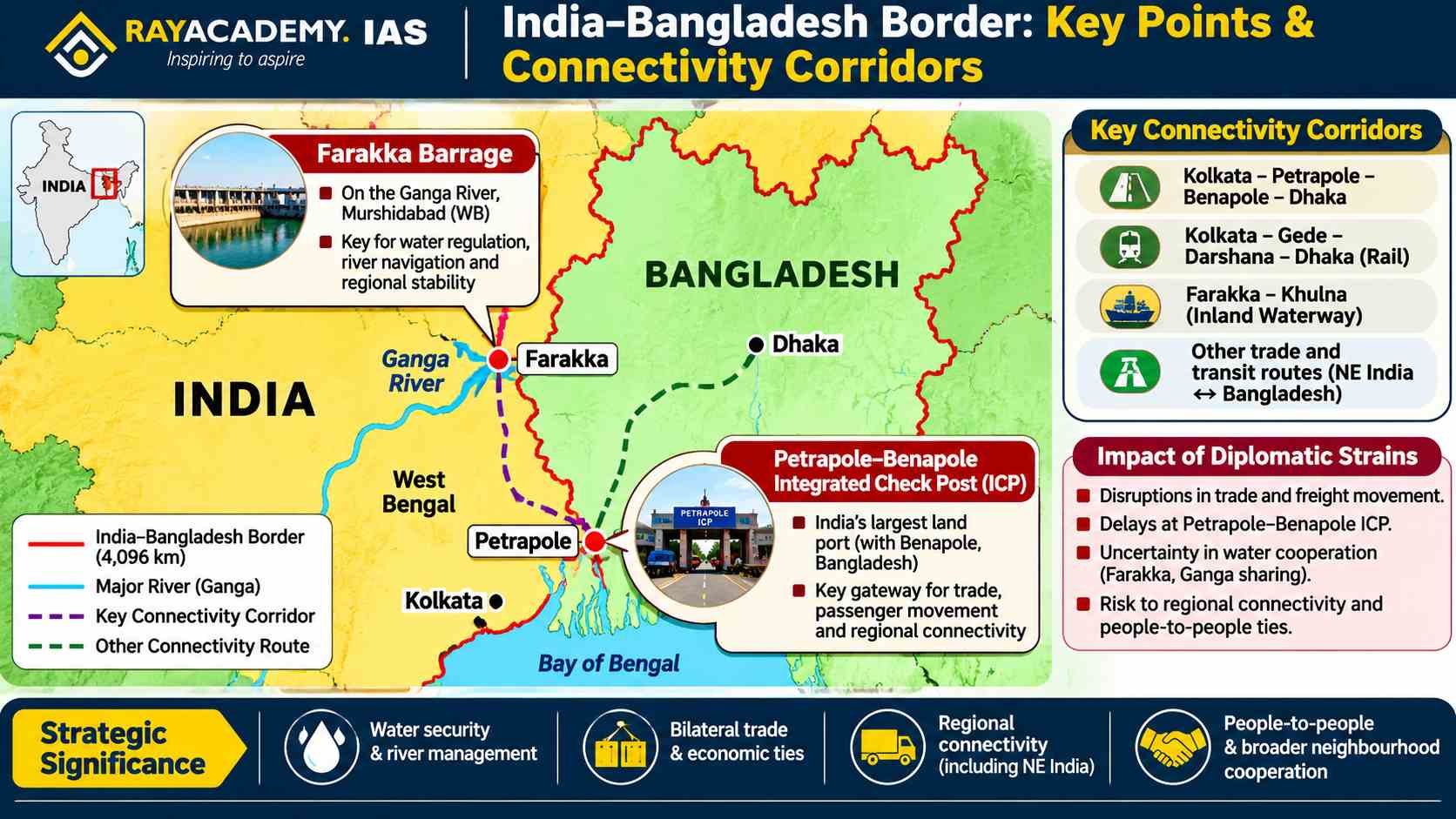
Signed on December 12, 1996, for a 30-year tenure, the Ganga Water Sharing Treaty governs the dry-season (January 1 to May 31) allocation of Ganga waters at the Farakka Barrage in West Bengal.
Institutional Mechanism: Water-sharing disputes and data exchanges are overseen by the Indo-Bangladesh Joint Rivers Commission (JRC), established in 1972 and co-chaired by the Water Resources Ministers of both nations.
Constitutional Federalism: Under Entry 56 of the Union List and Article 253 of the Indian Constitution, Parliament holds treaty-making power over inter-state and international rivers, though practical implementation requires close political consensus with riparian states like West Bengal.
Prelims Focus: High-Yield Objective Facts
India-Bangladesh Land Border: India shares its longest international land boundary (4,096.7 km) with Bangladesh across five Indian states: West Bengal (2,216.7 km), Tripura, Meghalaya, Mizoram, and Assam.
Petrapole–Benapole Border: Located in North 24 Parganas district (West Bengal), Petrapole is South Asia’s largest land port and handles nearly one-third of bilateral land-based trade between India and Bangladesh.
Ganga Water Treaty (1996): Signed for 30 years (expiring December 2026); regulates dry-season flow (Jan 1 – May 31) in 10-day cycles at Farakka Barrage (Murshidabad district, West Bengal). Unlike the 1977 agreement, the 1996 treaty omitted the minimum "guarantee clause" for downstream flow.
Joint Rivers Commission (JRC): Constituted in 1972 following the Indira–Mujib Treaty of Friendship, Cooperation and Peace; India and Bangladesh share 54 transboundary rivers (including Ganga, Brahmaputra/Jamuna, Teesta, Kushiyara, and Feni).
Extradition Act, 1962: The domestic statutory framework governing extradition in India, administered by the Consular, Passport and Visa (CPV) Division of the Ministry of External Affairs (MEA).
Article 51 of the Indian Constitution: Directs the State to promote international peace and security, maintain just and honourable relations between nations, and foster respect for international law and treaty obligations.
Mains Analytical Breakdown
Significance of Balancing Bilateral Ties with Humanitarian Protection
Safeguarding Regional Security and Connectivity: Bangladesh is the cornerstone of India’s Neighbourhood First and Act East policies. Stable ties are essential to sustain multimodal transit corridors (such as access to Chattogram and Mongla ports), power transmission grids, and counter-insurgency cooperation along India’s sensitive Northeast frontier.
Upholding Diplomatic Credibility as a Reliable Partner: Abandoning a long-standing political ally to face capital punishment would severely damage India’s strategic credibility across South Asia, signaling to regional leaders that New Delhi’s friendship is transactional rather than enduring.
Preventing Domestic Radicalization and Instability in Dhaka: Paradoxically, Ms. Hasina’s sudden return could trigger violent street clashes in Bangladesh, destabilizing the BNP government and strengthening hardline Islamist factions such as Jamaat-e-Islami. Maintaining status-quo stability serves both New Delhi and Dhaka’s core security interests.
Multi-Dimensional Challenges
Geopolitical & Diplomatic Deadlock: Allowing Ms. Hasina to conduct political press briefings from Indian soil has created acute diplomatic friction, prompting Dhaka to cancel high-level visits and freeze institutional dialogue.
Transboundary Water & Economic Fallout: With the 1996 Ganga Water Treaty expiring in December 2026, diplomatic paralysis threatens timely technical renewal—creating uncertainty for downstream agriculture in Bangladesh and navigation at Kolkata Port, while stalling negotiations on the Teesta River and CEPA (Comprehensive Economic Partnership Agreement).
Legal & Sovereignty Conundrum: India cannot physically restrain Ms. Hasina from traveling to a land port like Petrapole or boarding a commercial flight, yet facilitating or ignoring an uncoordinated return could spark a major border and diplomatic crisis.
External Strategic Encroachment: Prolonged estrangement between New Delhi and Dhaka creates a strategic vacuum that extra-regional powers—particularly China (via infrastructure and defense diplomacy) and Pakistan—can exploit to encircle India’s eastern flank.
Ethical & Humanitarian Dilemma: New Delhi must navigate the classic realist-versus-idealist tension in foreign policy: balancing pragmatic statecraft and institutional engagement with an elected government in Dhaka against moral obligations toward an exiled leader facing a death sentence.
Way Forward
Practice "Quiet Diplomacy" and Enforce Political Neutrality: While continuing to guarantee Ms. Hasina’s personal safety and dignified stay on humanitarian grounds, New Delhi must diplomatically advise against public political broadcasts or press conferences from Indian territory that directly target Dhaka’s incumbent leadership.
De-Link Functional Cooperation from Political Friction: Following the Gujral Doctrine—which emphasizes non-reciprocal accommodation toward smaller neighbours—India and Bangladesh must insulate critical developmental tracks, particularly technical Joint Rivers Commission (JRC) talks on renewing the 1996 Ganga Water Treaty, from bilateral political rhetoric.
Broaden Multi-Party Engagement in Dhaka: Aligning with recommendations of the Parliamentary Standing Committee on External Affairs, India must institutionalize sustained diplomatic outreach across Bangladesh’s entire political spectrum—engaging the BNP administration, civil society, youth groups, and business chambers—rather than relying on single-party equations.
Build Domestic Federal Consensus on Water Sharing: The Union Ministry of Jal Shakti and Ministry of External Affairs should proactively consult the Government of West Bengal to craft a scientifically updated, climate-resilient renewal framework for the Ganga Water Treaty that protects both Kolkata Port’s navigability and Bangladesh’s dry-season ecological needs.
Leverage Economic Interdependence and Track-II Dialogue: Activate Track-II academic, media, and business dialogues alongside uninterrupted trade facilitation at Petrapole–Benapole and power-grid connectivity to rebuild people-to-people trust and counter anti-India narratives.
Value Addition for Mains
Official Bilateral Trade & Connectivity Data (MEA / Ministry of Commerce): Bangladesh is India’s largest trading partner in South Asia, with bilateral trade exceeding $13–14 billion annually, while India remains Bangladesh’s second-largest trading partner globally—demonstrating deep economic interdependence that makes sustained diplomatic rupture mutually costly.
Foreign Policy Doctrine Anchor: Quoting former Prime Minister Atal Bihari Vajpayee’s timeless maxim—"You can change your friends, but not your neighbours"—alongside Article 51(c) of the Constitution provides an authoritative, balanced conclusion emphasizing why pragmatic engagement with Dhaka is a permanent geopolitical necessity for India.
Practice Questions for Active Recall
Prelims Practice MCQ
With reference to India-Bangladesh bilateral frameworks and transboundary river governance, consider the following statements:
The 1996 Ganga Water Sharing Treaty regulates the sharing of Ganga waters at the Farakka Barrage during the dry season between January and May.
Under the India-Bangladesh Extradition Treaty, an offence of a political character can never be grounds for refusing an extradition request.
The Indo-Bangladesh Joint Rivers Commission (JRC) was established in 1972 to facilitate cooperation on shared transboundary rivers.
Which of the statements given above are correct?
(a) 1 and 2 only
(b) 1 and 3 only
(c) 2 and 3 only
(d) 1, 2, and 3
Correct Answer: (b) 1 and 3 only
Explanation:
Statement 1 is correct: Signed in December 1996 for a 30-year period (expiring in December 2026), the Ganga Water Sharing Treaty governs dry-season water allocation (January 1 to May 31) at the Farakka Barrage in West Bengal.
Statement 2 is incorrect: Under Article 6 of the India-Bangladesh Extradition Treaty, extradition may be refused if the offence is of a political character (excluding specific scheduled crimes like terrorism/murder) or if the request is not made in good faith in the interests of justice.
Statement 3 is correct: The Joint Rivers Commission (JRC) was constituted in 1972 to ensure effective joint efforts in maximizing benefits from common river systems shared by India and Bangladesh.
Mains Practice Question (GS Paper II — 150 Words | 10 Marks)
"India’s diplomatic challenge in Bangladesh lies in reconciling its humanitarian and historical obligations toward an exiled leader with the strategic imperative of maintaining constructive ties with the incumbent government in Dhaka." Examine the key irritants in current India-Bangladesh relations and suggest a pragmatic diplomatic roadmap for New Delhi.
Answer Structure Hints:
Introduction: Contextualize the diplomatic strain triggered by Sheikh Hasina’s exile in India, her rejected passport application and return plans, and the stalling of bilateral engagements.
Body Part 1 (Key Irritants): Highlight friction over extradition demands vs. legal/humanitarian protections, public political statements from Indian soil, cancellation of bilateral visits, and stalled renewal talks for the 1996 Ganga Water Treaty (expiring December 2026).
Body Part 2 (Pragmatic Roadmap): Recommend quiet diplomacy (curbing political broadcasts from India while ensuring personal safety), de-linking functional JRC water talks and Petrapole trade from political friction, and broadening multi-party outreach in Dhaka under the Neighbourhood First policy.
Conclusion: Conclude with Article 51 and the Gujral Doctrine, emphasizing that geographic permanence and regional security require steady, non-reciprocal engagement with Bangladesh.
Take this article with you
Save a reading copy for offline study.


