

Credit Guarantee Fund for Micro Units
The Union Cabinet, chaired by Prime Minister Narendra Modi, approved the five-year extension of the Credit Guarantee Fund for Micro Units (CGFMU) up to March 31, 2031, coinciding with the 16th Finance Commission cycle (FY 2026–27 to FY 2030–31).
UPSC Syllabus Mapping:
General Studies Paper III (Indian Economy): Indian Economy and issues relating to planning, mobilization of resources, growth, development and employment; Inclusive growth and issues arising from it; Effects of liberalization on the economy, changes in industrial policy and their effects on industrial growth (MSME sector financing).
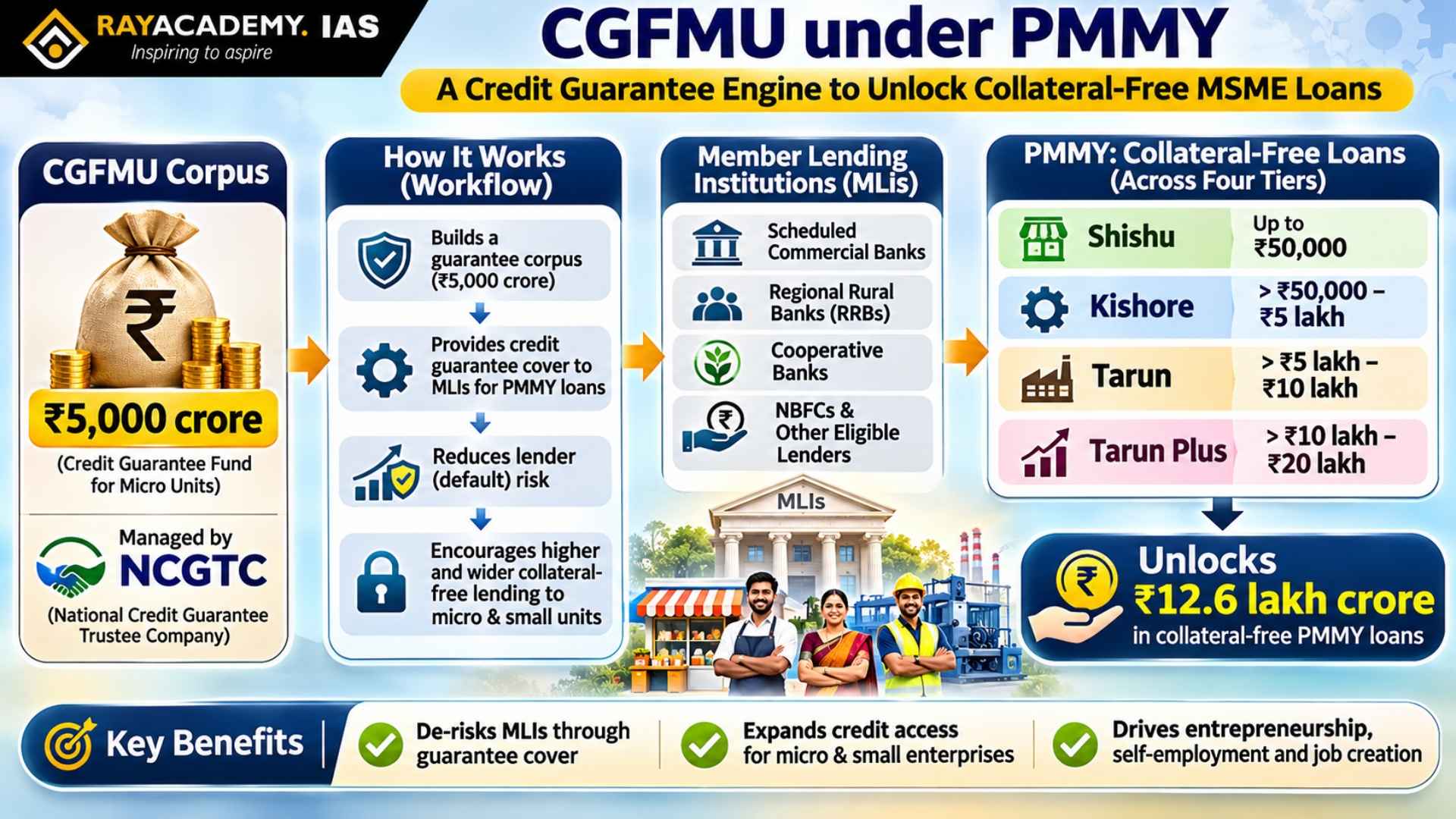
Backed by a dedicated corpus of ₹5,000 crore, the continuation of the CGFMU is projected to facilitate collateral-free Pradhan Mantri Mudra Yojana (PMMY) loans worth ₹12.6 lakh crore over the next five years. Since the inception of PMMY, lending institutions have sanctioned over 60.36 crore loans amounting to ₹43.34 lakh crore as of September 2026, underscoring the scheme's pivotal role in formalizing grassroots micro-entrepreneurship.
Static-Current Linkage: Credit Rationing, Sovereign Guarantees, and Financial Inclusion
Evaluating the extension of the CGFMU requires linking the macroeconomic theory of credit rationing with India’s statutory microfinance architecture and institutional risk-sharing mechanisms.
Overcoming Information Asymmetry and Collateral Constraints
In classical banking economics, small and micro-enterprises face acute credit rationing due to information asymmetry and a lack of tangible collateral. Commercial banks perceive first-generation entrepreneurs and informal micro-units as high-default risks, leading to either outright credit denial or reliance on predatory informal moneylenders.
To bridge this structural market failure, sovereign credit guarantee schemes act as third-party risk mitigants—absorbing a predetermined share of default losses so Member Lending Institutions (MLIs) can extend collateral-free credit based on cash-flow viability rather than physical asset backing.
Institutional Architecture: NCGTC, MUDRA, and CGFMU
Pradhan Mantri Mudra Yojana (PMMY): Launched on April 8, 2015, to "Fund the Unfunded" by providing institutional credit to non-corporate, non-farm small and micro-enterprises through Scheduled Commercial Banks (SCBs), Regional Rural Banks (RRBs), Small Finance Banks (SFBs), Non-Banking Financial Companies (NBFCs), and Microfinance Institutions (MFIs).
Credit Guarantee Fund for Micro Units (CGFMU): Notified in January 2016 by the Department of Financial Services (DFS), Ministry of Finance, to provide portfolio-level credit guarantee coverage against default risk on PMMY loans.
National Credit Guarantee Trustee Company Limited (NCGTC): A wholly-owned company of the Government of India (incorporated under the Companies Act, 1956) that acts as the trustee and operational manager for CGFMU and multiple national credit guarantee trusts.
Key Revised Parameters (2026–2031 Cycle)Credit Guarantee Fund for Micro Units
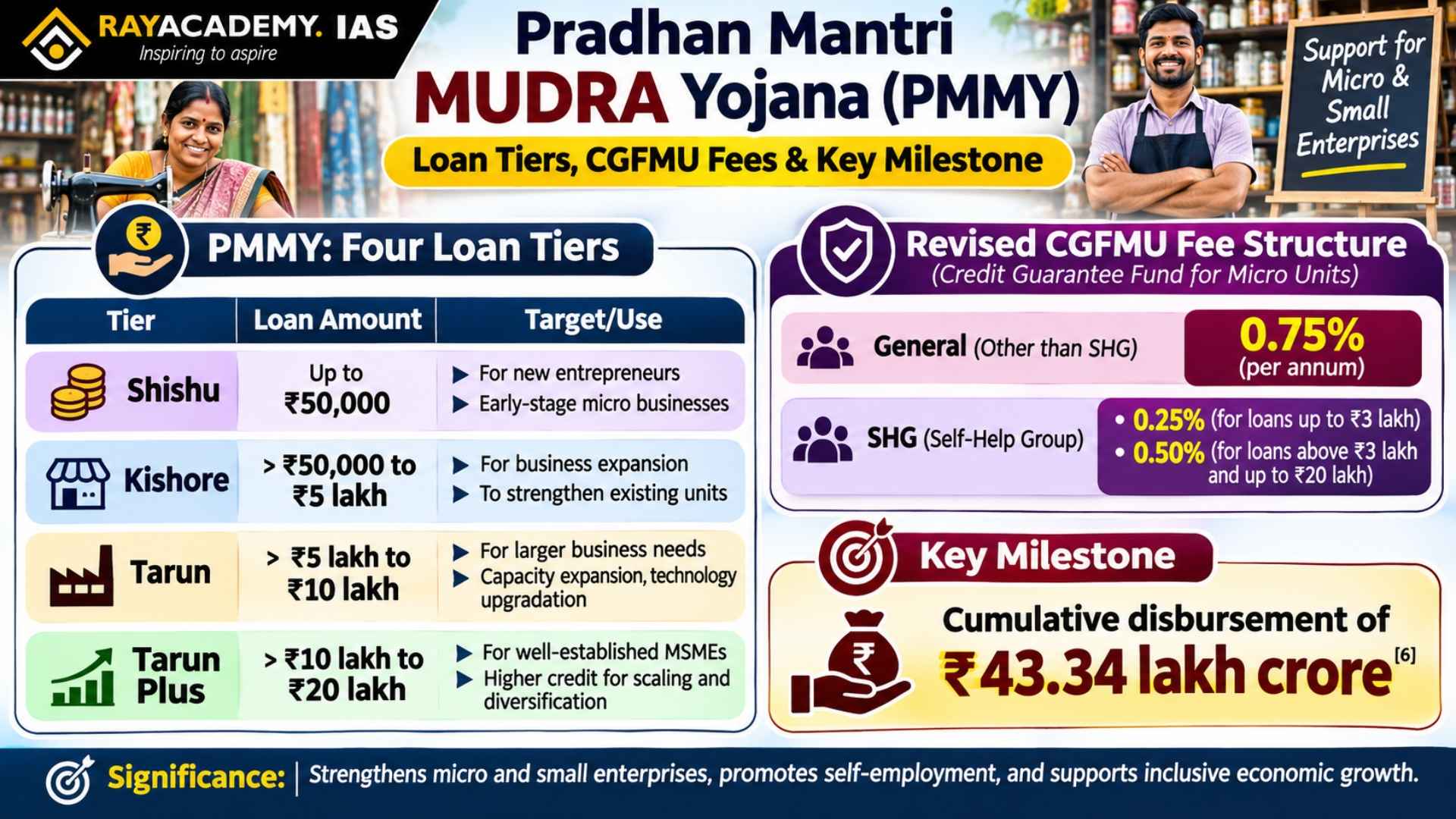
Expanded Loan Ceiling: Covers eligible micro-enterprise loans under PMMY up to ₹20 lakh (following the Union Budget 2024–25 introduction of the Tarun Plus category), alongside Pradhan Mantri Jan Dhan Yojana (PMJDY) overdraft facilities up to ₹10,000 and Self-Help Group (SHG) loans between ₹10 lakh and ₹20 lakh.
Reduced Guarantee Fee: To lower the cost of credit intermediation, the annual guarantee fee for lenders has been reduced from 1% per annum to 0.75% per annum, while retaining concessional rates for SHGs (0.25% in the first year and 0.50% in subsequent years).
Risk-Aligned Coverage: Guarantee coverage is linked to the disbursement amount for working capital limits and the outstanding principal for term loans to accurately reflect lenders' real-time risk exposure.
          SOVEREIGN CREDIT GUARANTEE MECHANISM (CGFMU)
   ┌──────────────────────────────────────────────────────────────┐
   │ First-Generation Micro-Enterprise / SHG / PMJDY Holder       │
   │ • Lacks physical collateral for formal bank credit           │
   └──────────────────────────────┬───────────────────────────────┘
                                  ▼
   ┌──────────────────────────────────────────────────────────────┐
   │ Member Lending Institutions (SCBs, RRBs, SFBs, NBFCs, MFIs)  │
   │ • Sanction collateral-free PMMY loans (up to ₹20 lakh)       │
   │ • Pay reduced 0.75% p.a. guarantee fee (0.25%/0.50% for SHGs)│
   └──────────────────────────────┬───────────────────────────────┘
                                  ▼
   ┌──────────────────────────────────────────────────────────────┐
   │ National Credit Guarantee Trustee Company Ltd. (NCGTC)       │
   │ • Manages ₹5,000 Cr CGFMU Corpus (extended till March 2031)  │
   │ • Absorbs default risk on working capital & term loans       │
   └──────────────────────────────┬───────────────────────────────┘
                                  ▼
   ┌──────────────────────────────────────────────────────────────┐
   │ Macro Outcome: ₹12.6 Lakh Cr Projected Credit (2026–2031)    │
   │ • Formalization, self-employment, and inclusive GDP growth   │
   └──────────────────────────────────────────────────────────────┘
Prelims Focus: High-Yield Objective Facts
Institution / Scheme | Key Details & Specifications for UPSC Prelims |
Credit Guarantee Fund for Micro Units (CGFMU) | Launched in January 2016; administered by Department of Financial Services (DFS), Ministry of Finance; managed by NCGTC; extended up to March 31, 2031 with a ₹5,000 crore corpus. |
PMMY Loan Categories | • Shishu: Loans up to ₹50,000 |
• Kishore: Loans above ₹50,000 and up to ₹5 lakh
• Tarun: Loans above ₹5 lakh and up to ₹10 lakh
• Tarun Plus: Loans above ₹10 lakh and up to ₹20 lakh (for entrepreneurs who previously availed and successfully repaid Tarun loans). | | Eligible Facilities under CGFMU | 1. PMMY micro-enterprise loans up to ₹20 lakh
PMJDY overdraft facilities up to ₹10,000
Self-Help Group (SHG) loans with portfolios between ₹10 lakh and ₹20 lakh. | | National Credit Guarantee Trustee Company (NCGTC) | Set up in 2014 by the Ministry of Finance as a common trustee company to manage multiple credit guarantee funds (including CGFMU, CGFSEL for education loans, and CGSSI for Stand-Up India). | | MUDRA Ltd. | Micro Units Development and Refinance Agency Ltd.; operates as a refinancing institution (does not lend directly to individuals) and is a wholly-owned subsidiary of SIDBI. |
Mains Analytical Breakdown
Significance for Inclusive Growth and Employment
Democratizing Institutional Credit: By backing 60.36 crore loans worth ₹43.34 lakh crore since inception, the PMMY–CGFMU ecosystem has brought millions of unbanked street vendors, artisans, and micro-traders into the formal financial fold.
Catalyzing Women’s Entrepreneurship and Social Equity: Historically, nearly 68% of Mudra accounts have been held by women entrepreneurs, with substantial representation from Scheduled Castes (SC), Scheduled Tribes (ST), and Other Backward Classes (OBC), directly advancing socio-economic empowerment.
Lowering Intermediation Costs: Cutting the annual guarantee fee from 1% to 0.75% improves lending economics for banks and NBFCs, encouraging deeper credit penetration in aspirational and rural districts during the 16th Finance Commission period.
Supporting Enterprise Scaling (Tarun Plus): Extending guarantee coverage up to ₹20 lakh prevents the "missing middle" trap, enabling successful micro-units to graduate into small enterprises without hitting a sudden collateral wall.
Multi-Dimensional Challenges
Asset Quality and Non-Performing Asset (NPA) Stress: Because PMMY loans are collateral-free and rapidly disbursed under target-driven campaigns, public sector banks and MFIs have periodically experienced elevated NPA ratios in Mudra portfolios, particularly during macroeconomic shocks.
Dominance of Low-Ticket Shishu Loans: A disproportionately high share of sanctioned Mudra accounts remains concentrated in small-ticket Shishu loans (up to ₹50,000), which primarily sustain subsistence self-employment rather than generating significant wage-paying jobs.
Moral Hazard in Credit Appraisal: Sovereign risk guarantees can inadvertently induce moral hazard, weakening due diligence and post-disbursement monitoring by bank branches relying on NCGTC payouts to cover defaults.
Microfinance Over-Indebtedness Risks: Rapid expansion of unsecured micro-credit through overlapping NBFC-MFIs and banks risks borrower over-leveraging if household cash flows are not rigorously assessed.
Regional Credit Asymmetry: Credit absorption remains uneven across states, with industrially advanced southern and western states capturing higher average ticket sizes compared to eastern and northeastern states.
Way Forward
Strengthen Cash-Flow-Based Underwriting via Digital Public Infrastructure: Integrate Account Aggregator (AA) frameworks, GST invoices, and UPI transaction histories into bank credit appraisal systems—as recommended by the RBI’s UK Sinha Committee on MSMEs—to replace collateral with verifiable digital cash-flow footprints.
Curb Moral Hazard Through Risk-Tiered Guarantee Pricing: Link NCGTC guarantee fees and payout caps to individual lender NPA performance, rewarding banks with strong recovery records while penalizing lax underwriting.
Pair Credit with Non-Financial Business Development Services: Aligning with NITI Aayog’s Strategy for New India, bundle Mudra disbursements with financial literacy, digital bookkeeping, Udyam registration, and market-linkage support (such as ONDC and GeM) to help Shishu borrowers scale into Kishore and Tarun enterprises.
Enforce Household Debt-Service Guardrails: Operationalize RBI’s Master Direction on Microfinance Loans strictly across all regulated entities to ensure total household debt repayments do not exceed 50% of monthly income, preventing borrower distress.
Promote Targeted Credit Outreach in Underserved Regions: Deploy targeted credit-outreach camps across Aspirational Districts and the Northeast, leveraging women-led Self-Help Groups (SHGs)—which enjoy concessional 0.25%–0.50% CGFMU fees—as disciplined grassroots credit conduits.
Value Addition for Mains
Official Cabinet & PMMY Benchmark: As of September 2026, lending institutions have sanctioned over 60.36 crore loans amounting to ₹43.34 lakh crore under PMMY, while the newly approved ₹5,000 crore CGFMU corpus (valid till March 2031) is projected to unlock ₹12.6 lakh crore in fresh micro-credit.
Constitutional & Policy Anchor: Expanding collateral-free institutional credit operationalizes Article 39(b) and (c) of the Directive Principles of State Policy—preventing the concentration of wealth and means of production while democratizing capital access for grassroots wealth creators.
Practice Questions for Active Recall
Prelims Practice MCQ
With reference to the Credit Guarantee Fund for Micro Units (CGFMU) and Pradhan Mantri Mudra Yojana (PMMY), consider the following statements:
The Credit Guarantee Fund for Micro Units (CGFMU) is managed and operated by the National Credit Guarantee Trustee Company Limited (NCGTC).
Under the extended CGFMU framework, credit guarantee coverage is restricted exclusively to PMMY loans and excludes overdraft facilities under the Pradhan Mantri Jan Dhan Yojana (PMJDY).
Micro Units Development and Refinance Agency Ltd. (MUDRA) functions as a refinancing institution and does not lend directly to micro-entrepreneurs.
Which of the statements given above are correct?
(a) 1 and 2 only
(b) 2 and 3 only
(c) 1 and 3 only
(d) 1, 2, and 3
Correct Answer: (c) 1 and 3 only
Explanation:
Statement 1 is correct: Established in January 2016, CGFMU provides credit guarantee coverage to lending institutions against default risk through the National Credit Guarantee Trustee Company Limited (NCGTC).
Statement 2 is incorrect: In addition to eligible PMMY loans (up to ₹20 lakh), CGFMU also covers overdraft facilities up to ₹10,000 under PMJDY accounts and eligible Self-Help Group (SHG) loans between ₹10 lakh and ₹20 lakh.
Statement 3 is correct: MUDRA Ltd. (a subsidiary of SIDBI) operates solely as a refinancing agency supporting banks, NBFCs, and MFIs that lend to micro-enterprises; it does not extend direct retail loans to individuals.
Mains Practice Question (GS Paper III — 150 Words | 10 Marks)
"Sovereign credit guarantee mechanisms play a vital role in overcoming collateral constraints for micro-enterprises, yet they must be carefully calibrated to avoid moral hazard and asset quality stress." Examine the significance of extending the Credit Guarantee Fund for Micro Units (CGFMU) till 2031 and suggest measures to strengthen sustainable micro-credit delivery in India.
Answer Structure Hints:
Introduction: Contextualize the Union Cabinet’s five-year extension of CGFMU till March 2031 with a ₹5,000 crore corpus to facilitate ₹12.6 lakh crore in collateral-free PMMY loans.
Body Part 1 (Significance): Explain how CGFMU mitigates bank risk aversion, builds on 60.36 crore sanctioned loans (₹43.34 lakh crore), lowers guarantee fees (to 0.75%), and supports women entrepreneurs and graduating Tarun Plus micro-units.
Body Part 2 (Risks & Calibration Measures): Address challenges like NPA spikes, moral hazard in branch underwriting, and concentration in subsistence Shishu loans. Recommend cash-flow underwriting via the Account Aggregator framework, risk-tiered guarantee pricing, and bundling credit with ONDC/Udyam market linkages.
Conclusion: Conclude with Article 39(b) and inclusive growth, emphasizing that pairing risk-sharing guarantees with prudent underwriting ensures both financial inclusion and banking stability.
Take this article with you
Save a reading copy for offline study.


