

31st Conference of the Parties
The 31st Conference of the Parties (COP31) to the United Nations Framework Convention on Climate Change (UNFCCC) convened in Antalya, Türkiye (November 9–20, 2026), featuring a unique co-leadership model hosted by Türkiye under COP31 President Murat Kurum while negotiations are presided over by Australia (Minister Chris Bowen).
UPSC Syllabus Mapping:
General Studies Paper III (Environment & Conservation): Conservation, environmental pollution and degradation, environmental impact assessment; Global climate change negotiations, UNFCCC frameworks, climate finance, and India's climate diplomacy.
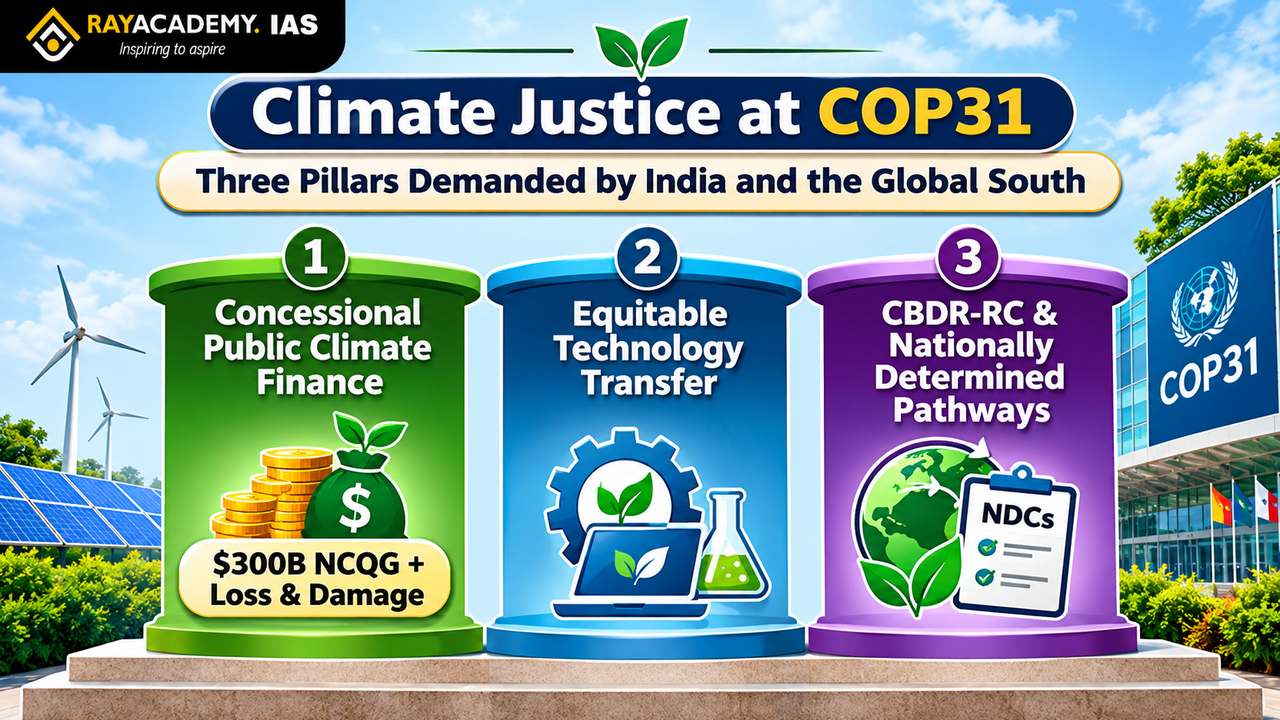
Ahead of the summit, ministerial delegations visited Pacific Small Island Developing States (SIDS) like Fiji and Tuvalu to spotlight existential sea-level rise. However, opening sessions have been marked by subdued political attendance from major Western leaders—compounded by the U.S. withdrawal from the Paris Agreement, the West Asia conflict, and European fiscal strain—shifting focus toward fulfilling past pledges, specifically the $300 billion annual climate finance goal by 2035 (NCQG) and operationalizing the Loss and Damage Fund. Simultaneously, India refused to sign a proposed COP31 pledge to raise electricity’s share in global energy consumption from 23% to 35% by 2035, insisting instead on predictable climate finance, technology transfer, and Nationally Determined Contributions (NDCs).
Static-Current Linkage: UNFCCC Architecture, Paris Agreement Mechanisms, and Climate Equity
Understanding the negotiating deadlocks at COP31 requires linking foundational climate treaty principles with evolving global financial and scientific review mechanisms.
Common But Differentiated Responsibilities (CBDR-RC)
Adopted at the 1992 Rio Earth Summit, the UNFCCC is anchored in Article 3(1), which enshrines the principle of Common But Differentiated Responsibilities and Respective Capabilities (CBDR-RC) and equity.
Historical Responsibility: Developed nations (Annex I parties) bear primary historical responsibility for cumulative greenhouse gas (GHG) emissions since the Industrial Revolution and are statutorily obligated under Article 4 to provide financial resources and technology transfer to developing nations.
India’s Negotiating Pillar: India’s refusal to accept uniform sectoral electrification mandates (the 35% by 2035 target) reflects CBDR-RC and the Paris Agreement (2015) bottom-up architecture, which respects national developmental pathways and poverty eradication priorities.
The Global Stocktake (GST) & IPCC Assessment Cycles. COP31 Climate Summit
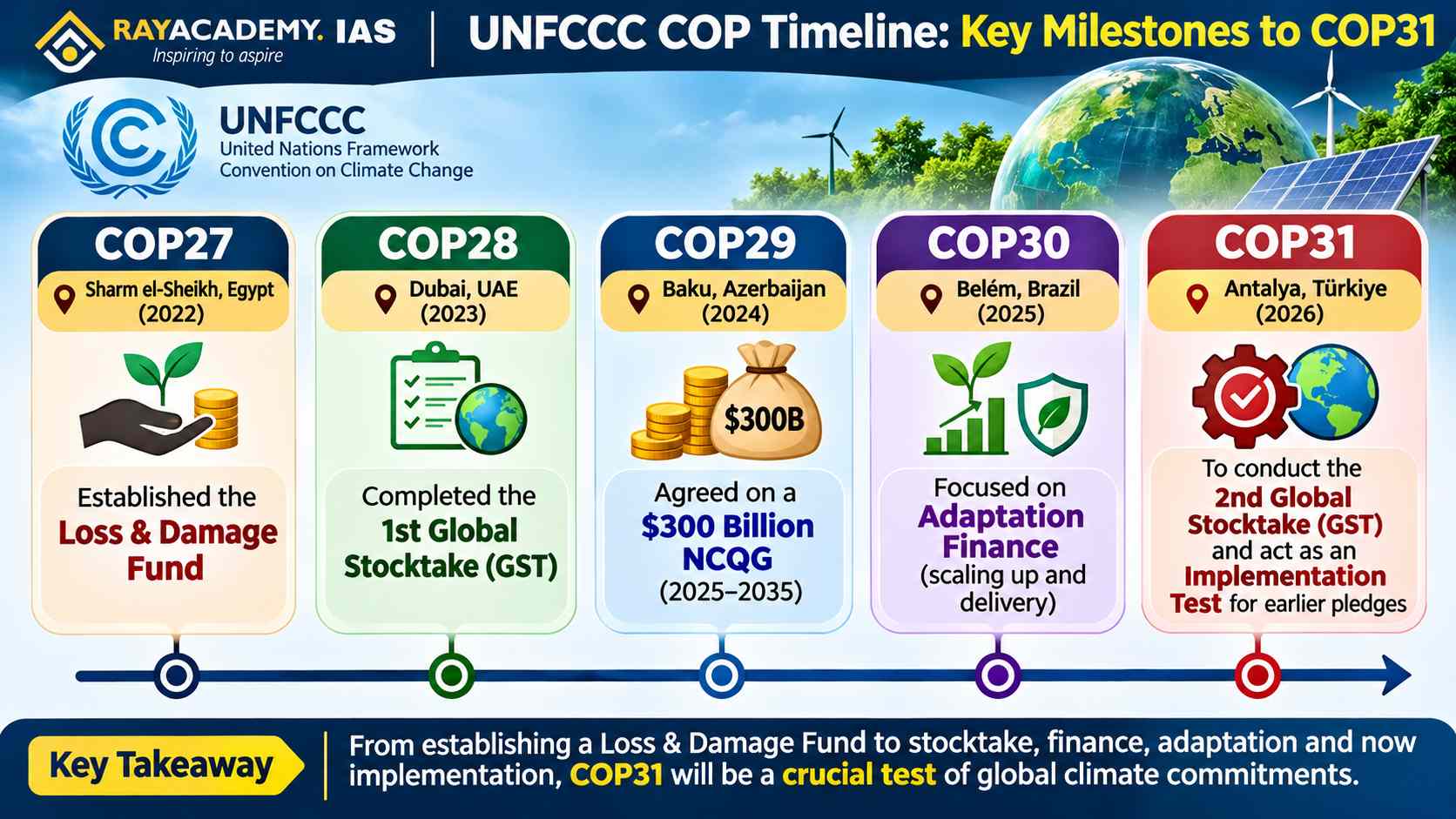
Under Article 14 of the Paris Agreement, parties conduct a Global Stocktake (GST) every five years to assess collective progress toward limiting global warming to well below 2 degrees Celsius and pursuing efforts for 1.5 degrees Celsius above pre-industrial levels.
Second Global Stocktake: Initiated at COP31 (following the first GST concluded at COP28 in Dubai), the second GST relies on scientific synthesis from the Intergovernmental Panel on Climate Change (IPCC). Delays in finalizing the IPCC Seventh Assessment Report (AR7) timeline risk weakening the scientific urgency required to drive ambitious NDCs 3.0. COP31 Climate Summit
Climate Finance & Loss and Damage Architecture
New Collective Quantified Goal (NCQG): Agreed at COP29 (Baku, 2024), the NCQG replaced the unfulfilled $100 billion goal with a target to mobilize at least $300 billion per year by 2035 for developing countries, alongside a COP30 (Belém) call to triple adaptation finance.
Fund for Responding to Loss and Damage (FRLD): Established at COP27 (Sharm El-Sheikh, 2022) and operationalized at COP28 (Dubai, 2023), the fund is temporarily hosted as a Financial Intermediary Fund by the World Bank to assist vulnerable nations suffering irreversible climate impacts beyond adaptation.
Prelims Focus: High-Yield Objective Facts
COP31 Host & Governance: Held in Antalya, Türkiye (Nov 2026); unique dual leadership with Türkiye as host/Presidency (Murat Kurum) and Australia presiding over formal negotiations (via Western European and Others Group consensus).
Geographical Locations in News:
Antalya: Mediterranean coastal city in southwestern Türkiye along the Gulf of Antalya.
Fiji & Tuvalu: Pacific Island nations (SIDS) highly vulnerable to sea-level rise; Tuvalu is a low-lying Polynesian atoll nation located midway between Hawaii and Australia.
Intergovernmental Panel on Climate Change (IPCC): Established in 1988 by the World Meteorological Organization (WMO) and the United Nations Environment Programme (UNEP); headquartered in Geneva, Switzerland. Note: IPCC does not conduct its own original research; it assesses peer-reviewed scientific literature.
Fund for Responding to Loss and Damage (FRLD): Temporarily hosted by the World Bank for an interim 4-year period; approved its first disaster payout of ~$21–21.6 million to Nepal following the August 2026 Bhotekoshi floods.
India’s Updated NDC Targets (2030): Reduce emissions intensity of GDP by 45% from 2005 levels; achieve 50% cumulative electric power installed capacity from non-fossil fuel-based energy resources; create an additional carbon sink of 2.5 to 3 billion tonnes of CO₂ equivalent.
Mains Analytical Breakdown
Significance of COP31’s Focus on Delivery Over New Pledges
Shifting from Ambition to Accountability: Prioritizing the delivery of existing financial commitments—specifically the $300 billion NCQG and tripling adaptation finance—prevents developed countries from masking unfulfilled promises behind lofty new headline targets.
Operationalizing Loss and Damage Support: The fund's inaugural disaster allocation to Nepal marks a historic transition from institutional design to on-ground disbursement for climate-vulnerable developing countries.
Protecting Developmental Space for the Global South: India’s firm stance against binding top-down sectoral targets (such as the 35% electrification pledge) reinforces sovereign policy space for emerging economies balancing energy security with clean transitions.
Multi-Dimensional Challenges
Acute Climate Finance Deficit and Delayed Disbursement: While Nepal’s reconstruction needs following the 2026 floods exceed $4.7 billion, the Loss and Damage Fund approved just $21 million—highlighting a staggering gap between multi-billion-dollar pledges and actual payouts. Furthermore, deferring operational modalities for finance flows to COP32 prolongs uncertainty.
Geopolitical Headwinds and Multilateral Fragmentation: The United States’ withdrawal from the Paris Agreement, ongoing conflict in West Asia disrupting global energy markets, and fiscal strain across Europe have eroded political will and squeezed public climate budgets.
Weakening Fossil Fuel Transition Momentum: Following COP30’s failure to adopt a formal fossil fuel phase-out roadmap, keeping the transition roadmap outside formal COP31 negotiating text risks diluting accountability for major emitters.
Scientific & Stocktake Delays: Indecision over the IPCC report calendar threatens to deprive the second Global Stocktake of updated scientific benchmarks needed to accelerate pre-2030 emissions reductions.
Technology Access & Debt-Trap Concerns: Developing nations face high capital costs and intellectual property barriers for clean energy technologies, while much of existing climate finance is delivered as high-interest loans rather than concessional grants.
Way Forward
Establish Predictable, Grant-Based Finance Modalities: Developed countries must finalize clear accounting rules and disbursement pathways at COP31—rather than deferring to COP32—ensuring the $300 billion NCQG and Loss and Damage Fund prioritize non-debt-creating grants and rapid-response windows for climate disasters.
Anchor the Second Global Stocktake in a Fixed IPCC Calendar: Parties must lock in a binding schedule for IPCC Seventh Assessment Report (AR7) deliverables so that the second Global Stocktake is driven by robust, peer-reviewed climate science.
Reform Multilateral Development Banks (MDBs) and Risk-Sharing: In line with the G20 Independent Expert Group (NK Singh–Lawrence Summers) Report, MDBs should triple sustainable lending capacity and deploy blended-finance guarantees to lower the cost of capital for renewable energy in the Global South.
Keep Sectoral Targets Voluntary and Backed by Technology Transfer: As advocated by India, sectoral goals (like the 35% electrification target) should remain voluntary benchmarks supported by affordable Intellectual Property Rights (IPR) sharing and joint R&D rather than coercive mandates.
Leverage South-South Cooperation and Indian Initiatives: India should continue scaling global public goods like the International Solar Alliance (ISA), Coalition for Disaster Resilient Infrastructure (CDRI), and Mission LiFE to build climate resilience across SIDS and developing economies.
Value Addition for Mains
Empirical Climate & Finance Data (WMO & UNFCCC, Nov 2026): According to the World Meteorological Organization’s (WMO) State of the Climate Update 2026, each of the past 12 years has ranked among the warmest on record. Yet, against an annual NCQG target of $300 billion by 2035, the Loss and Damage Fund’s maiden payout to Nepal stood at just $21 million against multi-billion-dollar reconstruction needs—illustrating the stark gap between climate vulnerability and financial delivery.
Constitutional & Ethical Anchor: India’s climate diplomacy operationalizes Article 48A (protection of environment) and Article 51(c) (respect for international treaty obligations), guided by Mahatma Gandhi’s ethic of trusteeship and the principle of Climate Justice—ensuring that carbon space is shared equitably without penalizing the developmental aspirations of the poor.
Practice Questions for Active Recall
Prelims Practice MCQ
With reference to global climate governance and institutions associated with UNFCCC negotiations, consider the following statements:
The Intergovernmental Panel on Climate Change (IPCC) was jointly established by the World Meteorological Organization (WMO) and the United Nations Environment Programme (UNEP) to conduct primary climate research.
Under the Paris Agreement, the Global Stocktake is conducted every five years to assess collective progress toward long-term temperature goals.
The Fund for Responding to Loss and Damage is temporarily hosted by the World Bank as a Financial Intermediary Fund.
Which of the statements given above are correct?
(a) 1 and 2 only
(b) 2 and 3 only
(c) 1 and 3 only
(d) 1, 2, and 3
Correct Answer: (b) 2 and 3 only
Explanation:
Statement 1 is incorrect: While the IPCC was indeed established in 1988 by WMO and UNEP, it does not conduct original scientific research or monitor climate data; instead, it assesses thousands of peer-reviewed scientific papers published globally.
Statement 2 is correct: Under Article 14 of the Paris Agreement, the Global Stocktake (GST) takes place every five years (the first concluded at COP28 in 2023; the second began at COP31 in 2026) to ratchet up climate ambition.
Statement 3 is correct: Operationalized at COP28, the Loss and Damage Fund is temporarily hosted by the World Bank for an interim four-year period.
Mains Practice Question (GS Paper III — 150 Words | 10 Marks)
"Global climate negotiations risk losing credibility if developed nations continue to defer the delivery of promised climate finance while demanding uniform sectoral targets from developing economies." Examine the key challenges confronting COP31 and evaluate India’s negotiating position rooted in climate justice.
Answer Structure Hints:
Introduction: Contextualize COP31 in Antalya (Türkiye), noting the shift in focus toward fulfilling past financial pledges ($300B NCQG, adaptation finance) amid geopolitical turbulence.
Body Part 1 (Key Challenges at COP31): Highlight the gap between pledges and payouts (e.g., $21M Loss and Damage approval for Nepal vs. multi-billion-dollar needs), deferral of finance flow rules to COP32, U.S. withdrawal from the Paris Agreement, and delays in the IPCC timeline for the second Global Stocktake.
Body Part 2 (India’s Position): Explain India’s rejection of the mandatory 35% electrification pledge, emphasizing CBDR-RC, predictable grant-based finance, technology transfer, and nationally determined pathways.
Conclusion: Conclude with the need for operationalizing Climate Justice, MDB reforms, and honoring historical commitments to keep the 1.5 degrees Celsius goal alive.
Take this article with you
Save a reading copy for offline study.


