

Cabinet Approval for Rajaswa Bhawan
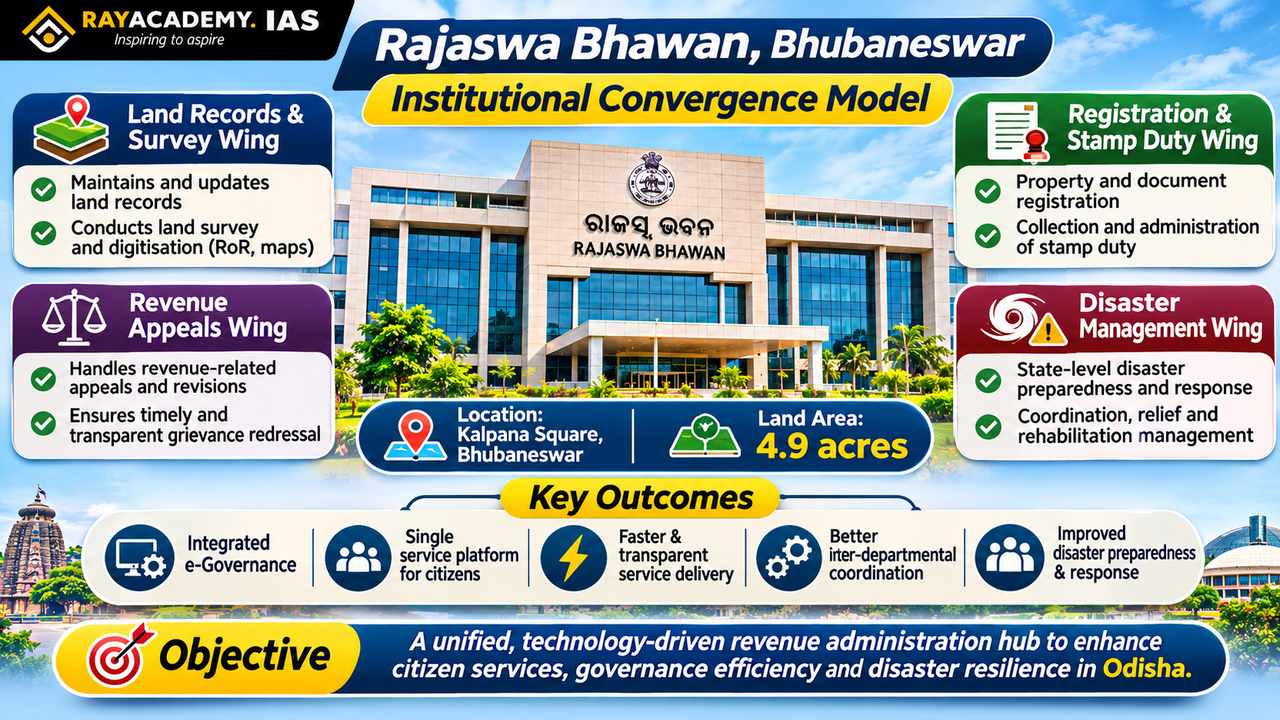
Odisha Chief Minister Mohan Charan Majhi approved the construction of a nine-storey Rajaswa Bhawan in Bhubaneswar at an estimated cost of ₹347.86 crore (approx. ₹348 crore) to bring all administrative wings and directorates of the Revenue and Disaster Management Department under a single roof.
UPSC Syllabus Mapping:
General Studies Paper II (Governance & Polity): Important aspects of governance, transparency and accountability, e-governance—applications, models, successes, limitations, and potential; Role of civil services in a democracy; Development processes and the development industry.
General Studies Paper III (Indian Economy & Disaster Management): Land reforms in India; Disaster and disaster management (institutional convergence of Revenue and Disaster Management administration).
Project Redesign & Spatial Expansion: Originally mooted in August 2022 as an iconic building on 1.8 acres at BJB Nagar, the project was subsequently reworked into a comprehensive complex at Kalpana Square spread over 4.9 acres, comprising two basement floors, a ground floor, and nine upper floors.
Objective of Institutional Convergence: Consolidating fragmented offices into a unified administrative hub aims to eliminate inter-departmental delays, strengthen revenue administration, and streamline citizen-centric land and disaster governance.
Static-Current Linkage: Constitutional Land Governance, Revenue Administration, and Digital Land Reforms
Evaluating the administrative significance of consolidating revenue administration in Odisha requires linking constitutional entries on land and revenue with historical revenue structures and modern e-governance reforms:
1. Constitutional Mandate Over Land and Revenue Administration
Seventh Schedule – State List (List II):
Entry 18: Land, that is to say, rights in or over land, land tenures including the relation of landlord and tenant, and the collection of rents; transfer and alienation of agricultural land; land improvement and agricultural loans; colonization.
Entry 45: Land revenue, including the assessment and collection of revenue, the maintenance of land records, survey for revenue purposes and records of rights, and alienation of revenues.
Article 300A (Right to Property): Mandates that no person shall be deprived of their property save by authority of law, placing a high fiduciary duty on revenue authorities to maintain accurate, tamper-proof Records of Rights (RoR).
Eleventh & Twelfth Schedules (Articles 243G & 243W): Empower Panchayati Raj Institutions (PRIs) and Urban Local Bodies (ULBs) in land improvement, implementation of land reforms, land consolidation, and soil conservation—requiring close coordination with district and state revenue establishments.
2. Evolution of Revenue & Disaster Management Administration in India
From Colonial Extraction to Welfare & Disaster Resilience: Historically anchored in the Board of Revenue (established during the colonial era for agrarian tax collection), state Revenue Departments in post-Independence India evolved into the backbone of land reform implementation, caste/income certification, land acquisition for public infrastructure, and disaster relief administration.
Odisha’s Integrated Revenue–Disaster Model: Following the 1999 Super Cyclone, Odisha integrated disaster response directly within its Revenue and Disaster Management Department, creating seamless command-and-control between the State Secretariat, Special Relief Commissioner (SRC), Revenue Divisional Commissioners (RDCs), and District Collectors/Tahsildars.
3. National Digital Land Governance Frameworks
Digital India Land Records Modernization Programme (DILRMP): Administered by the Department of Land Resources (DoLR), Ministry of Rural Development, DILRMP aims to replace presumptive land titles with conclusive land titling through computerization of Records of Rights (RoR), digitization of cadastral maps, Unique Land Parcel Identification Numbers (ULPIN / Bhu-Aadhaar), and integration of registration offices with tehsil revenue records.
National Generic Document Registration System (NGDRS): Standardizes property registration workflows across states to curb stamp duty evasion and benami transactions.
Prelims Focus: High-Yield Objective Facts for UPSC
Quick Revision Fact Box:
Revenue Administration, Land Records & Odisha GovernanceRajaswa Bhawan Project Specs: Approved at ₹347.86 crore on 4.9 acres at Kalpana Square, Bhubaneswar; structure comprises 2 basement floors + ground floor + 9 upper floors housing wings of the Revenue and Disaster Management Department.
Constitutional Entries (Seventh Schedule): Entry 18 (Land & land tenures) and Entry 45 (Land revenue & maintenance of land records) fall under the State List (List II); Entry 42 of the Concurrent List deals with Acquisition and Requisitioning of Property.
ULPIN (Bhu-Aadhaar): A 14-digit alpha-numeric Unique Land Parcel Identification Number generated using geo-coordinates (latitude and longitude) of each land parcel under DILRMP to prevent fraudulent multiple registrations.
SVAMITVA Scheme: Survey of Villages and Mapping with Improvised Technology in Village Areas—implemented by the Ministry of Panchayati Raj in collaboration with Survey of India and State Revenue Departments using drone technology to provide rural residential Property Cards.
Key Odisha Land & Revenue Portals: Bhulekh Odisha (online Records of Rights / Khata and Plot portal) and e-Pauti (online land revenue/rent payment system).
Mains Analytical Breakdown
Significance of Consolidated Revenue Infrastructure & Administrative Convergence
Eliminating Inter-Wing Silos & File Delays: Housing the Inspector General of Registration (IGR), Directorate of Land Records and Surveys, Board of Revenue wings, and Disaster Management cells under one roof reduces physical file movement, expedites quasi-judicial revenue appeals, and improves inter-departmental coordination.
Enhancing Citizen-Centric Service Delivery (Ease of Living): Citizens and investors seeking land conversion, mutation, valuation benchmarks, or disaster compensation can access integrated single-window facilitation desks rather than navigating scattered offices across the city.
Synergy with Digital Land Governance (DILRMP & ULPIN): Centralized physical infrastructure enables unified data centres, GIS mapping labs, and digitized archival record rooms, accelerating the integration of sub-registrar deeds with tehsil mutation records.
Strengthening Disaster Response Command: Co-locating revenue and disaster management directorates sharpens real-time coordination during cyclonic emergencies, flood relief disbursement, and damage assessment.
Multi-Dimensional Challenges in Revenue Administration
Physical Infrastructure vs. Process Re-Engineering (Administrative): Constructing modern administrative buildings alone cannot eliminate bureaucratic bottlenecks unless accompanied by Business Process Re-engineering (BPR), simplified revenue codes, and strict timelines under Right to Public Services (RTPS) laws.
Legacy Land Record Discrepancies & Litigation (Legal & Judicial): Outdated cadastral surveys, unrecorded family partitions, and discrepancies between physical possession and paper Records of Rights (RoR) fuel nearly two-thirds of all civil litigation in Indian courts.
Presumptive vs. Conclusive Titling Deficit (Economic): Under India’s Registration Act, 1908, registration records only the transaction (deed) and not the guarantee of title, creating land-title uncertainty that delays infrastructure projects and industrial investment.
Accessibility for Rural & Marginalized Citizens (Social & Ethical): Centralizing state-level revenue wings in the state capital must not dilute decentralized, grassroots accessibility at the Tehsil, Revenue Inspector (RI) circle, and Gram Panchayat levels—especially for small farmers and Scheduled Tribe communities in Fifth Schedule areas.
Way Forward: Anchored in Authoritative Frameworks
To ensure Rajaswa Bhawan catalyzes genuine administrative transformation rather than mere spatial consolidation, policy execution should follow four reform pillars:
Transition Toward Conclusive Land Titling (NITI Aayog Model Land Titling Act, 2020): Integrate the co-located Registration and Land Records & Survey directorates to operationalize auto-mutation upon property registration, assign 14-digit ULPIN (Bhu-Aadhaar) IDs to all rural and urban plots, and move progressively toward state-guaranteed conclusive titles.
Digitize Quasi-Judicial Revenue Courts & Clear Case Backlogs (Law Commission & 2nd ARC Recommendations): Following the 2nd Administrative Reforms Commission’s (12th Report – Citizen-Centric Administration) emphasis on process simplification, deploy an end-to-end Revenue Court Case Management System (RCCMS) with e-summons, virtual hearings, and time-bound disposal norms for mutation and encroachment appeals.
Modernize Cadastral Surveys Using Drone & GIS Technology (SVAMITVA & DILRMP): Utilize high-resolution drone photogrammetry and Continuously Operating Reference Stations (CORS) to update decades-old settlement maps, resolving boundary disputes in agrarian and peri-urban belts.
Decentralize Last-Mile Delivery to Mo Seva Kendras / CSCs: Pair apex administrative consolidation in Bhubaneswar with empowered, corruption-free service delivery at Tehsil offices and Common Service Centres (CSCs), protecting tribal land rights under Odisha’s Regulation 2 of 1956 (OSATIP) and PESA, 1996.
Value Addition Snippet (For Mains Introductions & Conclusions)
Governance & Land Reform Benchmarks:
According to NITI Aayog and Daksh judicial assessments, land and property disputes account for over 60% of all pending civil cases in Indian courts, locking up billions of dollars in stalled infrastructure and private capital.
Odisha’s ₹347.86 crore Rajaswa Bhawan (spanning 4.9 acres with 12 functional levels including two basements, ground, and nine upper floors) exemplifies how administrative co-location paired with digital land records (Bhulekh / DILRMP) reduces transaction costs and strengthens public accountability.
Administrative Catchphrase for Mains Answers: "Modernizing revenue administration requires a dual architecture: consolidated, tech-enabled institutional hubs at the apex and transparent, time-bound land record delivery at the grassroots."
Active Recall: UPSC Practice Questions
1. Prelims Practice Question (Multi-Statement Format)
With reference to land governance, revenue administration, and constitutional provisions in India, consider the following statements:
Both "Land tenures" and "Land revenue, including the maintenance of land records" are enumerated in the State List of the Seventh Schedule of the Constitution of India.
The Unique Land Parcel Identification Number (ULPIN), also known as Bhu-Aadhaar, is a 14-digit geo-referenced alphanumeric ID assigned to land parcels under the Digital India Land Records Modernization Programme (DILRMP).
Under the Registration Act, 1908, registration of a sale deed in India automatically confers a state-guaranteed conclusive title to the buyer.
Which of the statements given above is/are correct?
(a) 1 and 2 only
(b) 2 and 3 only
(c) 1 only
(d) 1, 2, and 3
Correct Answer: (a) 1 and 2 only
Explanation:
Statement 1 is correct: Under the Seventh Schedule of the Constitution, Entry 18 (Land, rights in or over land, land tenures) and Entry 45 (Land revenue, maintenance of land records, survey for revenue purposes) are both placed in the State List (List II).
Statement 2 is correct: ULPIN (Bhu-Aadhaar) is a 14-digit geo-referenced alphanumeric unique ID rolled out under DILRMP (Department of Land Resources) to uniquely identify every surveyed land parcel.
Statement 3 is incorrect: India currently follows a system of presumptive land titling, where registration under the Registration Act, 1908 only records a transaction deed and does not provide a state-guaranteed conclusive title.
2. Mains Practice Question (150 Words | 10 Marks)
Q. "Co-locating fragmented revenue wings under unified administrative hubs can improve institutional coordination, yet genuine land governance reform requires process re-engineering and conclusive land titling." Discuss. (150 words)
Model Answer Structure Hint:
Introduction: Contextualize Odisha’s approval of the ₹347.86 crore nine-storey Rajaswa Bhawan in Bhubaneswar to unify wings of the Revenue and Disaster Management Department, linking it to Entries 18 and 45 of the State List.
Body:
Benefits of Institutional Convergence: Explain how consolidating land records, survey, registration, and disaster wings reduces file delays, enhances inter-departmental synergy, and streamlines single-window citizen services.
Beyond Brick-and-Mortar Reforms: Highlight persistent bottlenecks—presumptive titling under the Registration Act, 1908, outdated cadastral maps, and civil litigation backlogs—and propose DILRMP/ULPIN integration, auto-mutation, digitized revenue courts (2nd ARC), and SVAMITVA drone surveys.
Conclusion: Conclude that pairing modern physical infrastructure with NITI Aayog’s conclusive titling framework and decentralized tehsil-level delivery ensures transparent, citizen-centric land governance.
Take this article with you
Save a reading copy for offline study.


