

The Gambia v. Myanmar
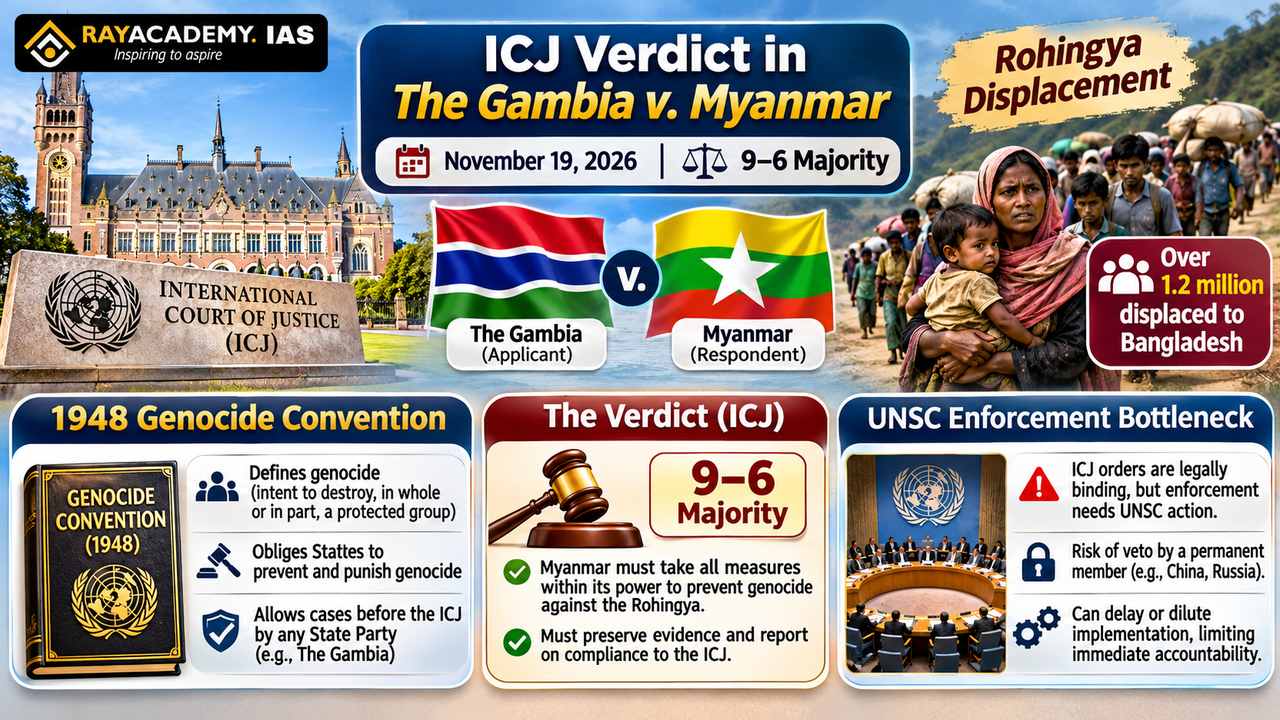
istoric ICJ Judgment Holding Myanmar Responsible for Genocide: On November 19, 2026, the International Court of Justice (ICJ) at The Hague delivered a landmark final judgment in The Gambia v. Myanmar, ruling by a 9-to-6 majority that the State of Myanmar committed genocide against the Rohingya population during its 2017 military "clearance operations" in northern Rakhine State.
UPSC Syllabus Mapping:
General Studies Paper II (International Relations): Important International institutions, agencies and fora—their structure, mandate (International Court of Justice & UN Security Council); India and its neighbourhood—relations (Myanmar and Bangladesh); Effect of policies and politics of developed and developing countries on India’s interests.
General Studies Paper II (Polity & Governance): India and international legal obligations under treaties and conventions; Human rights, refugee governance, and statutory protection frameworks.
First State-Level Conviction Under the 1948 Convention: This marks the first occasion in international judicial history that the World Court has held a sovereign State directly responsible for committing genocide—ordering Myanmar to cease ongoing violations, prosecute perpetrators, pay reparations, and facilitate the safe, voluntary, and dignified return of over 1.2 million displaced Rohingya.
Enforcement Impasse and Regional Geopolitics: Despite the binding nature of the ruling, implementation faces severe geopolitical hurdles due to potential UN Security Council (UNSC) vetoes by China and Russia, ongoing civil war in Rakhine State (now largely controlled by the Arakan Army), and pragmatic diplomatic engagement with Naypyitaw by regional powers, including India.
Static-Current Linkage: The 1948 Genocide Convention, ICJ Jurisdiction, and Rohingya Statelessness
Analyzing the legal and geopolitical ramifications of the ICJ Rohingya genocide verdict requires linking international humanitarian law with the historical roots of statelessness in Myanmar.
1. The 1948 Genocide Convention & Erga Omnes Partes Obligations
Convention on the Prevention and Punishment of the Crime of Genocide (1948): Adopted by the UN General Assembly on December 9, 1948 (coined by jurist Raphael Lemkin), Article II defines genocide as specific acts—such as killing, causing serious bodily or mental harm, or imposing measures to prevent births—committed with the specific intent (dolus specialis) to destroy, in whole or in part, a national, ethnical, racial, or religious group.
Legal Standard of Inferred Intent: In the absence of an explicit written state policy, the ICJ reaffirmed its strict evidentiary threshold: genocidal intent can be inferred from a pattern of conduct only when it is "the only reasonable inference"—a threshold met in 2026 based on indiscriminate killings (~10,000+), mass sexual violence, destruction of 392 villages, and attacks on children.
Standing Without Direct Injury (Erga Omnes Partes): Although The Gambia—a small West African nation supported by the Organisation of Islamic Cooperation (OIC) and 11 intervening states (including Canada, France, Germany, the UK, and Maldives)—suffered no direct territorial injury, the ICJ affirmed in 2022 that every State Party to the 1948 Convention possesses a common legal interest (erga omnes partes) to hold another Party accountable.
2. ICJ vs. ICC: State Responsibility vs. Individual Criminal Liability
International Court of Justice (ICJ): The principal judicial organ of the UN (under Article 92 of the UN Charter), based at the Peace Palace in The Hague. It adjudicates legal disputes between States and establishes State responsibility. Its judgments are final and binding under Article 94 of the UN Charter, enforceable only through the UN Security Council.
International Criminal Court (ICC): An independent treaty body created by the Rome Statute (1998) that prosecutes individuals (military commanders, political leaders) for genocide, war crimes, and crimes against humanity. Neither India nor Myanmar is a party to the Rome Statute, though the ICC opened an investigation into cross-border deportation crimes into Bangladesh (an ICC member).
3. Historical Roots of Rohingya Statelessness in Myanmar
1982 Citizenship Law: Following earlier military expulsions in 1978 and 1991–92, Myanmar’s military junta enacted the 1982 Citizenship Law, excluding the Rohingya from the list of 135 officially recognized ethnic groups (Taingyintha), rendering them stateless and stripping their voting rights prior to the 2015 elections.
Prelims Focus: High-Yield Objective Facts
UPSC Prelims Quick-Revision Box:
The Gambia v. Myanmar (2026), ICJ & GeographyICJ Verdict Details (November 19, 2026):Majority: 9–6 holding Myanmar directly responsible for committing genocide under Articles II(a), II(b), and II(d) of the 1948 Genocide Convention.A
dditional Violations Found: Failure to prevent and punish genocide, violation of Article V (failure to enact domestic anti-genocide legislation), and breach of the January 2020 Provisional Measures Order (destruction of village remnants/evidence).
Compliance Timeline: Myanmar was directed to submit a compliance report on restitution and compensation within two years.International Court of Justice (ICJ) Composition:Comprises 15 judges elected for 9-year terms by the UN General Assembly and the UN Security Council voting independently (one-third elected every 3 years).
Four Indian jurists have served as ICJ judges: Sir Benegal Narsing Rau, Nagendra Singh (also ICJ President), Raghunandan Swarup Pathak, and Dalveer Bhandari.India’s Position on International Conventions:1948 Genocide Convention: India signed (1949) and ratified (1959) the Convention, though Parliament has not yet enacted standalone domestic anti-genocide legislation.
1951 UN Refugee Convention & 1967 Protocol: India is not a signatory; refugees in India are governed administratively under the Foreigners Act, 1946 (and Immigration and Foreigners framework) and constitutional protections under Articles 14 and 21.
Mains Analytical Breakdown: Significance and Multi-Dimensional Challenges
Legal and Geopolitical Significance
Breaking the Impunity Threshold in International Law: Unlike Bosnia v. Serbia (2007)—where Serbia was held liable only for failing to prevent the Srebrenica genocide—the 2026 ruling establishes direct State attribution for committing genocide, setting a watershed precedent for pending ICJ cases (South Africa v. Israel, Ukraine v. Russia, DRC v. Rwanda).
Affirming Protected Group Status Irrespective of Citizenship: By recognizing the Rohingya as a protected ethnic group under the 1948 Convention, the ICJ rejected Myanmar’s defence that domestic citizenship denial strips a minority of international legal protection.
Empowering Small States in Rules-Based Multilateralism: The successful litigation led by The Gambia demonstrates how smaller nations can utilize treaty-based dispute resolution to uphold universal human rights norms against powerful military regimes.
Multi-Dimensional Challenges in Implementation and Regional Diplomacy
UNSC Enforcement Paralysis (Geopolitical): While ICJ judgments are binding, enforcement relies on the UN Security Council under Article 94(2) of the UN Charter. Given China and Russia’s diplomatic backing of Myanmar—and their November 2026 Shenzhen joint declaration stressing "immunities of State officials"—coercive UNSC enforcement faces near-certain veto paralysis.
Fragmented Ground Control in Rakhine State (Security): Rakhine State is engulfed in civil war, with the ethnic insurgent Arakan Army (AA) now controlling vast swathes of territory. Because the AA itself faces allegations of abuses against Rohingya civilians, neither Naypyitaw nor the insurgency currently guarantees safe repatriation.
Protracted Humanitarian Crisis in Bangladesh (Social & Economic): Over 1.2 million Rohingya refugees remain confined to overcrowded camps in Cox’s Bazar and Bhasan Char amid declining international donor aid, straining Bangladesh’s ecology, local economy, and internal security.
India’s Strategic Tightrope (Diplomatic & Internal Security): India shares a 1,643-km porous border with Myanmar across four Northeastern states (Arunachal Pradesh, Nagaland, Manipur, Mizoram) and has critical strategic stakes—including curbing Northeast insurgency sanctuaries, countering Chinese influence (Kyaukphyu port), and completing the Kaladan Multi-Modal Transit Transport Project in Rakhine. Consequently, New Delhi has maintained pragmatic engagement with Myanmar’s leadership while extending humanitarian aid to Bangladesh (Operation Insaniyat), creating a delicate balance between realpolitik and normative human rights commitments.
Democratic Deficit as the Core Structural Barrier (Political & Ethical): As analytical commentary underscores, legal orders alone cannot enable voluntary repatriation unless Myanmar transitions toward a genuinely democratic, federal, and pluralistic polity that restores full citizenship and equal rights to the Rohingya.
Way Forward: Constructive Policy and Institutional Roadmap
Coordinated Regional Diplomacy for Inclusive Federal Democracy in Myanmar (ASEAN & Neighbourhood Track): India, Bangladesh, and ASEAN (building on its Five-Point Consensus) should align diplomatic leverage to encourage a genuine inclusive political dialogue among Myanmar’s military, the National Unity Government (NUG), and ethnic armed organizations—recognizing that constitutional restoration of Rohingya citizenship is the prerequisite for durable repatriation.
Sustained International Burden-Sharing for Cox’s Bazar (UNHCR & Global Compact on Refugees): Donor nations and multilateral development banks must bridge the acute humanitarian funding gap in Bangladesh while supporting skill development, education, and ecological restoration in host districts.
Institutionalizing India’s Refugee and Asylum Framework (Law Commission & Parliamentary Reform): While safeguarding national security and border integrity along the India–Myanmar frontier, India should consider enacting a transparent National Asylum and Refugee Management Policy—distinguishing persecuted refugees from illegal economic migrants in alignment with Article 21 constitutional values.
Enacting Domestic Anti-Genocide Legislation in India (Article V Compliance): To fulfill its treaty obligation under Article V of the 1948 Genocide Convention (ratified in 1959), India should incorporate specific provisions against genocide and crimes against humanity into its domestic penal framework, strengthening India’s moral leadership in the Global South.
Value Addition: Official Data Points for Mains Answers
Scale of Displacement (UNHCR / UN Estimates): Over 1.2 million Rohingya refugees currently reside in Bangladesh (primarily in Cox’s Bazar, the world’s largest refugee settlement), following the exodus of over 7,00,000 people in August 2017 alongside earlier waves in 1978 and 1991–92.
India’s Bilateral & Humanitarian Footprint (MEA): India shares a 1,643-km land border and a maritime boundary in the Bay of Bengal with Myanmar, has committed over $484 million to the Kaladan Multi-Modal Transit Transport Project linking Kolkata to Sittwe and Mizoram, and has delivered multiple tranches of relief assistance to both Rakhine State and Cox’s Bazar under Operation Insaniyat.
Administrative Catchphrase for Mains Conclusions: "While the ICJ verdict delivers vital normative vindication under the 1948 Genocide Convention, sustainable repatriation of the Rohingya ultimately hinges on transforming Myanmar into a federal, pluralistic democracy backed by coordinated regional diplomacy."
Practice Questions for Active Recall
Prelims Practice Question (Multi-Statement Format)
Q. With reference to the International Court of Justice (ICJ) and the 1948 Genocide Convention, consider the following statements:
In The Gambia v. Myanmar (2026), the ICJ held for the first time in its history that a sovereign State was directly responsible for committing genocide.
Under the UN Charter, judgments of the ICJ are binding on the parties to a dispute and are enforced directly by the ICJ’s own international police force.
India has ratified the 1948 Convention on the Prevention and Punishment of the Crime of Genocide, though it is not a signatory to the 1951 UN Refugee Convention.
Which of the statements given above is/are correct?
(a) 1 and 2 only
(b) 1 and 3 only
(c) 2 and 3 only
(d) 1, 2, and 3
Correct Answer: (b) 1 and 3 only
Explanation:
Statement 1 is correct: On November 19, 2026, the ICJ ruled by a 9–6 vote that Myanmar committed genocide against the Rohingya in 2017—marking the first time the Court has held a State directly liable for committing genocide (in Bosnia v. Serbia [2007], Serbia was found liable only for failing to prevent genocide).
Statement 2 is incorrect: The ICJ has no independent enforcement mechanism or police force; under Article 94(2) of the UN Charter, enforcement of non-complied ICJ judgments rests with the UN Security Council, where permanent members hold veto power.
Statement 3 is correct: India ratified the 1948 Genocide Convention in 1959, whereas it has neither signed nor ratified the 1951 UN Refugee Convention or its 1967 Protocol.
Mains Practice Question (150 Words | 10 Marks)
Q. "The International Court of Justice’s verdict holding Myanmar responsible for genocide marks a watershed in international law, yet geopolitical realities constrain its enforcement on the ground." Examine the significance of the ruling and its strategic implications for India. (150 words)
Model Answer Structure:
Introduction: Introduce the November 19, 2026 ICJ judgment in The Gambia v. Myanmar (9–6 vote), noting it as the first ruling holding a State directly culpable for genocide under the 1948 Genocide Convention.
Body Paragraph 1 (Legal Significance & Enforcement Limits): Highlight the recognition of erga omnes partes standing and inferred genocidal intent, juxtaposed against UNSC veto paralysis (China/Russia) and civil war in Rakhine State (Arakan Army control).
Body Paragraph 2 (Implications for India): Analyze India’s delicate balancing act—securing its 1,643-km border, countering Northeast insurgency, safeguarding the Kaladan project in Rakhine, and managing humanitarian spillover alongside Bangladesh.
Conclusion: Conclude that durable repatriation of the 1.2 million Rohingya requires coordinated ASEAN–regional diplomacy fostering an inclusive, democratic, and federal Myanmar.
Take this article with you
Save a reading copy for offline study.


