

Tracxn’s India AI
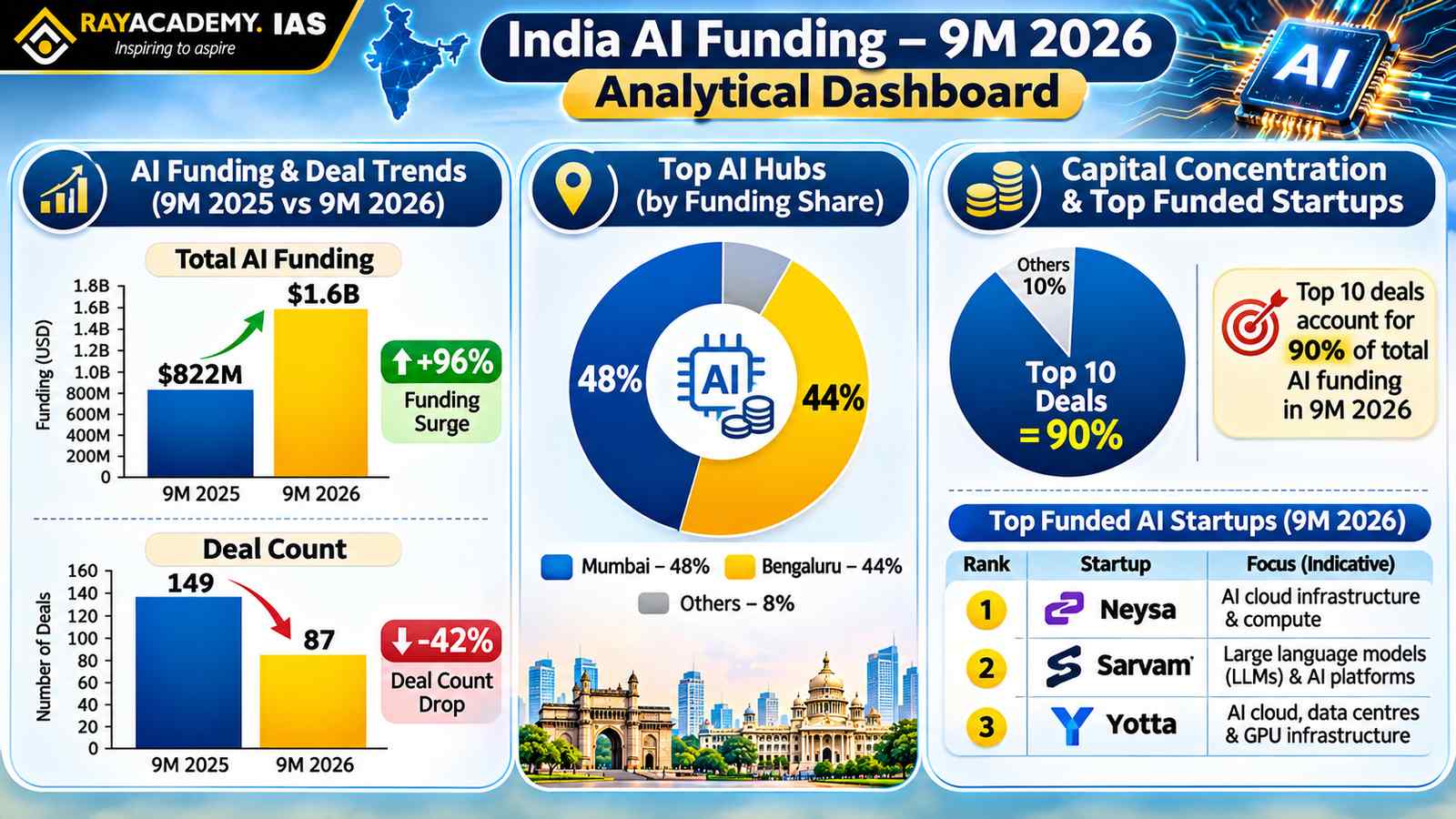
According to data intelligence platform Tracxn’s India AI – 9M 2026 Report, equity funding raised by Indian Artificial Intelligence (AI) companies surged by 96% to $1.6 billion during the first nine months of 2026 (January–September 2026), compared to $822 million in the corresponding period of 2025.
UPSC Syllabus Mapping:
General Studies Paper III (Science & Technology): Awareness in the fields of IT, Space, Computers, robotics, nano-technology, bio-technology; Indigenization of technology and developing new technology (Artificial Intelligence, Sovereign Cloud, and Generative AI).
General Studies Paper III (Indian Economy): Indian Economy and issues relating to planning, mobilization of resources, growth, development and employment; Inclusive growth and issues arising from it; Effects of liberalization on the economy, changes in industrial policy and their effects on industrial growth.
In a major geographical shift within India’s technology ecosystem, Mumbai overtook Bengaluru as the largest recipient of AI venture capital during this nine-month window, driven by mega-rounds in AI cloud infrastructure.
However, the report also highlights stark capital concentration: while total funding reached a seven-year high and placed India ninth globally, the total number of funding deals fell by 42% (from 149 to 87), with 90% of all capital ($1.5 billion) flowing into just 10 large rounds and seed-stage funding contracting by 42%.
Static-Current Linkage: Deep-Tech Financing, Sovereign Compute, and Startup Policy
Interpreting the 2026 Indian AI funding surge requires connecting venture capital lifecycle dynamics with India’s public-sector deep-tech policy architecture.
1. Venture Capital Stages: Seed, Early-Stage, and Late-Stage Dynamics
Seed-Stage Capital: Initial risk capital (typically angel or pre-seed/seed funds) supporting ideation, prototype validation, and early research. The 42% drop in seed-stage funding (and a 60% fall in first-time funded AI companies, from 60 to 24) signals heightened investor selectivity toward untested early ventures.
Early-Stage (Series A & B) & Late-Stage (Series C & D): Capital deployed to scale proven commercial models, build GPU clusters, and train foundational Large Language Models (LLMs). In 9M 2026, early-stage AI funding jumped 191% and late-stage rose 4%, lifting the average deal size more than threefold from $5.5 million to $18.5 million.
2. Why Mumbai Overtook Bengaluru: The Infrastructure vs. Application Layer Shift
AI Stack Layers: The modern AI value chain comprises three layers: (i) Infrastructure/Compute Layer (hyperscale data centres, GPU cloud clusters), (ii) Model Layer (foundation LLMs and domain models), and (iii) Application Layer (enterprise SaaS and vertical AI tools).
Subsea Cable & Data Centre Advantage: Mumbai’s rise as India’s top AI funding hub ($765 million, or 48% of total inflows) reflects massive capital inflows into AI cloud and data-centre operators like Neysa ($600 million Series B) and Yotta ($150 million Series D), leveraging Mumbai’s subsea cable landing stations, power infrastructure, and proximity to enterprise financial clients.
3. India’s Institutional Policy Architecture for Deep-Tech & AI
IndiaAI Mission (Approved March 2024; Outlay ₹10,371.92 crore): Implemented by IndiaAI under the Ministry of Electronics and Information Technology (MeitY) to democratize access to sovereign GPU compute, curate indigenous datasets (AIKosh), fund foundational models (such as Sarvam AI), and support deep-tech startup financing (IndiaAI Startup Financing).
National Deep Tech Startup Policy (NDTSP): Formulated by the Office of the Principal Scientific Adviser (PSA) to address long gestation cycles, intellectual property commercialization, and patient capital needs of research-intensive startups.
Abolition of Angel Tax (Finance Act, 2024): Eliminated Section 56(2)(viib) of the Income-tax Act, 1961 across all investor classes to encourage domestic and foreign venture investment in Indian startups.
Prelims Focus: High-Yield Objective Facts
UPSC Prelims Quick-Revision Box:
Tracxn 9M 2026 AI Report & Indian Startup PoliciesHeadline Funding Metrics (Jan–Sept 2026):Total Equity Funding: $1.6 billion (+96% YoY over $822 million in 9M 2025; highest 9-month total since 2019).Global Standing: India ranked 9th globally, accounting for 0.4% of the $383.5 billion raised by AI companies worldwide in 9M 2026.Deal Volume & Size: Total rounds fell from 149 to 87; average deal size tripled from $5.5 million to $18.5 million.
Top Funded Companies: Neysa (Mumbai-based AI cloud provider: $600 million Series B), Sarvam AI (Bengaluru-based generative AI developer: $255 million Series B + $90.4 million), and Yotta (Mumbai-based data-centre/AI infrastructure firm: $150 million Series D).
Key Government Deep-Tech Funds:Fund of Funds for Startups (FFS): Managed by SIDBI under the Department for Promotion of Industry and Internal Trade (DPIIT) to catalyze SEBI-registered Alternative Investment Funds (AIFs).
Research, Development and Innovation (RDI) Fund: ₹1 lakh crore corpus announced by the Union Government to provide long-term, low- or zero-interest financing for private-sector R&D and sunrise sectors including AI.
Mains Analytical Breakdown: Significance vs. Multi-Dimensional Challenges
Economic and Strategic Significance
Maturation of Capital-Intensive AI Infrastructure: Unlike earlier Indian tech cycles dominated by asset-light software services, mega-rounds in AI cloud providers (Neysa, Yotta) and indigenous foundational models (Sarvam) indicate that India is building domestic sovereign compute and Indic LLM capabilities.
Spatial Diversification of Tech Hubs: Mumbai’s emergence as the top AI funding destination (48% share) alongside Bengaluru (44%) and Chennai demonstrates that India’s digital economy is diversifying beyond a single metropolitan cluster.
Strengthening Strategic Autonomy: Domestic equity inflows into sovereign cloud and regional language AI reduce India’s dependence on foreign hyperscalers and reinforce Digital Public Infrastructure (DPI) integration.
Multi-Dimensional Challenges
Extreme Capital Concentration & Winner-Takes-All Dynamics (Economic): With 90% of total funding ($1.5 billion) concentrated in just 10 deals (and Neysa alone accounting for 37%), capital access is heavily skewed toward established players, limiting broader ecosystem participation.
Seed-Stage Contraction Threatening Innovation Pipeline (Entrepreneurial): A 42% decline in seed-stage funding and a 60% drop in first-time funded startups risk starving grassroots innovators and university spin-offs of early validation capital.
Wide Global Scale Gap (Global Competitiveness): Despite a 96% domestic surge, India’s $1.6 billion represents just 0.4% of global AI funding ($383.5 billion)—trailing far behind the United States, China, France ($4.7B), Singapore ($4.3B), and Germany ($4B).
Energy, Water, and Carbon Footprint of Hyperscale AI Clusters (Environmental): Rapid expansion of large GPU data centres in urban hubs like Mumbai and Navi Mumbai places heavy demands on grid electricity and freshwater cooling systems, requiring green-energy mandates.
Limited Exit & Public-Market Depth (Financial): The absence of domestic AI Initial Public Offerings (IPOs) during 9M 2026 underscores the need for deeper domestic institutional capital (pension and insurance funds) to provide long-term liquidity.
Way Forward: Reform-Oriented Policy Roadmap
Bridge the Seed-Stage Valley of Death (IndiaAI Mission & SIDBI FFS): Earmark dedicated tranches under the IndiaAI Startup Financing pillar and SIDBI’s Fund of Funds for Startups (FFS) specifically for pre-seed and seed-stage AI startups and academic spin-offs to counter the 42% seed contraction.
Democratize Access to Subsidized Sovereign Compute: Operationalize the IndiaAI Compute Capacity portal to offer subsidized GPU hours to early-stage founders and researchers across Tier-2 and Tier-3 cities, lowering upfront R&D barriers.
Mobilize Domestic Patient Capital (NITI Aayog & SEBI Reforms): Relax regulatory caps to allow domestic insurance companies, pension funds (EPFO/NPS), and corporate venture arms to invest in SEBI-registered deep-tech AIFs—reducing reliance on volatile foreign venture capital.
Enforce Green Data Centre Standards (MeitY & Bureau of Energy Efficiency): Pair Mumbai and other coastal data-centre expansions with mandatory Renewable Consumption Obligations (RCO), liquid/closed-loop cooling norms, and Power Usage Effectiveness (PUE) benchmarks.
Expand AI Innovation Beyond Metro Hubs (National Deep Tech Startup Policy): Establish AI Centres of Excellence (CoEs) and shared testing sandboxes in emerging Tier-2 tech clusters (such as Bhubaneswar, Jaipur, Pune, and Ahmedabad) to foster inclusive regional growth.
Value Addition for Mains
Official & Industry Scale Benchmarks (Tracxn 9M 2026 & IndiaAI Mission): Cite that Indian AI equity funding nearly doubled (+96%) to $1.6 billion across 87 rounds in 9M 2026—with Mumbai (48% share) overtaking Bengaluru (44%)—yet India still accounts for only 0.4% of global AI funding ($383.5 billion) and faces a 42% drop in seed-stage capital.
Administrative Catchphrase for Mains Conclusions: "Converting India’s AI funding momentum into broad-based technological leadership requires pairing mega-investments in sovereign compute infrastructure with patient seed capital and green data-centre governance."
Practice Questions for Active Recall
Prelims Practice MCQ
With reference to India’s Artificial Intelligence (AI) startup ecosystem and policy initiatives, consider the following statements:
According to Tracxn’s 9M 2026 report, Mumbai overtook Bengaluru as the largest recipient of AI equity funding in India during the first nine months of 2026.
The IndiaAI Mission is implemented by the Department for Promotion of Industry and Internal Trade (DPIIT) under the Ministry of Commerce and Industry.
Under the Fund of Funds for Startups (FFS), SIDBI invests directly in the equity shares of individual early-stage startups rather than through Alternative Investment Funds (AIFs).
Which of the statements given above is/are correct?
(a) 1 only
(b) 1 and 2 only
(c) 2 and 3 only
(d) 1, 2, and 3
Correct Answer: (a) 1 only
Explanation:
Statement 1 is correct: As per Tracxn’s India AI – 9M 2026 Report, Mumbai accounted for 48% ($765 million) of India’s $1.6 billion AI funding—surpassing Bengaluru (44%, $711 million)—driven by mega-rounds in AI cloud firms like Neysa and Yotta.
Statement 2 is incorrect: The IndiaAI Mission (outlay ₹10,371.92 crore) is implemented by IndiaAI under the Ministry of Electronics and Information Technology (MeitY), not DPIIT.
Statement 3 is incorrect: Under the Fund of Funds for Startups (FFS), SIDBI does not invest directly in startups; instead, it contributes capital to SEBI-registered Alternative Investment Funds (AIFs) (daughter funds), which in turn invest in Indian startups.
Mains Practice Question (GS Paper III — 150 Words | 10 Marks)
"While equity inflows into Indian Artificial Intelligence ventures nearly doubled in 2026, sharp capital concentration in infrastructure mega-deals and a contraction in seed-stage funding highlight structural asymmetries in India’s deep-tech ecosystem." Examine these trends and suggest policy interventions for broad-based AI innovation.
Answer Structure Hints:
Introduction: Contextualize Tracxn’s 9M 2026 report showing Indian AI funding rising 96% to $1.6 billion (with Mumbai overtaking Bengaluru), alongside a 42% drop in deal count and seed funding.
Body Part 1 (Significance & Asymmetries): Highlight the positive shift toward sovereign AI cloud (Neysa, Yotta) and Indic foundational models (Sarvam), contrasted against 90% capital concentration in 10 rounds, a 42% seed-stage contraction, India’s modest 0.4% share of global AI funding, and data-centre energy/water demands.
Body Part 2 (Policy Interventions): Recommend dedicated seed-stage tranches under IndiaAI Startup Financing and SIDBI FFS, subsidized GPU access via the IndiaAI Compute portal, mobilizing domestic pension/insurance patient capital, and enforcing green data-centre norms.
Conclusion: Conclude that balancing hyperscale infrastructure with vibrant grassroots seed innovation is essential for inclusive growth and technological self-reliance.
Take this article with you
Save a reading copy for offline study.


