

Artificial Intelligence
A sharp debate has emerged across India’s legal and academic fraternity over the rapid proliferation of generative Artificial Intelligence (AI) in legal scholarship, court pleadings, and judicial drafting—a phenomenon increasingly critiqued as "AI slop".
UPSC Syllabus Mapping:
General Studies Paper II (Indian Polity & Governance): Structure, organization and functioning of the Executive and the Judiciary; Dispute Redressal Mechanisms and Institutions; Important aspects of governance, transparency and accountability.
General Studies Paper III (Science & Technology): Awareness in the fields of IT, Space, Computers, robotics, nano-technology, bio-technology and issues relating to intellectual property rights (IPR).
General Studies Paper IV (Ethics, Integrity & Aptitude): Ethics and Human Interface—essence, determinants and consequences of Ethics in human actions; Probity in Governance; Ethical concerns and dilemmas in government and private institutions.
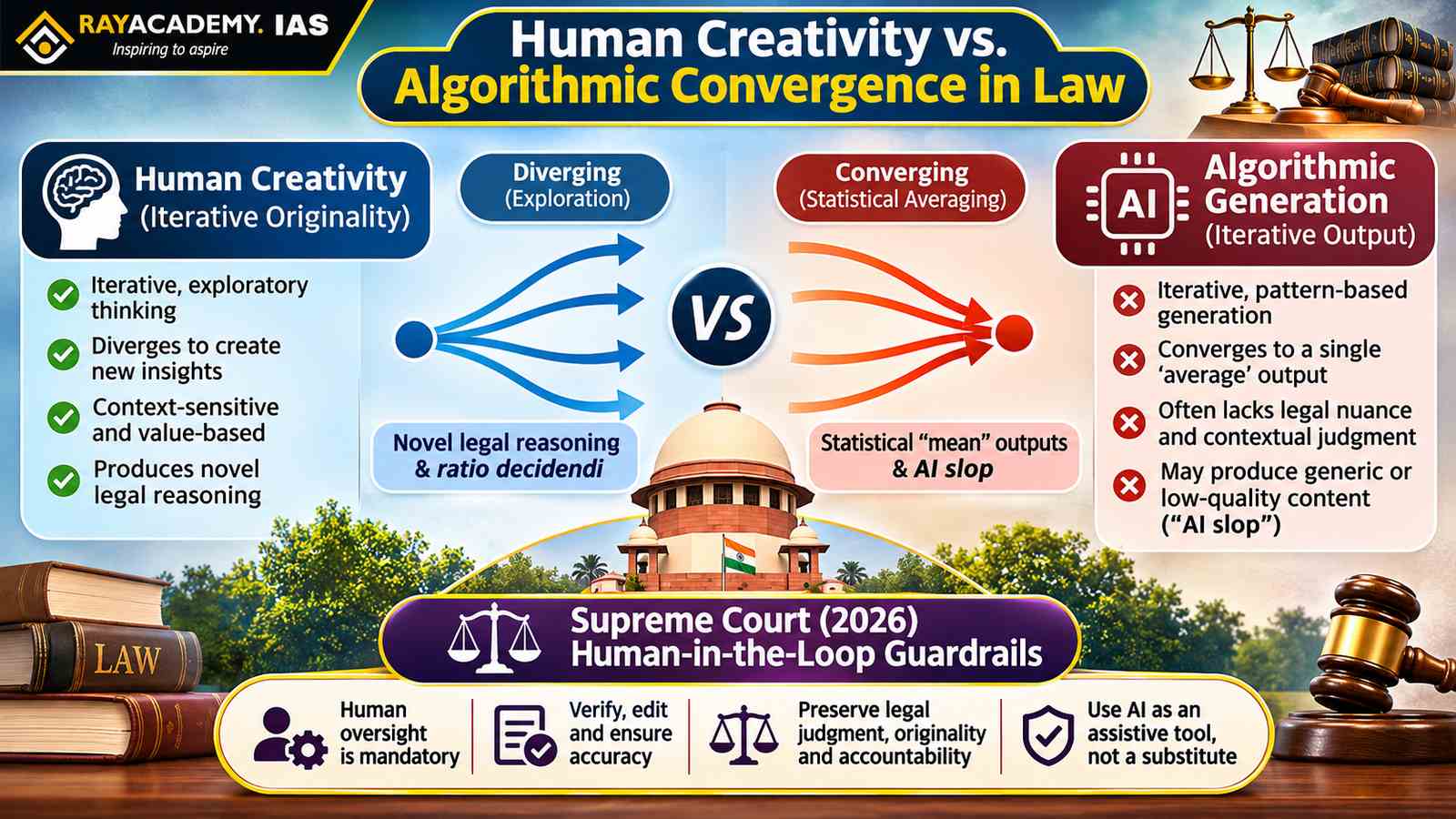
Senior legal practitioners have flagged that delegating analytical writing to large language models (LLMs) produces formulaic, logically repetitive legal articles and risks contaminating the core judicial reasoning—or ratio decidendi—of court judgments.
This concern coincides with the Supreme Court of India’s Draft Regulations for Use of Artificial Intelligence in Courts, 2026 (prepared by the AI Committee headed by Justice P.S. Narasimha) and judicial strictures against AI-hallucinated precedents cited in tribunals and High Courts.
Static-Current Linkage: Jurisprudence, Intellectual Property, and Judicial AI Governance
Examining the impact of Artificial Intelligence in legal academia and the judiciary requires connecting foundational legal doctrines with emerging regulatory frameworks in India.
1. Jurisprudence of Ratio Decidendi and Judicial Application of Mind
Meaning of Ratio Decidendi: Literally translating to "the reason for the decision", ratio decidendi refers to the binding legal principle or core reasoning applied by a judge to material facts to reach a verdict. Under Article 141 of the Constitution of India, the law declared by the Supreme Court—embodied in its ratio decidendi—is binding on all courts within India.
Difference from Obiter Dicta: Unlike obiter dicta (incidental observations made in passing), ratio decidendi requires conscious, independent human adjudication. Outsourcing dispositive judicial reasoning to probabilistic algorithms threatens natural justice and reasoned speaking orders (audi alteram partem and duty to give reasons).
2. Intellectual Property Rights (Copyright Act, 1957) & Authorship
Human Authorship Requirement: Under Section 2(d) of the Copyright Act, 1957, the "author" of a literary or artistic work is a natural human creator (or, for computer-generated works, "the person who causes the work to be created").
Loss of Originality & Moral Rights: Legal scholarship relies on original intellectual labour, critical synthesis, and moral rights (Section 57) to advance jurisprudence. Wholesale outsourcing of articles to AI models reduces human writers from independent authors to passive editors of homogenized machine outputs.
3. Supreme Court Draft Regulations for Use of AI in Courts, 2026
Human Primacy & Human-in-the-Loop: Released in June 2026, the Supreme Court Draft AI Regulations, 2026 enshrine Human Primacy as a non-negotiable principle—mandating that final adjudicative authority and accountability rest exclusively with human judges.
Strict Prohibitions (Regulation 20): Absolutely prohibits using AI systems for automated algorithmic decision-making, sentencing, risk scoring (such as predicting recidivism, flight risk, or bail eligibility), or evaluating witness credibility.
Mandatory Disclosure & Verification: Requires advocates and litigants to disclose AI-assisted drafting in pleadings and holds officers and lawyers strictly liable for verifying every citation against AI hallucinations.
Prelims Focus: High-Yield Objective Facts
UPSC Prelims Quick-Revision Box:
Judicial AI Tools, Regulations & Legal ConceptsSupreme Court AI Committee (2026): Headed by Justice P.S. Narasimha; drafted the Regulations for Use of Artificial Intelligence in Courts, 2026, establishing principles of Human Primacy, Transparency, Data Minimisation, and Data Sovereignty (hosting judicial data within India).
Key Indian Judicial AI Platforms:SUPACE (Supreme Court Portal for Assistance in Court’s Efficiency): AI-driven research and case-management tool assisting judges in collecting relevant facts and laws without making decisions.SUVAS (Supreme Court Vidhik Anuvaad Software): AI-powered machine translation tool translating judicial orders from English into vernacular Indian languages.
Adalat AI: Deployed in High Courts (notably Kerala High Court's 2025 AI Policy) to assist in real-time transcription of witness depositions.AI Hallucination (Regulation 3(z)): Defined as any AI output that is inaccurate, fabricated, or non-existent (such as fake case citations) presented with apparent confidence; strictly excluded as a legal defence.
Algorithmic Mean Convergence: Because generative AI models predict the statistically most probable next token, repeated iterations converge toward a standardized "mean" style—eroding idiosyncratic human creativity.
Mains Analytical Breakdown: Significance vs. Multi-Dimensional Challenges
Significance of Responsible AI Adoption in Law and Academia
Democratizing Linguistic Access: For researchers, law students, and practitioners from non-English or vernacular backgrounds, AI tools help translate complex legal concepts into cogent English and regional languages, lowering linguistic entry barriers.
Accelerating Administrative & Registry Efficiency: Deployment of AI in case listing, metadata tagging, redaction of personal data, and transcription reduces clerical backlogs across India’s overburdened courts.
Faster Precedent & Statutory Retrieval: Properly verified AI research assistants help legal scholars scan vast repositories of judgments and statutes rapidly, freeing time for deeper doctrinal analysis.
Multi-Dimensional Challenges
Erosion of Ratio Decidendi and Judicial Legitimacy (Constitutional & Legal): If judges rely on generative AI to draft dispositive sections of judgments, opaque "black-box" probabilistic patterns risk polluting the ratio decidendi, undermining Article 141 precedent certainty and public trust in reasoned adjudication.
Proliferation of "AI Slop" & Intellectual Homogenization (Academic & Social): High-volume, low-substance AI articles follow identical structural templates—formulaic bulleting and repetitive premise-conjunction phrasing—leading to intellectual stillness and the atrophy of critical legal thinking among law students and scholars.
Citation Hallucinations & Professional Misconduct (Institutional): Recent instances before the National Company Law Tribunal (NCLT) and Bombay High Court—where non-existent, AI-fabricated judgments were cited in orders and pleadings—highlight severe risks to the integrity of justice delivery.
Abdication of Moral Authorship & Academic Integrity (Ethical): Presenting machine-generated prose as original scholarship compromises intellectual honesty, blurs accountability for errors, and diminishes the value of peer-reviewed academic discourse.
Data Privacy & Cross-Border Sovereignty Risks (Technological & Security): Uploading sensitive litigant records or confidential case files onto public cloud LLMs risks cross-border data exposure, violating the Digital Personal Data Protection (DPDP) Act, 2023 and judicial confidentiality.
Way Forward: Reform-Oriented Policy Roadmap
Enforce Strict "Human-in-the-Loop" Boundaries in Adjudication: Adopt and notify the Supreme Court Draft Regulations for Use of AI in Courts, 2026, strictly confining AI to administrative, translation, and indexing tasks while prohibiting algorithmic drafting of ratio decidendi or risk scoring.
Mandate Citation Verification & Disclosure Protocols: Require advocates, researchers, and judicial clerks to sign mandatory AI-disclosure and primary-source verification certificates, backed by disciplinary penalties from the Bar Council of India (BCI) for submitting hallucinated precedents.
Reform Legal Education & Peer-Review Standards: In alignment with the National Education Policy (NEP) 2020 and Bar Council of India curriculum reforms, law universities must shift assessments from take-home essays to viva-voce examinations, moot courts, and primary-source doctrinal analysis, while law journals enforce transparent AI-use policies.
Deploy Sovereign, Air-Gapped Judicial AI Infrastructure: Under the IndiaAI Mission and e-Courts Phase III, host court-specific AI models on sovereign Indian servers with strict data minimisation, zero-retention settings, and periodic algorithmic audits.
Promote Ethical AI Literacy Over Wholesale Outsourcing: Train students and young professionals to use AI strictly as an assistive editing and research aid—never as a substitute for independent reasoning—preserving human originality at the centre of legal scholarship.
Value Addition for Mains
Institutional & Judicial Benchmark (e-Courts Phase III & SC AI Rules 2026): Under e-Courts Phase III (outlay of ₹7,210 crore) and the Supreme Court’s 2026 Draft AI Regulations, India is pioneering a Human-Primacy model of judicial technology—balancing AI-enabled registry efficiency (SUPACE, SUVAS) with an absolute ban on algorithmic adjudication and risk scoring.
Administrative & Ethical Catchphrase for Mains Conclusions: "Artificial Intelligence must remain a cognitive scaffold, never a substitute for conscience or critical thought—ensuring that human reason remains the sole author of scholarship and the sovereign anchor of justice.
Practice Questions for Active Recall
Prelims Practice MCQ
With reference to the use of Artificial Intelligence (AI) in the Indian judiciary and legal frameworks, consider the following statements:
SUPACE (Supreme Court Portal for Assistance in Court’s Efficiency) is an AI-driven tool designed to assist judges in legal research and fact collection without performing automated decision-making.
Under the Supreme Court’s Draft Regulations for Use of Artificial Intelligence in Courts, 2026, AI systems are permitted to conduct algorithmic risk scoring for determining bail eligibility and flight risk.
Under Article 141 of the Constitution of India, the binding authority of a Supreme Court judgment flows from its ratio decidendi.
Which of the statements given above are correct?
(a) 1 and 2 only
(b) 1 and 3 only
(c) 2 and 3 only
(d) 1, 2, and 3
Correct Answer: (b) 1 and 3 only
Explanation:
Statement 1 is correct: SUPACE is a workflow and research assistant built for judges to process facts and retrieve relevant precedents, strictly preserving human judicial discretion.
Statement 2 is incorrect: Regulation 20 of the Supreme Court Draft AI Regulations, 2026 absolutely prohibits the use of AI systems for risk scoring, including predicting recidivism, assessing flight risk, or evaluating bail eligibility.
Statement 3 is correct: Under Article 141, the law declared by the Supreme Court—encapsulated in the ratio decidendi (core legal reasoning necessary for the decision)—is binding on all courts in India.
Mains Practice Question (GS Paper II & GS Paper IV — 150 Words | 10 Marks)
"Unchecked reliance on generative Artificial Intelligence risks replacing original legal scholarship with formulaic 'AI slop' and polluting the ratio decidendi of judicial pronouncements." Examine the ethical and governance concerns of AI adoption in legal academia and the judiciary, and outline safeguards for responsible integration.
Answer Structure Hints:
Introduction: Contextualize the growing debate over generative AI in legal writing and courts—marked by concerns over "AI slop", AI-hallucinated citations, and the Supreme Court’s Draft AI Regulations, 2026.
Body Part 1 (Ethical & Governance Concerns): Highlight the atrophy of critical thinking and intellectual authorship in academia; algorithmic convergence toward unoriginal "mean" prose; threats to ratio decidendi (Article 141) and reasoned orders from opaque black-box models; citation hallucinations; and litigant data privacy risks.
Body Part 2 (Safeguards for Responsible Integration): Recommend enforcing Human Primacy and prohibiting AI in dispositive reasoning or risk scoring; mandatory AI-disclosure and citation verification rules; sovereign, encrypted judicial AI servers; and reforming legal assessments toward analytical and oral evaluation.
Conclusion: Conclude with an ethical governance principle—technology must amplify human reasoning and probity rather than abdicate intellectual and judicial responsibility.
Take this article with you
Save a reading copy for offline study.


