

Bellatrix Aerospace
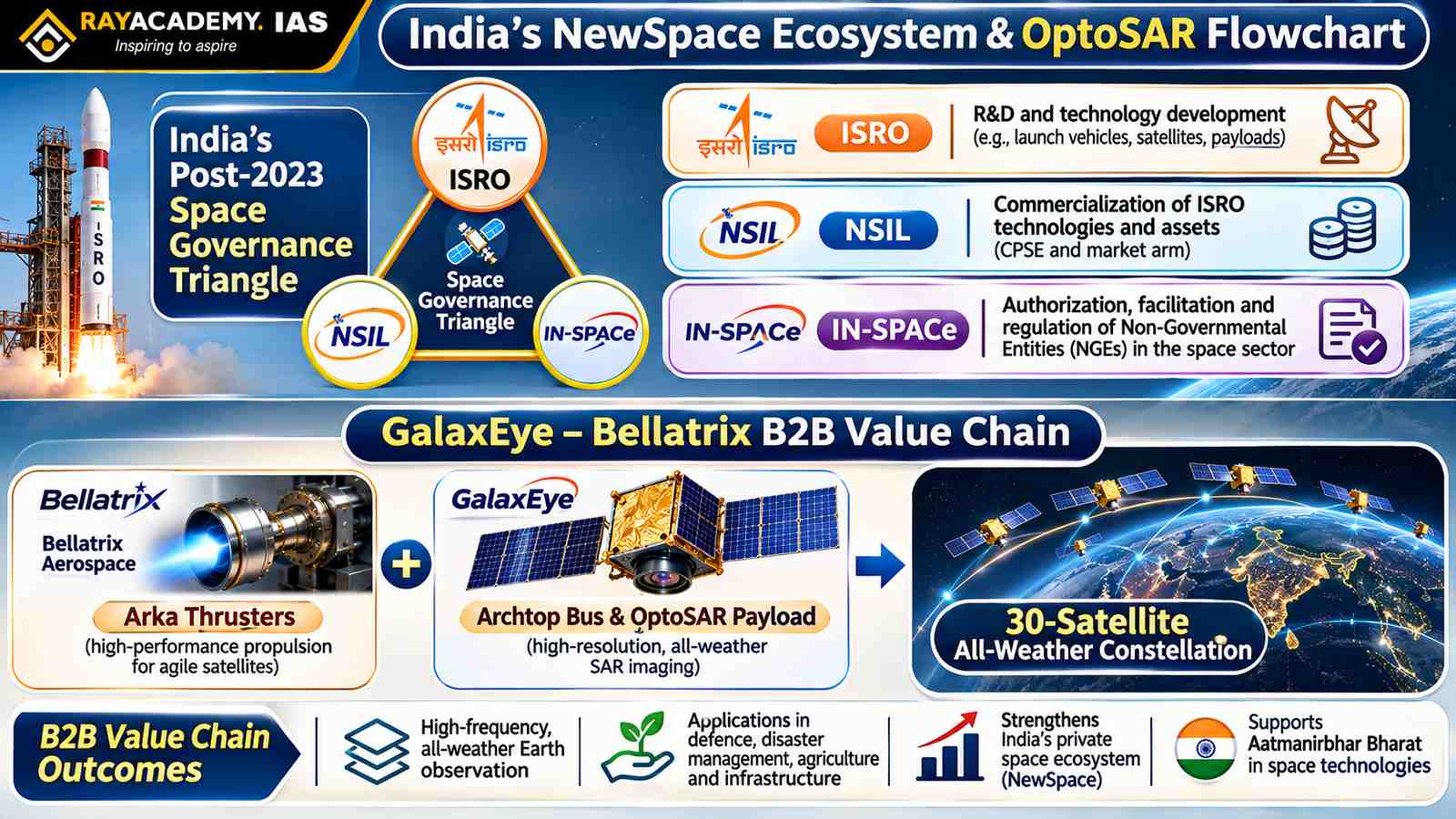
Bengaluru-based space technology startups GalaxEye and Bellatrix Aerospace signed a landmark multi-year contract on November 24, 2026, under which Bellatrix will design, test, and deliver indigenous in-space propulsion systems for GalaxEye’s next 30 OptoSAR Gen-II satellites.
UPSC Syllabus Mapping:
General Studies Paper III (Science & Technology): Awareness in the fields of IT, Space, Computers, robotics, nano-technology, bio-technology; Achievements of Indians in science & technology; Indigenization of technology and developing new technology.
General Studies Paper III (Indian Economy & Infrastructure): Indian Economy and issues relating to planning, mobilization of resources, growth, development and employment; Effects of liberalization on the economy, changes in industrial policy and their effects on industrial growth.
Unveiled at the 5th India International Space Conclave (IISC 2026)—organized by the Indian Space Association (ISpA) in collaboration with ISRO and IN-SPACe—this represents the largest business-to-business (B2B) order placed by one Indian private space enterprise with another since the space sector opened to private participation in 2020.
The agreement marks a structural shift in India’s NewSpace ecosystem, signaling that domestic startups are evolving from mere component vendors to the Indian Space Research Organisation (ISRO) into self-sustaining commercial primes building end-to-end satellite constellations.
Static-Current Linkage: Space Reforms, Propulsion Physics, and International Space Law . Private Space
Understanding the significance of the GalaxEye-Bellatrix B2B deal requires connecting India’s post-2020 institutional space architecture with remote-sensing technology and orbital mechanics.
1. Institutional Architecture of India’s Space Reforms (2020–2023)
Indian National Space Promotion and Authorisation Centre (IN-SPACe): Established in 2020 under the Department of Space (DoS), IN-SPACe functions as the autonomous single-window nodal agency for authorizing, regulating, and promoting Non-Governmental Entities (NGEs) across end-to-end space activities.
NewSpace India Limited (NSIL): Incorporated in 2019 as a Central Public Sector Enterprise (CPSE) under the Department of Space, NSIL serves as ISRO’s commercial arm—executing demand-driven missions, technology transfers, and commercial launch services.
Indian Space Policy, 2023: Delineated clear institutional boundaries by directing ISRO to focus on advanced research, deep-space exploration, and human spaceflight (Gaganyaan), while empowering NGEs to independently build launch vehicles, satellites, and downstream geospatial applications using ISRO’s testing infrastructure.
2. Scientific Principles: OptoSAR Imaging and Electric Propulsion
OptoSAR Technology: Developed by IIT Madras-incubated GalaxEye, OptoSAR integrates optical imaging sensors (which capture high-resolution, true-colour imagery in clear daylight) with Synthetic Aperture Radar (SAR) (which transmits microwave pulses capable of penetrating clouds, smoke, and darkness) on a single satellite platform.
In-Space Electric & Green Propulsion: Unlike conventional chemical thrusters that burn toxic propellants like hydrazine, Bellatrix Aerospace’s Arka Hall-effect electric propulsion systems ionize a propellant gas (such as xenon or krypton) using electric fields to generate high specific impulse (Iₛₚ)—enabling precise orbit raising, constellation phasing, collision avoidance, and end-of-life de-orbiting.
3. International Space Law & State Responsibility
Outer Space Treaty (1967), Article VI: Establishes that States bear international responsibility for national activities in outer space, whether carried on by governmental agencies or by non-governmental entities, requiring continuous authorization and supervision (fulfilled in India by IN-SPACe).
Liability Convention (1972): Holds the "launching State" absolutely liable to pay compensation for damage caused by its space objects on the surface of the Earth or to aircraft in flight—making rigorous technical vetting by IN-SPACe vital even for private constellations.
Prelims Focus: High-Yield Objective Facts
UPSC Prelims Quick-Revision Box:
Space Startups, Policies & Mission DrishtiNodal Department & Regulator: Department of Space (DoS) (directly under the Prime Minister); IN-SPACe (headquartered in Ahmedabad) acts as the single-window regulatory and promotional body for private space entities. Space Startup Growth Benchmark: Over 440 space startups now operate in India, with 70–80% of ISRO’s launch vehicle and satellite budgets channelled into domestic industry.
Mission Drishti (May 2026): Launched on May 3, 2026 aboard a SpaceX Falcon 9 rocket, Mission Drishti was the world’s first private OptoSAR satellite, validating GalaxEye’s spacecraft deployment, attitude control, and onboard computing before contact was lost due to a geomagnetic storm.
Research, Development and Innovation (RDI) Fund Support: In September 2026, the Technology Development Board (TDB) under the Department of Science and Technology (DST) committed ₹63.84 crore from the government’s RDI Fund to support GalaxEye’s next multi-sensor satellite targeting imagery sharper than 0.5 metres.
100% FDI in Space Sector (2024 Amendment):Up to 100% automatic route for manufacturing components, systems, and sub-systems for satellites, ground segment, and user segment.Up to 74% automatic route (beyond 74% via government route) for satellite manufacturing, operation, and data products.Up to 49% automatic route (beyond 49% via government route) for launch vehicles and spaceports.
Mains Analytical Breakdown: Significance vs. Multi-Dimensional Challenges
Strategic and Economic Significance
Maturation of Domestic B2B Supply Chains: Historically, private firms relied almost exclusively on ISRO procurement contracts. A 30-satellite B2B propulsion contract between two Bengaluru startups demonstrates horizontal value-chain integration, shortening engineering lead times and retaining intellectual property within India.
Dual-Use Geospatial Intelligence & National Security: All-weather, day-and-night OptoSAR imagery (sharper than 0.5 metres) enhances border surveillance, maritime domain awareness, disaster response during monsoon floods/cyclones, and precision agriculture without relying on foreign commercial satellites.
Validating Blended Public-Private Innovation Financing: Combining patient sovereign catalytic capital—such as DST-TDB’s ₹63.84 crore RDI Fund commitment—with private venture capital de-risks capital-intensive deep-tech R&D.
Accelerating India’s Global Space Economy Target: Strengthening domestic sub-system manufacturing (thrusters, satellite buses, payloads) advances IN-SPACe’s Decadal Vision to expand India’s space economy from $8.4 billion to $44 billion by 2033, lifting global market share from ~2% to 8%.
Multi-Dimensional Challenges
Domestic Anchor Demand Deficit (Economic & Market): As highlighted by IN-SPACe Chairman Pawan Goenka, while India has successfully built supply-side engineering capacity, generating heavy domestic anchor demand from government ministries (defence, agriculture, urban planning) remains the biggest bottleneck for private space startups.
Long Gestation Cycles & Patient Capital Scarcity (Financial): Space hardware does not yield commercial returns within 6–9 months; high upfront capital costs for constellation deployment and in-orbit testing require sustained institutional funding and tax incentives.
Space Weather & Orbital Resilience Risks (Scientific & Environmental): As demonstrated when a geomagnetic storm disrupted GalaxEye’s Mission Drishti, Low Earth Orbit (LEO) constellations face severe vulnerabilities from solar flares, radiation hardening costs, and growing space debris congestion.
Regulatory & Procedural Bottlenecks Across Governance Tiers (Administrative): Startups still navigate multi-agency clearances spanning spectrum allocation (WPC/DoT), remote-sensing data dissemination policies, export controls (SCOMET), and insurance mandates, requiring smoother procedural alignment.
Dependence on Foreign Heavy-Lift Launchers (Infrastructure): Until indigenous private launch vehicles (such as Skyroot’s Vikram and Agnikul’s Agnibaan) and ISRO’s commercial PSLV/SSLV lines achieve high launch cadence, Indian startups occasionally depend on foreign launchers like SpaceX.
Way Forward: Reform-Oriented Policy Roadmap
Institutionalize Government Anchor Procurement (IN-SPACe & Defence Space Agency Model): Mandate central ministries (Agriculture, Jal Shakti, Home Affairs, MoEFCC) and the Defence Space Agency (DSA) to procure domestic private geospatial data and satellite-as-a-service under long-term off-take agreements—creating predictable anchor demand.
Enact a Comprehensive National Space Activities Legislation: Introduce a dedicated Space Activities Act to codify third-party liability caps, mandatory space insurance frameworks, spectrum priority, and IN-SPACe statutory enforcement powers, providing long-term policy stability.
Operationalize the ₹1 Lakh Crore RDI Fund for Deep-Tech Constellations: Scale concessional long-term financing instruments (such as optionally convertible debentures via DST-TDB and the Anusandhan National Research Foundation) to bridge the "valley of death" between prototype validation and multi-satellite constellation deployment.
Strengthen Space Situational Awareness & Debris Mitigation (Project NETRA): Integrate private constellations with ISRO’s Project NETRA and space-weather forecasting networks while mandating end-of-life de-orbiting thrusters—a capability built into Bellatrix’s propulsion contract.
Streamline Single-Window Clearances Across Central & State Levels: Harmonize customs exemptions, SCOMET dual-use export licensing, and IN-SPACe authorizations through a unified digital workflow to eliminate procedural friction.
Value Addition for Mains
Official Space Ecosystem Benchmarks (ISRO, IN-SPACe & DST, 2026): Cite that India now hosts over 440 space startups, with 70–80% of ISRO’s launch and satellite budgets flowing to domestic industry, backed by catalytic instruments like DST-TDB’s ₹63.84 crore RDI Fund support for sub-0.5-metre OptoSAR satellites—anchoring India’s roadmap toward a $44 billion space economy by 2033.
Administrative Catchphrase for Mains Conclusions: "Sustaining India’s NewSpace revolution requires transitioning from supply-side deregulation to demand-side anchor procurement and patient deep-tech capital—turning indigenous startups into globally competitive space primes."
Practice Questions for Active Recall
Prelims Practice MCQ
With reference to India’s space sector reforms and satellite technologies, consider the following statements:
The Indian National Space Promotion and Authorisation Centre (IN-SPACe) functions as an autonomous single-window nodal agency under the Department of Space to authorize and regulate non-governmental entities.
Synthetic Aperture Radar (SAR) sensors rely on reflected visible sunlight and therefore cannot capture Earth observation imagery through dense cloud cover or at night.
Under the Outer Space Treaty (1967), a State bears international responsibility for national space activities carried out by private non-governmental entities.
Which of the statements given above are correct?
(a) 1 and 2 only
(b) 1 and 3 only
(c) 2 and 3 only
(d) 1, 2, and 3
Correct Answer: (b) 1 and 3 only
Explanation:
Statement 1 is correct: Established in 2020 under the Department of Space (DoS), IN-SPACe is the single-window regulatory and promotional body for private space companies (Non-Governmental Entities) in India.
Statement 2 is incorrect: Unlike passive optical sensors, Synthetic Aperture Radar (SAR) is an active microwave remote-sensing technology that transmits its own radar pulses—enabling all-weather, day-and-night imaging through clouds, smoke, and darkness.
Statement 3 is correct: Article VI of the Outer Space Treaty (1967) mandates that States bear international responsibility for national space activities conducted by both governmental and non-governmental entities, requiring ongoing State authorization and supervision.
Mains Practice Question (GS Paper III — 150 Words | 10 Marks)
"The emergence of domestic business-to-business (B2B) contracts among Indian space startups marks a structural shift from vendor participation to end-to-end constellation building." Examine the significance of India’s post-2020 space reforms in fostering a self-reliant private space ecosystem and discuss key challenges that remain.
Answer Structure Hints:
Introduction: Contextualize the November 2026 GalaxEye–Bellatrix Aerospace B2B deal (propulsion systems for 30 OptoSAR satellites), noting India’s 440+ space startups and 70–80% ISRO industry budget share.
Body Part 1 (Significance of Post-2020 Reforms): Highlight role clarity under Indian Space Policy, 2023 (ISRO for R&D, NSIL for commercialization, IN-SPACe as single-window regulator), 100% FDI norms, catalytic RDI Fund support, and dual-use capabilities like all-weather OptoSAR and green electric propulsion.
Body Part 2 (Key Challenges & Way Forward): Discuss the anchor demand deficit flagged by IN-SPACe, need for patient capital over long gestation cycles, procedural alignment across agencies, and space-weather/debris risks. Suggest guaranteed government data procurement, a dedicated Space Activities Act, and expanded RDI financing.
Conclusion: Conclude with India’s target of a $44 billion space economy by 2033, emphasizing strategic autonomy and public-private synergy.
Take this article with you
Save a reading copy for offline study.


