

UPSC Syllabus Mapping: General Studies Paper II (International Relations) — Bilateral, regional and global groupings and agreements involving India and/or affecting India’s interests; Effect of policies and politics of developed and developing countries on India’s interests.
India-US Why in News?
The ongoing India-US diplomatic relations faced fresh legal scrutiny after a U.S. District Court in New York permitted Khalistani separatist Gurpatwant Singh Pannun to serve a civil summons on India’s National Security Adviser (NSA) Ajit Doval and former Research and Analysis Wing (RAW) chief Samant Goel through Indian judicial channels.
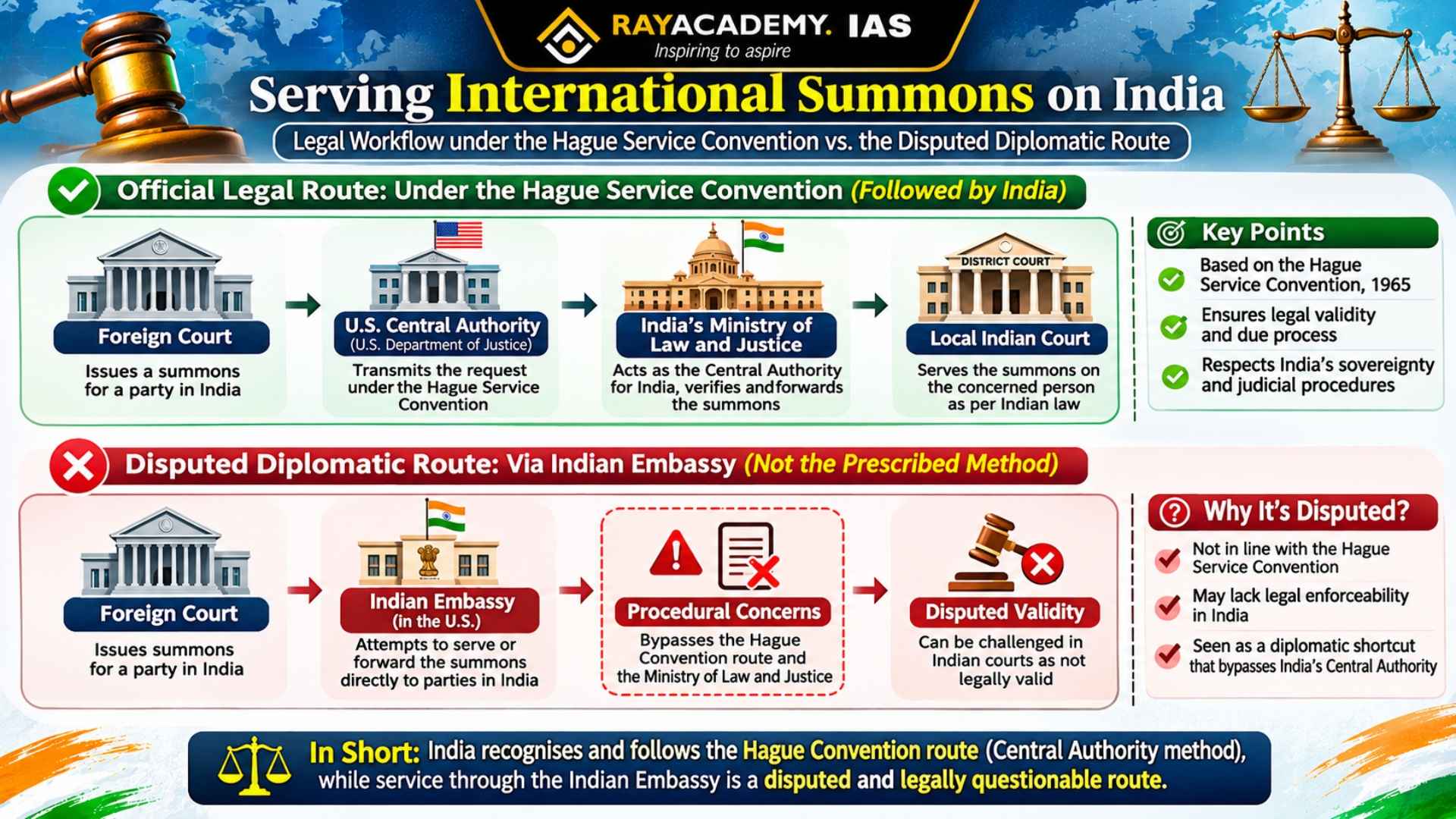
This judicial order follows a submission by the U.S. State Department confirming it had delivered a legal notice to the Indian Embassy in Washington. In response, India’s Ministry of External Affairs (MEA) strongly rejected the lawsuit as "frivolous" and emphasized that international judicial summons can only be routed through India's designated central authority under the Hague Service Convention.
Static-Current Linkage: International Law, Sovereign Immunity, and Bilateral Treaties
Understanding this diplomatic episode requires examining the intersection of international civil procedure, domestic sovereignty, and bilateral legal frameworks between New Delhi and Washington.
The Hague Service Convention of 1965
The Convention on the Service Abroad of Judicial and Extrajudicial Documents in Civil or Commercial Matters (1965), commonly known as the Hague Service Convention, is a multilateral treaty negotiated under the Hague Conference on Private International Law (HCCH). Both India and the United States are signatories to this convention, which establishes a streamlined, standardized mechanism for transmitting judicial documents across international borders without relying on slow diplomatic channels.
Under Article 2 of the Convention, each member state must designate a Central Authority to receive requests for service coming from other contracting states. In India, the Department of Legal Affairs under the Ministry of Law and Justice is the sole designated Central Authority. The MEA clarified that any attempt to bypass this nodal ministry—such as serving notices directly via diplomatic missions—violates established international protocol. Furthermore, Article 13 of the Convention empowers a signatory state to refuse compliance if executing the request would infringe upon its sovereignty or security.
Sovereign Immunity and State Officials
In international law, sovereign immunity (or state immunity) protects a sovereign state and its high-ranking officials from being sued in the domestic courts of another country without consent. In the United States, civil suits against foreign states are governed by the Foreign Sovereign Immunities Act (FSIA) of 1976, while suits against individual foreign officials fall under common law conduct-based immunity (as clarified by the U.S. Supreme Court in Samantar v. Yousuf).
Officials acting in their official capacity—such as an NSA or intelligence chief—generally enjoy functional immunity for official acts, making cross-border civil litigation against serving or former security officials highly contentious in bilateral diplomacy.
Prelims Focus: High-Yield Objective Facts
Treaty Name: Convention on the Service Abroad of Judicial and Extrajudicial Documents in Civil or Commercial Matters (Hague Service Convention), adopted in 1965 and entered into force in 1969.
India’s Accession: India acceded to the Hague Service Convention in 2006 (entered into force for India in August 2007).
India's Designated Central Authority: Department of Legal Affairs, Ministry of Law and Justice (not the Ministry of External Affairs).
India’s Key Reservations: India opposes service of judicial documents through postal channels (Article 10) and insists that documents must be in English or accompanied by an English translation.
Nodal Security Agencies Mentioned:
National Security Council Secretariat (NSCS): Headed by the National Security Adviser (NSA), advising the Prime Minister on strategic and security policy.
Research and Analysis Wing (RAW): India's primary foreign intelligence agency, established in 1968 under the Cabinet Secretariat.
Counter-Terrorism Legal Framework: Gurpatwant Singh Pannun is designated as an individual terrorist under the Fourth Schedule of the Unlawful Activities (Prevention) Act (UAPA), 1967 (as amended in 2019), and his organization, Sikhs for Justice (SFJ), is banned as an unlawful association.
Mains Analytical Breakdown
Strategic Significance for India
Asserting Procedural Sovereignty: By insisting that notices follow the Ministry of Law and Justice route under the Hague Convention, India upholds rules-based international order and prevents foreign domestic courts from setting unilateral precedents against Indian officials.
Compartmentalizing Legal Friction from Strategic Ties: Both New Delhi and Washington have demonstrated diplomatic maturity by distinguishing judicial processes from core strategic cooperation. Despite legal proceedings in New York, high-level bilateral engagements—including summit-level diplomacy and defense technology partnerships—continue to advance.
Reinforcing Counter-Terrorism Narrative: The episode provides India an opportunity to highlight the activities of anti-India extremist networks operating from Western soil under the guise of free speech, pressing allies to act against designated terrorists under UAPA.
Multi-Dimensional Challenges
Political and Diplomatic Friction: Publicized court summons targeting serving top security officials like the NSA create domestic political sensitivity and test mutual trust within the Comprehensive Global Strategic Partnership.
Legal and Jurisdictional Asymmetry: The strict separation of powers in the U.S. allows private litigants to initiate civil suits independently of the executive branch. While the U.S. State Department noted its delivery of the notice was merely a "legal obligation" and not taking a position, such technicalities often complicate diplomatic messaging.
Security and Intelligence Operational Risks: Prolonged civil litigation in foreign jurisdictions risks exposing sensitive intelligence methodologies or forcing governments to expend diplomatic capital defending functional immunity for security personnel.
Social and Diaspora Polarization: Extraterritorial legal battles involving separatist elements can deepen ideological fault lines within the Indian diaspora in North America, affecting community harmony and consular outreach.
Way Forward
Invoke Article 13 of the Hague Convention: India’s Ministry of Law and Justice can formally examine any valid request routed through the Central Authority and exercise its sovereign prerogative under Article 13 to refuse execution if it prejudices national security and sovereign immunity.
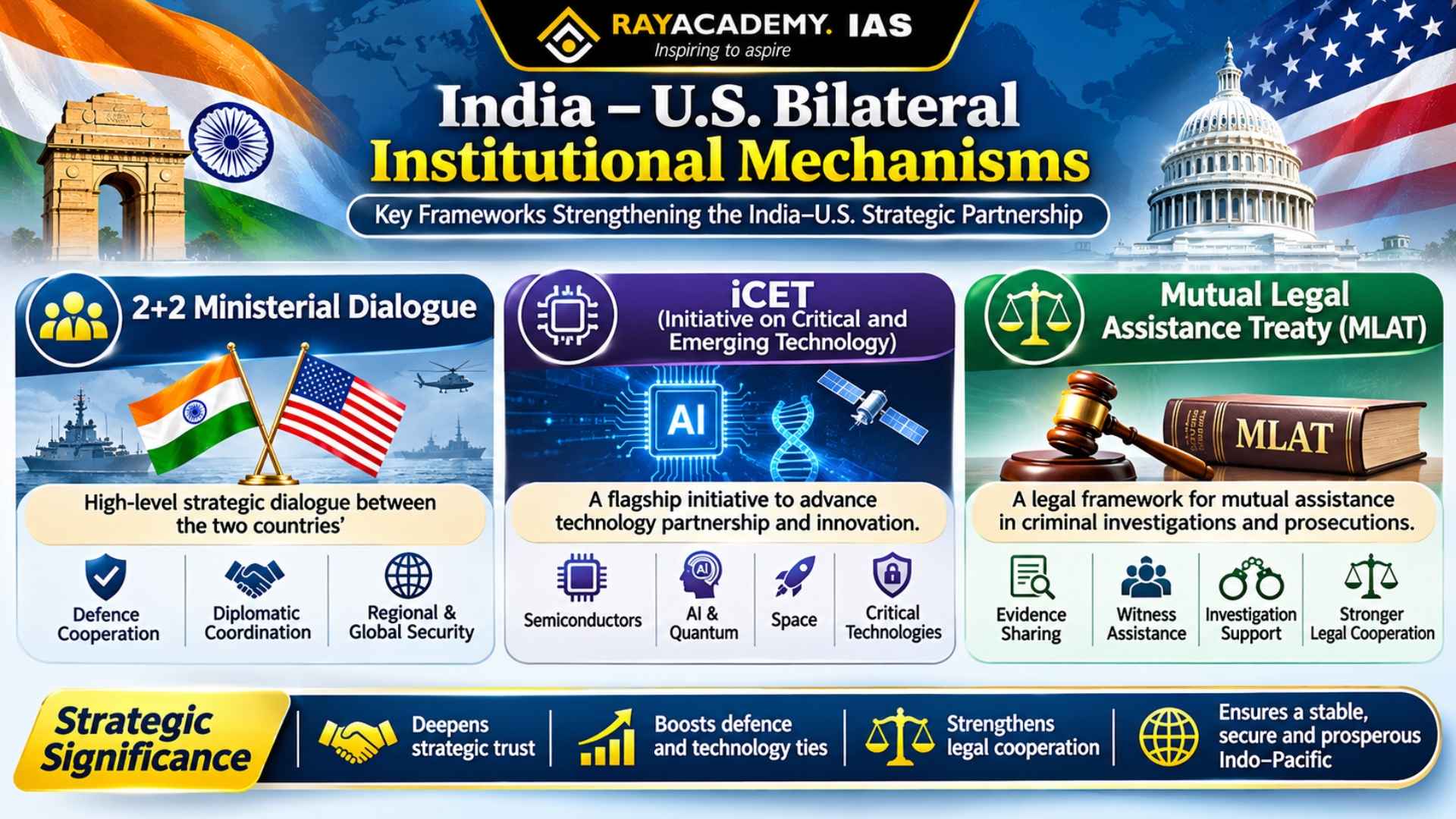
Strengthen Intelligence and Law Enforcement Cooperation: Both nations should utilize existing institutional frameworks—such as the India-US Mutual Legal Assistance Treaty (MLAT) and the Counter-Terrorism Joint Working Group—to address transnational security threats discreetly rather than through public litigation.
Diplomatic Engagement on Sovereign Immunity: India’s MEA and legal missions in Washington should proactively file amicus curiae briefs or seek Suggestions of Immunity from the U.S. Executive Branch to ensure U.S. courts uphold common-law conduct-based immunity for Indian officials.
Proactive Diaspora and Strategic Communication: As recommended by the Parliamentary Standing Committee on External Affairs, India must pair legal diplomacy with sustained outreach to foreign lawmakers and think tanks to distinguish legitimate democratic dissent from violent separatism.
Value Addition for Mains
Constitutional Anchor: Article 51(c) of the Directive Principles of State Policy (DPSP) directs the State to foster respect for international law and treaty obligations in the dealings of organized peoples with one another.
Bilateral Context Data: According to the Ministry of External Affairs Annual Report, the United States remains India's largest trading partner (with bilateral trade exceeding $118 billion) and a foundational pillar of Indo-Pacific security through the QUAD, underscoring why both nations prioritize insulating strategic convergence from isolated legal irritants.
Practice Questions for Active Recall
Prelims Practice MCQ
Consider the following statements regarding the Hague Service Convention (1965):
It governs the cross-border transmission of judicial and extrajudicial documents in both civil and criminal matters.
In India, the Ministry of External Affairs is designated as the sole Central Authority to receive foreign judicial summons.
A signatory state may refuse to comply with a request for service if it deems that compliance would infringe upon its sovereignty or security.
Which of the statements given above is/are correct?
(a) 1 and 2 only
(b) 3 only
(c) 2 and 3 only
(d) 1, 2, and 3
Correct Answer: (b) 3 only
Explanation:
Statement 1 is incorrect: The Hague Service Convention applies strictly to civil or commercial matters, not criminal matters (which are covered under Mutual Legal Assistance Treaties).
Statement 2 is incorrect: India’s designated Central Authority under the Convention is the Department of Legal Affairs, Ministry of Law and Justice, not the Ministry of External Affairs.
Statement 3 is correct: Under Article 13 of the Convention, a contracting state may refuse execution if it considers that compliance would infringe its sovereignty or security.
Mains Practice Question (GS Paper II — 150 Words | 10 Marks)
"While bilateral strategic partnerships are built on converging geopolitical interests, friction over extraterritorial legal jurisdictions and sovereign immunity often tests diplomatic trust." Examine this statement in the context of recent legal developments in India-US relations and the role of international treaties like the Hague Service Convention.
Answer Structure Hints:
Introduction: Define the dual nature of modern India-US ties—deepening strategic convergence juxtaposed with legal-jurisdictional friction over separatist elements.
Body: Briefly explain the procedural safeguard under the Hague Service Convention (1965) (role of Ministry of Law and Justice and Article 13) and the principle of sovereign/functional immunity for state officials. Highlight how separation of powers in democracies creates diplomatic sensitivities.
Conclusion: Conclude with a balanced way forward emphasizing institutional cooperation through MLATs and Article 51(c) adherence to ensure legal procedures do not derail strategic ties.
Take this article with you
Save a reading copy for offline study.


