

On this page
- Why in News? Russia-Ukraine Peace
- Static-Current Linkage: Post-Cold War Security Architecture and International Law
- Prelims Focus: High-Yield Objective Facts
- Mains Analytical Breakdown
- Way Forward: Strategic Implications and Policy Path for India
- Value Addition for Mains
- Practice Questions for Active Recall
UPSC Syllabus Mapping: General Studies Paper II (International Relations) — Bilateral, regional and global groupings and agreements involving India and/or affecting India’s interests; Effect of policies and politics of developed and developing countries on India’s interests.
Why in News? Russia-Ukraine Peace
The prolonged Russia-Ukraine conflict entered a renewed diplomatic phase as trilateral Russia-Ukraine peace talks mediated by the United States commenced in Abu Dhabi, United Arab Emirates (UAE). Marking the first direct formal engagement between Moscow and Kyiv in nine months, the two-day session aims to bridge core differences over post-war security guarantees, territorial sovereignty, and de-escalation measures.
The talks bring together senior delegations led by Russian presidential aide Vladimir Medinsky, Ukrainian Foreign Intelligence Service chief Rustem Umerov, and U.S. special envoys Steve Witkoff and Jared Kushner. Hosted on neutral Gulf soil, this diplomatic push seeks to end the nearly five-year European war that began with Russia’s full-scale invasion in February 2022.
Static-Current Linkage: Post-Cold War Security Architecture and International Law
To analyze the Abu Dhabi negotiations for UPSC Mains, aspirants must connect the immediate diplomatic parleys to the structural fault lines of post-Cold War European security and international law.
NATO Expansion vs. Spheres of Influence
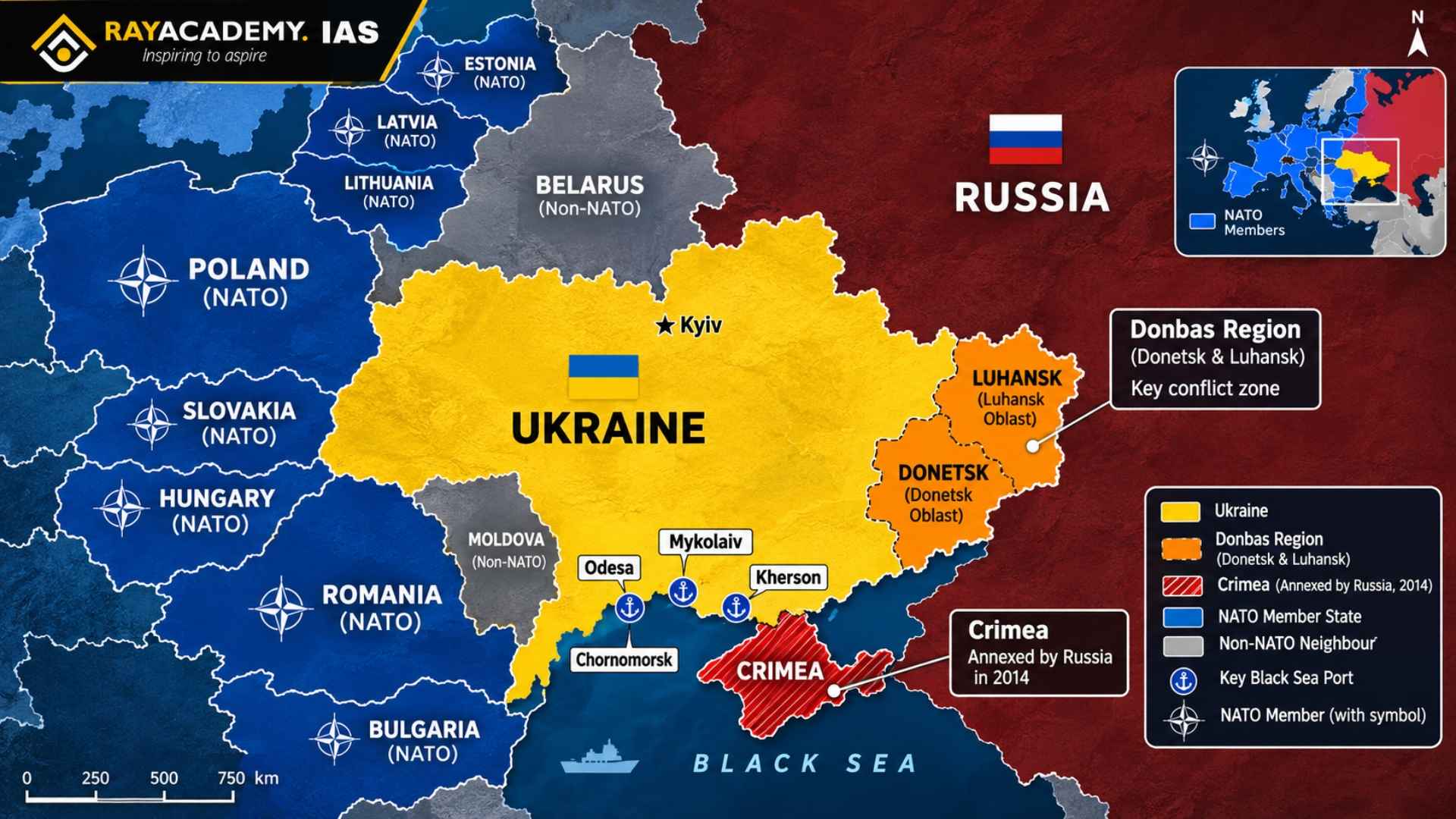
The fundamental trigger of the conflict lies in competing visions of European security architecture. Following the dissolution of the Soviet Union in 1991, the eastward expansion of the North Atlantic Treaty Organization (NATO) brought the Western military alliance directly to Russia's borders.
Moscow views NATO’s open-door policy and potential Ukrainian membership as an existential security threat. Conversely, Kyiv asserts its sovereign right under the Helsinki Final Act (1975) and the UN Charter to choose its own foreign policy and collective security alliances to deter future Russian aggression.
Failed Peace Frameworks: Minsk Agreements and Budapest Memorandum
Earlier diplomatic instruments failed to prevent full-scale escalation due to implementation deficits and lack of enforcement mechanisms:
Budapest Memorandum (1994): Ukraine surrendered its post-Soviet nuclear arsenal in exchange for security assurances from Russia, the United States, and the United Kingdom respecting its territorial integrity. Russia’s 2014 annexation of Crimea shattered the credibility of non-binding assurances, explaining why Kyiv now demands ironclad, legally binding security guarantees.
Minsk I (2014) and Minsk II (2015) Agreements: Brokered by France and Germany (the Normandy Format), these accords sought a ceasefire and special status for the Donbas region (Donetsk and Luhansk). Disagreements over the sequencing of political autonomy versus border control rendered the agreements defunct prior to the 2022 invasion.
Prelims Focus: High-Yield Objective Facts
Host Nation (UAE): Located in the eastern Arabian Peninsula along the Persian Gulf and Gulf of Oman; shares land borders with Saudi Arabia and Oman, and maritime borders with Qatar and Iran. Abu Dhabi is the capital and largest emirate of the UAE federation.
North Atlantic Treaty Organization (NATO): Established in 1949 via the Washington Treaty; headquartered in Brussels, Belgium. Article 5 enshrines the principle of collective defense (an attack on one ally is an attack on all). Recent additions include Finland (2023) and Sweden (2024), bringing total membership to 32 countries.
Key Conflict Regions in News:
Donbas Region: Industrial coal-and-steel heartland in eastern Ukraine comprising Donetsk and Luhansk oblasts.
Crimean Peninsula: Annexed by Russia in 2014; dominates the northern Black Sea and controls access to the Sea of Azov via the Kerch Strait.
Zaporizhzhia Nuclear Power Plant: Europe’s largest nuclear power plant, situated on the Dnieper River in southeastern Ukraine.
Black Sea Grain Initiative (2022): Brokered by the United Nations and Türkiye to ensure safe maritime export of Ukrainian grain and Russian fertilizers; collapsed in July 2023.
Mains Analytical Breakdown
Significance of the Abu Dhabi Peace Initiative
Reopening Direct Communication Channels: Resuming trilateral talks after a nine-month stalemate lowers the immediate risk of nuclear escalation and opens space for localized de-escalation, prisoner exchanges, and energy infrastructure ceasefires.
Rise of Middle Powers in Conflict Mediation: Hosting the talks in Abu Dhabi underscores the growing diplomatic agency of Gulf middle powers (such as the UAE and Saudi Arabia), which maintain pragmatic ties with both Washington and Moscow.
Global Economic Stabilization: A credible roadmap toward peace promises to ease global supply chain bottlenecks, stabilize crude oil and fertilizer markets, and reduce inflationary pressures across the Global South.
Multi-Dimensional Challenges
Geopolitical & Territorial Deadlock: A stark asymmetry persists between Russia’s demand for formal recognition of territorial gains in eastern and southern Ukraine and Kyiv’s constitutional refusal to cede sovereign territory.
Exclusion of European Stakeholders: The strictly trilateral format (U.S., Russia, Ukraine) has generated anxiety among European Union (EU) and NATO allies, who fear a bilateral Washington-Moscow bargain that sidelines Europe’s long-term security interests.
Economic & Sanctions Complexities: Designing a phased lifting of Western economic sanctions on Russia—while retaining snapback mechanisms if a ceasefire is violated—presents intricate legal and financial hurdles.
Ethical & Humanitarian Accountability: Balancing the pragmatic urgency of ending bloodshed with demands for transitional justice, accountability for war crimes, and the return of displaced populations remains a profound moral dilemma.
Environmental & Ecological Devastation: Nearly five years of trench warfare, artillery shelling, and destruction of critical infrastructure (such as the Kakhovka Dam) have caused severe soil contamination, deforestation, and heightened nuclear safety risks.
Way Forward: Strategic Implications and Policy Path for India
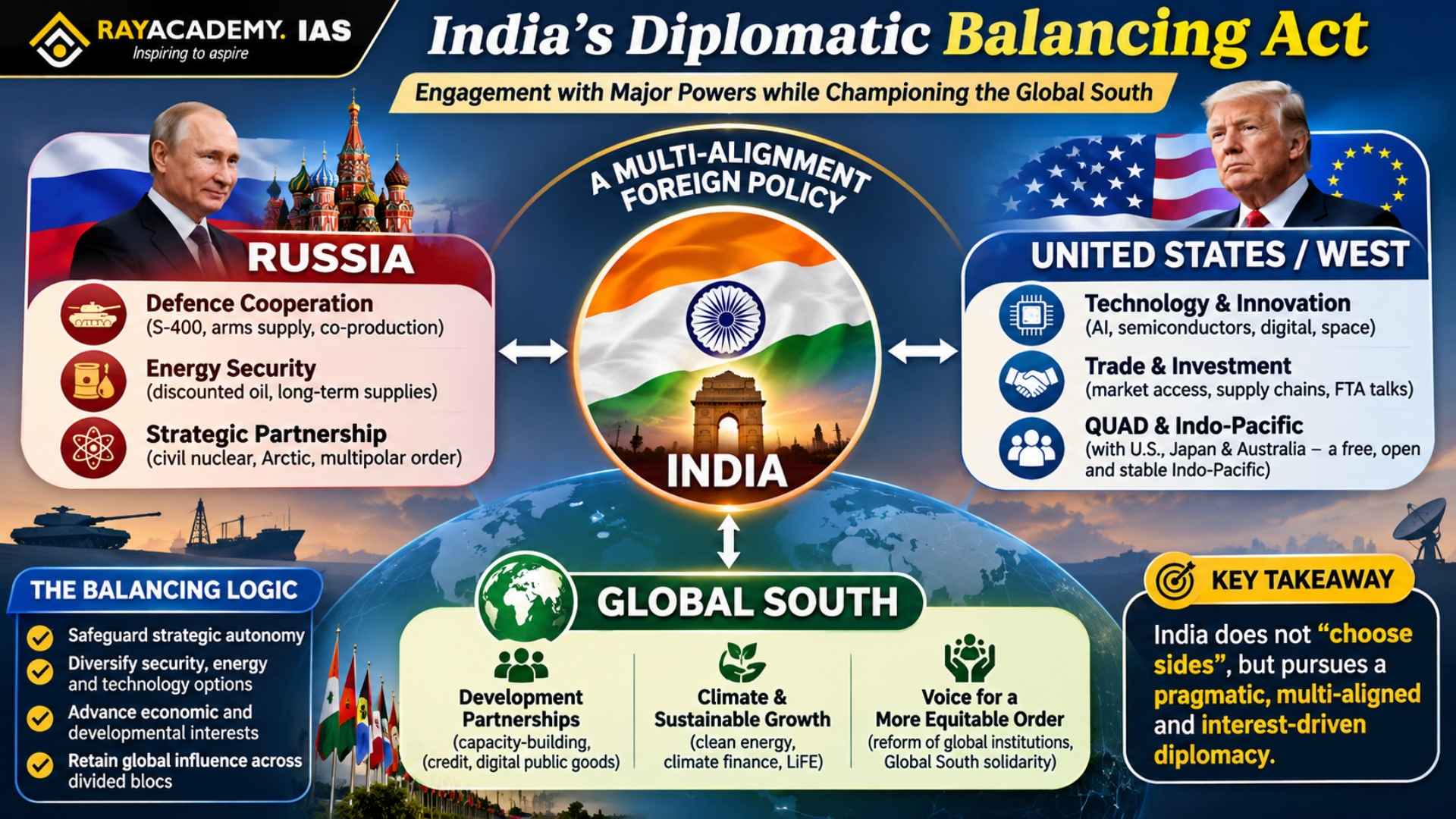
For India, whose foreign policy is anchored in strategic autonomy and multi-alignment, a negotiated settlement in Ukraine aligns directly with its national interests.
Championing Dialogue and Diplomacy: India should continue advocating Prime Minister Narendra Modi’s principle that "today’s era is not an era of war," offering diplomatic support to credible mediation efforts that respect the UN Charter, sovereignty, and territorial integrity of states.
Leveraging the Global South Consensus: Building on the G20 New Delhi Leaders' Declaration (2023), India can rally developing nations to prioritize food, fuel, and fertilizer security in any post-war global governance reform.
Securing Defense and Energy Diversification: As recommended by the Parliamentary Standing Committee on External Affairs, India must continue diversifying its defense procurement under Atmanirbhar Bharat while maintaining historic defense-industrial ties with Russia and deepening high-tech partnerships with the U.S. and Europe.
Participating in Post-War Reconstruction: India can leverage its expertise in Digital Public Infrastructure (DPI), pharmaceuticals, and infrastructure development to contribute to Ukraine’s post-war economic reconstruction.
Value Addition for Mains
Constitutional & Philosophical Anchor: India’s stand on peaceful conflict resolution reflects Article 51(d) of the Directive Principles of State Policy (encouraging settlement of international disputes by arbitration) and the civilizational ethos of Vasudhaiva Kutumbakam (the world is one family).
Economic Survey Data Point: According to the Economic Survey of India, geopolitical fragmentation and conflict-induced supply chain disruptions remain primary external risks to global trade growth, highlighting why early conflict resolution in Eurasia directly supports India’s macroeconomic stability and Viksit Bharat 2047 growth trajectory.
Practice Questions for Active Recall
Prelims Practice MCQ
Consider the following pairs of regions frequently seen in international news and the countries/water bodies associated with them:
Donbas Region : Bordering the Sea of Azov
Kerch Strait : Connects the Black Sea and the Sea of Azov
Zaporizhzhia : Located along the Danube River
How many of the pairs given above are correctly matched?
(a) Only one
(b) Only two
(c) All three
(d) None
Correct Answer: (b) Only two
Explanation:
Pair 1 is correct: The Donbas region (comprising Donetsk and Luhansk) is located in southeastern Ukraine, with southern Donetsk bordering the northern coast of the Sea of Azov.
Pair 2 is correct: The Kerch Strait separates the Kerch Peninsula of Crimea from the Taman Peninsula of Russia, connecting the Black Sea to the Sea of Azov.
Pair 3 is incorrect: Zaporizhzhia (home to Europe's largest nuclear power plant) is situated on the banks of the Dnieper River, not the Danube River.
Mains Practice Question (GS Paper II — 150 Words | 10 Marks)
"The prolonged Russia-Ukraine conflict has exposed the fragility of post-Cold War security architectures while elevating the diplomatic agency of middle powers." Discuss the key hurdles to a lasting peace settlement in Europe and analyze how an early resolution serves India’s strategic and economic interests.
Answer Structure Hints:
Introduction: Contextualize the Abu Dhabi trilateral talks as a renewed diplomatic effort to resolve Europe’s deadliest conflict since World War II, highlighting the emerging role of Gulf mediators.
Body Part 1 (Hurdles): Briefly discuss core deadlocks—territorial sovereignty (Donbas/Crimea) vs. Russian security demands, the quest for binding security guarantees post-Budapest Memorandum, and NATO’s eastern posture.
Body Part 2 (India's Interests): Explain how peace stabilizes energy/fertilizer prices, eases Western sanctions friction on India-Russia defense/trade ties, and allows India to focus on Indo-Pacific security.
Conclusion: Conclude with India’s consistent emphasis on the UN Charter, dialogue, and Article 51(d) values as the only sustainable pathway to global stability.
Take this article with you
Save a reading copy for offline study.


