

Election Commission of India
On November 26, 2026, marking 77 years since the Constituent Assembly adopted the Constitution of India in 1949, public discourse has sharply focused on political equality, universal adult suffrage, and the Election Commission of India’s (ECI) nationwide Special Intensive Revision (SIR) of electoral rolls.
UPSC Syllabus Mapping:
General Studies Paper II (Indian Polity & Governance): Indian Constitution—historical underpinnings, evolution, features, amendments, significant provisions and basic structure; Appointment to various Constitutional posts, powers, functions and responsibilities of various Constitutional Bodies (Election Commission of India); Salient features of the Representation of the People Act.
General Studies Paper II (Social Justice): Welfare schemes for vulnerable sections of the population by the State and the performance of these schemes; Issues relating to poverty and hunger.
Following its rollout in Bihar in mid-2025, Phase II of the SIR covered 12 States and Union Territories (encompassing roughly 51 crore electors) from November 2025, while Phase III—initiated in May 2026 across 16–17 States and three Union Territories—led to the preliminary exclusion of millions of entries from draft electoral rolls. Although the Supreme Court of India upheld the ECI's statutory competence to conduct the revision in Association for Democratic Reforms v. Election Commission of India (May 2026), ongoing tribunal appeals, internal commission dissents, and the linkage of deleted voter entries with Public Distribution System (PDS) welfare eligibility have sparked intense constitutional and administrative debate.
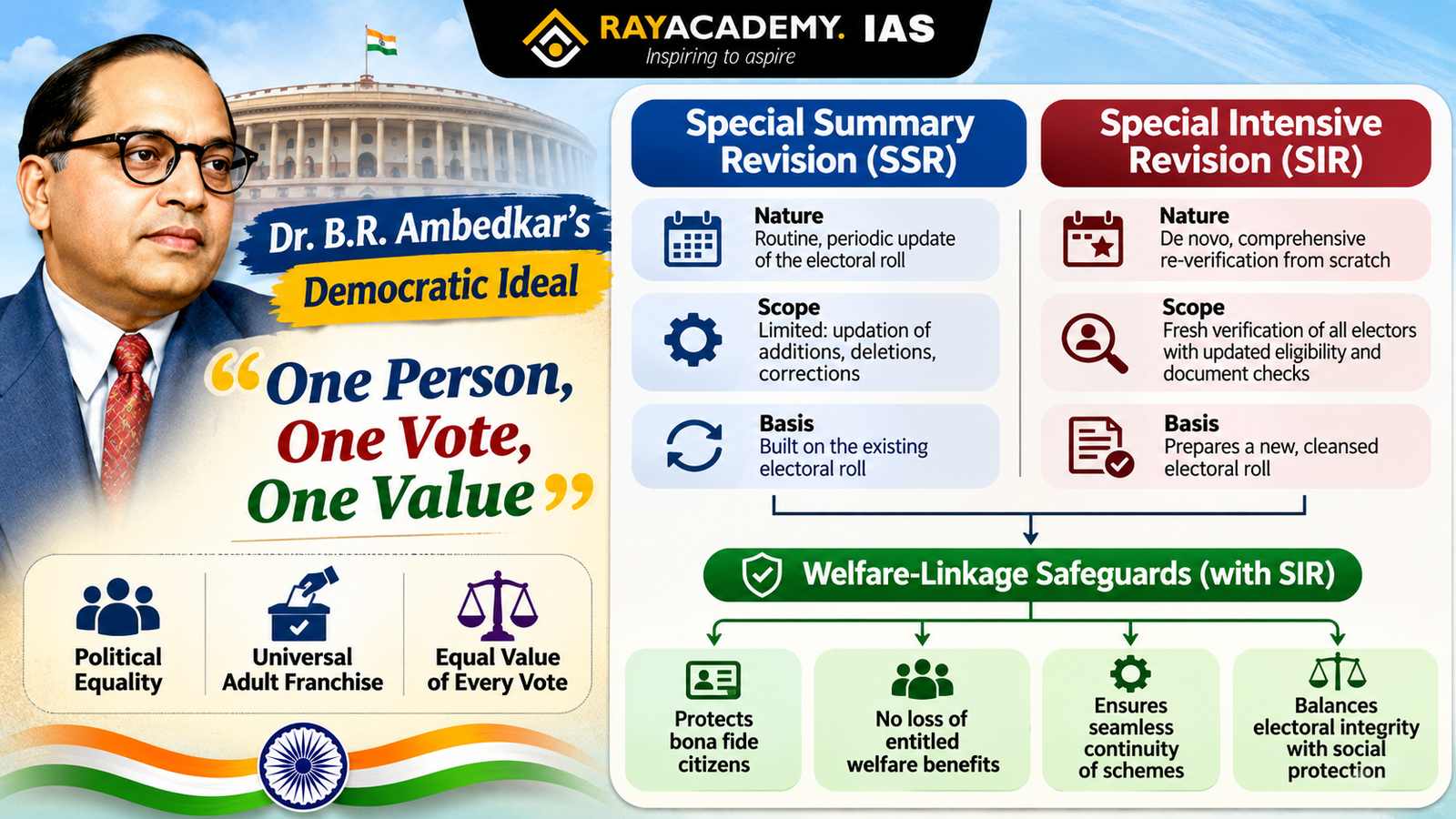
Static-Current Linkage: Constitutional Suffrage, Statutory Rules, and Ambedkar’s "Life of Contradictions"
Understanding the debate around electoral roll purity versus voter exclusion requires connecting Part XV of the Constitution and the Representation of the People Act, 1950 with the foundational philosophy of the Constituent Assembly.
Constitutional Foundations of Political Equality
Article 326 (Universal Adult Suffrage): Mandates that elections to the Lok Sabha and State Legislative Assemblies be conducted on the basis of adult suffrage—every citizen aged 18 years or above (reduced from 21 via the 61st Constitutional Amendment Act, 1988) is entitled to be registered as a voter unless disqualified on grounds of non-residence, unsoundness of mind, crime, or corrupt/illegal practice.
Article 324 (Superintendence, Direction, and Control): Vests the Election Commission of India (ECI) with plenary authority over the preparation and revision of electoral rolls and the conduct of elections.
Article 325 (Non-Discriminatory Electoral Rolls): Prohibits exclusion from a general electoral roll on grounds only of religion, race, caste, or sex.
Statutory Framework: Special Summary Revision (SSR) vs. Special Intensive Revision (SIR)
Under Section 21 of the Representation of the People Act, 1950 and the Registration of Electors Rules, 1960, electoral rolls are maintained through two distinct administrative mechanisms:
Special Summary Revision (SSR): Conducted annually under Rule 25, SSR treats the existing electoral roll as presumptively valid and processes incremental additions (Form 6), deletions (Form 7), and corrections (Form 8) across four qualifying dates (January 1, April 1, July 1, and October 1).
Special Intensive Revision (SIR): Invoked under Section 21(3) for recorded reasons (previously conducted in phases between 1952 and 2004), SIR initiates a de novo house-to-house enumeration by Booth Level Officers (BLOs), requiring electors to submit enumeration forms and documentary verification to establish ordinary residence and citizenship eligibility.
Dr. B.R. Ambedkar’s Warning of November 25, 1949
In his historic closing address to the Constituent Assembly on November 25, 1949, Dr. B.R. Ambedkar cautioned that India was entering a "life of contradictions" on January 26, 1950: recognizing "one man, one vote, and one vote, one value" in political life while retaining stark caste and economic inequalities in social and economic life. He emphasized that constitutional methods remain viable only when democratic channels stay genuinely open and political equality is reinforced by substantive social and economic democracy.
Prelims Focus: High-Yield Objective Facts
Constitutional Body: Election Commission of India (ECI) under Article 324 (currently a three-member body comprising the Chief Election Commissioner and two Election Commissioners).
Governing Statute: Representation of the People Act, 1950 (deals with allocation of seats, delimitation, and preparation/revision of electoral rolls) — distinct from the Representation of the People Act, 1951 (deals with actual conduct of elections, qualifications/disqualifications, and election disputes).
Key Statutory Safeguards:
Rule 21A of the Registration of Electors Rules, 1960: Mandates that an Electoral Registration Officer (ERO) must issue a formal show-cause notice and grant an opportunity of being heard before deleting an existing voter's name.
Section 23(3) of the RPA, 1950: Prohibits any amendment, transposition, or deletion of entries in the electoral roll after the last date for making nominations for an election in that constituency.
Supreme Court Precedents on Electoral Rolls:
Lal Babu Hussein v. Electoral Registration Officer (1995): Held that an enrolled voter enjoys a presumption of validity and cannot be struck off arbitrarily without following principles of natural justice and considering valid identity documents.
Association for Democratic Reforms & Ors. v. Election Commission of India (May 27, 2026): Upheld the ECI’s constitutional and statutory power under Article 324 and Section 21(3) of the RPA, 1950 to conduct SIR, while directing that Aadhaar cards, EPIC, and ration cards be accepted alongside prescribed documents to prevent wrongful exclusion of genuine citizens.
Mains Analytical Breakdown
Administrative & Democratic Significance of Electoral Roll Revision
Eliminating Ghost, Duplicate, and Deceased Entries: Rapid urbanization, interstate migration, and demographic shifts can cause deceased electors and duplicate registrations to persist across constituencies; periodic intensive verification restores electoral roll fidelity and strengthens public trust in the "one person, one vote" principle.
Enrolling First-Time and Relocated Voters: Door-to-door enumeration enables Booth Level Officers (BLOs) and Booth Level Agents (BLAs) nominated by political parties to proactively identify eligible youth turning 18 and newly settled urban residents who often miss voluntary form-based cycles.
Facilitating Electoral Logistics: Accurate voter lists allow the ECI to rationalize polling stations, optimize security deployment, and ensure equitable access on polling day.
Multi-Dimensional Challenges
Social — Disproportionate Burden on Vulnerable Groups: Documentary proof requirements disproportionately affect seasonal migrant workers, women who relocate after marriage, Dalits, Adivasis, and informal-sector labourers, who frequently lack legacy property records or standardized residency certificates.
Economic — Linkage of Voter Rolls with Welfare Entitlements: Using electoral roll deletion as a trigger to suspend Public Distribution System (PDS) rations, food security benefits, or caste certificates—even while statutory appeals remain pending—converts a procedural electoral exercise into acute livelihood deprivation.
Political — Institutional Transparency and Consensus: Reports of internal dissents within the multi-member ECI over operational directives, coupled with compressed revision timelines ahead of State elections, risk eroding institutional credibility and perceptions of electoral neutrality.
Legal & Constitutional — Inversion of Burden of Proof: Shifting from a presumption of validity for enrolled electors to requiring citizens to re-prove citizenship status blurs the boundary between routine electoral registration under the RPA, 1950 and formal citizenship determination under the Citizenship Act, 1955.
Ethical — Procedural Rigidity vs. Substantive Justice: Prioritizing statistical cleanup over individualized verification violates administrative empathy and natural justice, risking the disenfranchisement of bona fide citizens due to clerical gaps or temporary absence during field visits.
Way Forward: Institutional and Legal Reforms
Delink Welfare Entitlements from Electoral Roll Deletions: Union and State governments must issue binding administrative directives strictly separating National Food Security Act (NFSA) ration cards and social welfare databases from electoral roll revisions, ensuring no citizen loses food or pension benefits due to voter-roll adjudication.
Institutionalize the Lal Babu Hussein and ADR (2026) Safeguards: Ensure strict compliance with Rule 21A by mandating individualized written notice, speaking orders for every deletion, and universal acceptance of Aadhaar, EPIC, and ration cards as valid identity/residency proofs without inverting the burden of citizenship proof.
Reform ECI Appointment and Internal Transparency: In line with the Supreme Court’s Anoop Baranwal v. Union of India (2023) principles and the Law Commission of India’s 255th Report on Electoral Reforms, strengthen institutional independence in the appointment of Election Commissioners and publish reasoned minutes of major Commission decisions to reinforce public confidence.
Technology-Assisted Deduplication with Human Safeguards: Utilize demographic and algorithmic deduplication tools strictly as preliminary flags rather than triggers for automated deletion, backed by multilingual awareness camps and mobile facilitation booths for internal migrant workers.
Address Structural Economic Inequality: Realize Dr. Ambedkar’s vision of substantive democracy through progressive fiscal policy, universal quality public education and healthcare, and formalization of labour—bridging the gap between formal political rights and socio-economic capability.
Value Addition Snippet (World Inequality Report 2026 & ECI Data)
Economic Inequality Context (World Inequality Report 2026): The top 10% of earners in India capture nearly 57.7%–58% of national income, whereas the bottom 50% receive only 15%, and the top 1% hold approximately 40.1% of total national wealth. Citing this data in Mains answers powerfully illustrates Dr. Ambedkar’s warning that stark economic concentration undermines equal political agency.
Electoral Revision Scale (ECI Official Data, 2025–26): During Phase I of the SIR in Bihar, the electorate was revised from 7.89 crore to 7.42 crore (with over 68 lakh deletions primarily attributed to death, permanent migration, or duplication, alongside 21.53 lakh new additions), while Phase II across 12 States/UTs covered 50.99 crore electors—underscoring the massive administrative scale of India's democratic machinery.
Active Recall Practice Exercises
Prelims Practice Question (Multi-Statement MCQ)
Q. With reference to the preparation and revision of electoral rolls in India, consider the following statements:
Under Section 21(3) of the Representation of the People Act, 1950, the Election Commission of India is empowered to direct a Special Intensive Revision (SIR) of an electoral roll at any time for reasons to be recorded in writing.
Under the Registration of Electors Rules, 1960, an Electoral Registration Officer can delete an existing voter's name from the electoral roll without issuing a prior show-cause notice if the voter is absent during a single house-to-house visit.
No amendment, transposition, or deletion of any entry in an electoral roll can be made after the last date for making nominations for an election in that constituency.
How many of the statements given above are correct?
(a) Only one
(b) Only two
(c) All three
(d) None
Answer: (b) Only two
Explanation:
Statement 1 is correct: Section 21(3) of the Representation of the People Act, 1950 explicitly empowers the ECI to direct a special revision of the electoral roll for any constituency or part thereof at any time, for reasons to be recorded.
Statement 2 is incorrect: Rule 21A of the Registration of Electors Rules, 1960 mandates that before deleting any name from the electoral roll on grounds of ineligibility or non-residence, the Electoral Registration Officer must issue a formal notice and give the person concerned a reasonable opportunity of being heard.
Statement 3 is correct: Section 23(3) of the Representation of the People Act, 1950 strictly prohibits any direction for amendment, transposition, or deletion of entries in the electoral roll after the last date for making nominations for an election in that constituency and before the completion of that election.
Mains Practice Question (GS Paper II — 150 Words | 10 Marks)
Q. "Electoral roll integrity must not come at the cost of procedural disenfranchisement of vulnerable citizens." Examine the constitutional and administrative challenges associated with Special Intensive Revision (SIR) of electoral rolls in India and suggest safeguards to uphold universal adult suffrage. (150 words)
Model Answer Structure:
Introduction (25 words): Contextualize Article 326 (universal adult suffrage) and Article 324 alongside the ECI’s nationwide Special Intensive Revision (SIR) under Section 21(3) of the Representation of the People Act, 1950.
Body Part 1 – Constitutional & Administrative Challenges (60 words): While SIR targets duplicate and deceased entries, de novo enumeration risks excluding migrant workers, women, Dalits, and Adivasis lacking formal documentation. Highlight risks of inverting the burden of proof (Lal Babu Hussein principle) and linking voter-roll deletions to PDS ration exclusions.
Body Part 2 – Suggested Safeguards (50 words): Strictly enforce Rule 21A notice/hearing norms; accept Aadhaar, EPIC, and ration cards (ADR v. ECI, 2026); delink welfare databases from electoral rolls; and conduct targeted migrant facilitation camps.
Conclusion (15 words): Echo Dr. B.R. Ambedkar’s vision that political equality thrives when procedural fairness protects every citizen's voice.
Take this article with you
Save a reading copy for offline study.


