

Indian Council of Medical Research
On November 23, 2026, the Indian Council of Medical Research (ICMR) and the Department of Health Research (DHR) under the Union Ministry of Health and Family Welfare released key national findings from the Survey for Assessment of Markers of Population Health, Activity, Diet and Anthropometry (SAMPADA) 2023–2025.
UPSC Syllabus Mapping:
General Studies Paper II (Social Justice & Governance): Issues relating to development and management of Social Sector/Services relating to Health, Education, Human Resources; Welfare schemes for vulnerable sections of the population by the State and the performance of these schemes; Issues relating to poverty and hunger.
General Studies Paper III (Science & Technology): Science and Technology—developments and their applications and effects in everyday life; Public health diagnostics, nutritional biochemistry, and epidemiological surveillance.
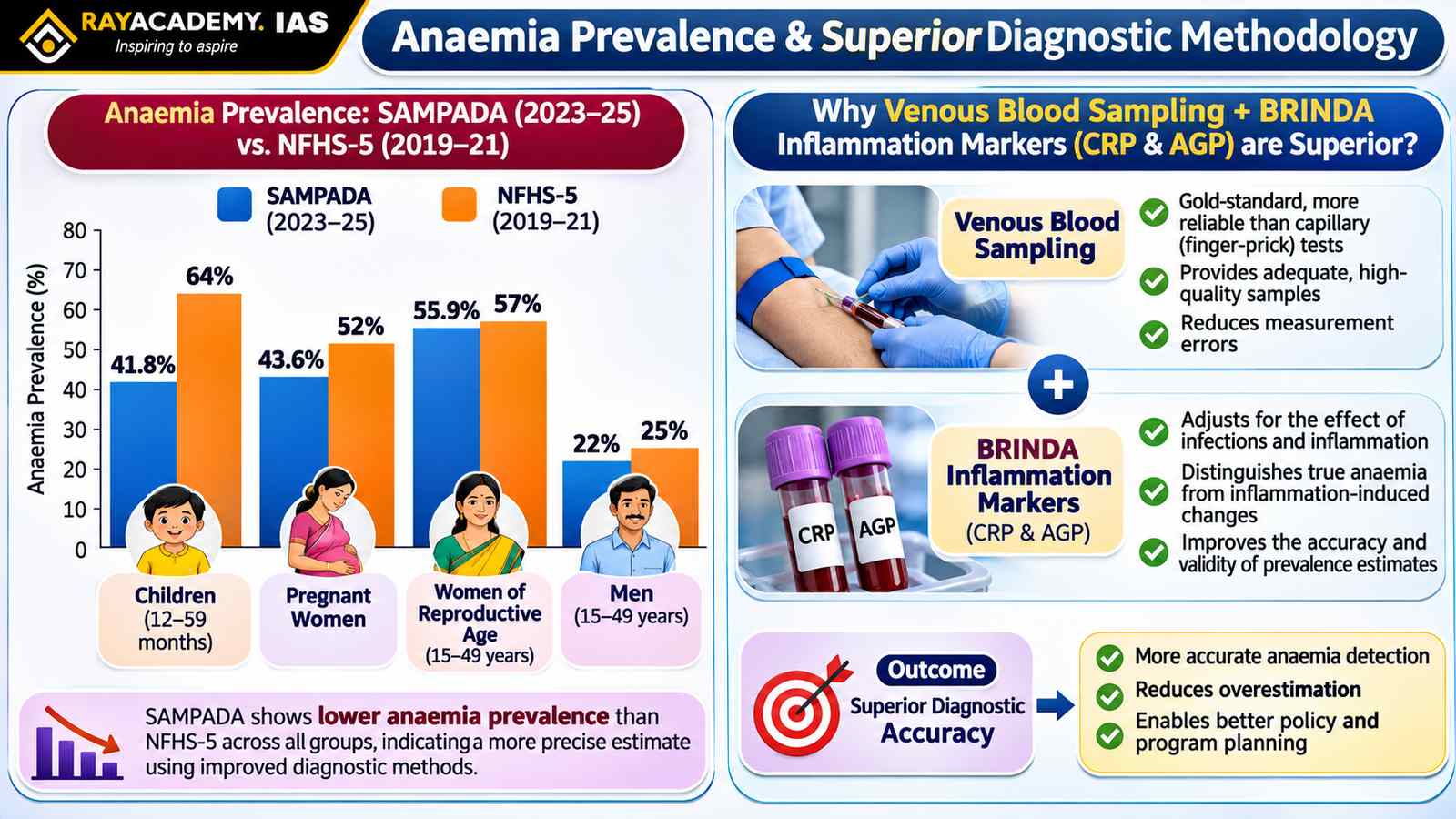
Using the gold-standard venous blood sampling method with automated haematology analysers across over 2 lakh individuals in 183 districts across 35 States and Union Territories, the survey reported a lower overall prevalence of anaemia compared to earlier national surveys such as NFHS-5 (2019–21).
Notably, anaemia among children aged 12–59 months stood at 41.8% (approx. 42%) compared to 64% in NFHS-5, while prevalence among pregnant women dropped to 44% (43.6%) from 52%, marking the first major nationwide biochemical dataset released after haemoglobin testing was dropped from NFHS-6.
Static-Current Linkage: Diagnostic Methodology, Nutritional Science, and Policy Architecture
Interpreting the SAMPADA 2023–2025 anaemia findings requires linking biomedical diagnostics, WHO haemoglobin thresholds, and India’s flagship nutrition programmes.
1. Venous Blood Sampling vs. Capillary Finger-Prick Testing
Why NFHS-6 Dropped Anaemia Testing: Earlier rounds of the National Family Health Survey (NFHS) estimated haemoglobin using capillary blood (finger-prick) samples analysed via portable photometers (HemoCue). Epidemiologists and the Health Ministry noted that capillary drops are prone to dilution by interstitial tissue fluid and operator error, often overestimating anaemia prevalence by 10–15 percentage points.
Gold-Standard Biochemical Precision: SAMPADA (executed with technical leadership from ICMR–National Institute of Nutrition, Hyderabad) utilized venous blood draws analysed on calibrated automated analysers, alongside sub-sample testing for serum ferritin (iron stores), vitamin B12, RBC folate, and inflammatory biomarkers—C-reactive protein (CRP) and alpha-1-acid glycoprotein (AGP)—using the BRINDA (Biomarkers Reflecting Inflammation and Nutritional Determinants of Anaemia) adjustment method.
2. Biological Pathophysiology & WHO Cut-Offs
Clinical Definition: Anaemia is a condition in which the number of red blood cells or their oxygen-carrying haemoglobin (Hb) concentration falls below physiological needs, impairing cognitive development, maternal survival, and economic productivity.
WHO (2024) Haemoglobin Thresholds: Anaemia is diagnosed when Hb falls below 11.0 g/dL in children aged 6–59 months and pregnant women (with a specific 10.5 g/dL threshold in the second trimester), 12.0 g/dL in non-pregnant women, and 13.0 g/dL in adult men.
Multi-Factorial Aetiology: Crucially, SAMPADA found that iron deficiency accounts for only about half of all anaemia cases among women, adolescent girls, and young children—highlighting the role of non-nutritional factors such as chronic inflammation, soil-transmitted helminths (worm infestation), menorrhagia (heavy menstrual bleeding), and inherited haemoglobinopathies (sickle cell disease and thalassaemia).
3. Anaemia Mukt Bharat (AMB) & POSHAN Abhiyaan
6×6×6 Strategy: Launched in 2018 under POSHAN Abhiyaan by the Ministry of Health and Family Welfare, Anaemia Mukt Bharat (AMB) targets six beneficiary groups (children 6–59 months, children 5–9 years, adolescents 10–19 years, women of reproductive age, pregnant women, and lactating women) through six core interventions (including prophylactic Iron and Folic Acid [IFA] supplementation, biannual deworming with Albendazole, digital haemoglobin testing, and fortified foods) supported by six institutional mechanisms.
Prelims Focus: High-Yield Objective Facts
UPSC Prelims Quick-Revision Box:
SAMPADA Survey (2023–2025) & BiomarkersNodal Agency: Conducted by ICMR and Department of Health Research (DHR) (with ICMR–NIN, Hyderabad) under the Ministry of Health and Family Welfare.Sample Coverage: Over 2 lakh individuals across 81,000+ households in 183 districts across 35 States and UTs; over 1.7 lakh blood samples analysed.
Disaggregated Anaemia Prevalence (SAMPADA 2023–25):Lactating women: 58.1%Women of reproductive age (15–49 yrs, NPNL): 55.9% (Women ≥ 60 yrs: 55.7%)Adolescent girls (10–19 yrs): 46.3%; Adolescent boys (10–19 yrs): 22.8%Pregnant women: 43.6%Children (12–59 months): 41.8%; Children (5–9 yrs): 31.3%Adult men (20–59 yrs): 22.0% (Men ≥ 60 yrs: 44.7%)Severity Profile: Majority of cases are mild anaemia; severe anaemia (Hb < 8.0 g/dL) is below 2% across most age groups.Key Biomarkers Assessed: Serum ferritin (iron stores), RBC folate, serum vitamin B12, C-reactive protein (CRP), and alpha-1-acid glycoprotein (AGP).
Mains Analytical Breakdown: Significance vs. Multi-Dimensional Challenges. Anaemia Prevalence
Policy and Public Health Significance
Establishing an Accurate Epidemiological Baseline: By replacing error-prone finger-prick estimates with venous blood sampling and inflammation-adjusted ferritin testing, SAMPADA prevents policy distortion and provides reliable life-course data—including first-ever national estimates for older adults (≥ 60 years).
Reorienting Anaemia Mukt Bharat Toward Precision Targeting: Discovering that severe anaemia is below 2% while mild cases dominate enables public health systems to stratify care—using dietary counselling and fortified staples for mild cases while prioritizing clinical testing and parenteral/oral therapy for moderate-to-severe cases under Anaemia Mukt Bharat 2.0.
Validating Investments in Maternal & Child Health: Substantial reductions in child (41.8%) and pregnancy (43.6%) anaemia reflect cumulative gains from POSHAN 2.0, Swachh Bharat Mission (reducing open defecation and hookworm transmission), and expanded antenatal care.
Multi-Dimensional Challenges
Persistent Burden Among Women & Adolescent Girls (Social & Gender Equity): Despite methodological improvements, nearly 56% of women of reproductive age, 58.1% of lactating women, and 46.3% of adolescent girls remain anaemic—underscoring deep-rooted intra-household nutritional disparities and untreated menorrhagia.
Methodological Non-Comparability Risk (Statistical & Governance): Public health researchers caution that lower SAMPADA figures compared to NFHS-5 partly reflect venous vs. capillary sampling differences rather than purely an overnight biological drop, requiring careful communication so States do not prematurely scale back nutrition funding.
Limitations of a "One-Size-Fits-All" Iron Pill Approach (Scientific & Clinical): Since iron deficiency explains only ~50% of anaemia, indiscriminate IFA distribution fails to resolve non-iron-deficiency anaemia (such as chronic inflammation, haemoglobinopathies, or gastrointestinal blood loss) and can even trigger oxidative stress or gut dysbiosis if unmonitored.
Dietary Inhibitors & Poor IFA Tablet Adherence (Cultural & Behavioural): Staple diets rich in phytates and polyphenols (such as whole wheat in North India and tea consumption with meals) inhibit non-heme iron absorption. Meanwhile, side effects like gastritis, nausea, and constipation, compounded by social myths (e.g., fears that iron tablets make babies overly large or darker-skinned), depress compliance.
Intergenerational Human Capital Drag (Economic): High anaemia prevalence among working-age women and adolescents reduces physical work capacity, impairs cognitive learning outcomes, and elevates maternal and neonatal mortality risks—constraining India’s demographic dividend.
Way Forward: Reform-Oriented Policy Roadmap
Transition to "Test, Treat, and Track" Under Anaemia Mukt Bharat 2.0: Move away from blanket supplementation toward point-of-care digital haemoglobinometers and ferritin/haemoglobinopathy screening at Ayushman Arogya Mandirs, ensuring moderate and severe cases receive targeted clinical treatment and follow-up.
Integrate Reproductive Health & Adolescent Gynaecology Services: Embed screening and management of menorrhagia and menstrual health within the Rashtriya Kishor Swasthya Karyakram (RKSK) so adolescent girls are not socialized to normalize excessive menstrual blood loss.
Promote Bioavailable Dietary Diversification & Food Fortification: In line with ICMR–NIN Dietary Guidelines for Indians and NITI Aayog’s POSHAN 2.0 strategy, pair iron-fortified rice and double-fortified salt with Vitamin C-rich foods (amla, citrus fruits) to overcome phytate inhibition in wheat- and cereal-heavy diets, while discouraging tea/coffee intake around meals.
Intensify Behaviour Change Communication (BCC) & Counselling: Mobilize ASHA workers, Anganwadi workers, and Self-Help Groups (SHGs) to counsel pregnant women on managing mild gastrointestinal side effects of IFA tablets (such as taking tablets after meals) and actively dispel cultural myths surrounding iron supplementation.
Converge WASH, Deworming, and Sickle Cell Elimination Missions: Synchronize National Deworming Day, Jal Jeevan Mission, Swachh Bharat Mission (Grameen), and the National Sickle Cell Anaemia Elimination Mission to tackle infectious and genetic contributors to anaemia holistically.
Value Addition for Mains
Official Biochemical & Survey Benchmark (ICMR SAMPADA 2023–25): Cite that India’s largest venous-blood nutrition survey (>2 lakh participants across 183 districts) recorded severe anaemia below 2% across most age groups, yet found 55.9% of reproductive-age women and 46.3% of adolescent girls still anaemic—with iron deficiency explaining only half of all cases.
Constitutional & Administrative Catchphrase for Mains Conclusions: "Fulfilling Article 47’s constitutional mandate to raise nutrition and public health requires shifting from universal iron pill distribution to precision diagnostics, dietary bioavailability, and gender-sensitive healthcare."
Practice Questions for Active Recall
Prelims Practice MCQ
With reference to the Survey for Assessment of Markers of Population Health, Activity, Diet and Anthropometry (SAMPADA) 2023–2025, consider the following statements:
It was conducted by the Indian Council of Medical Research (ICMR) and the Department of Health Research using venous blood sampling and automated analysers for haemoglobin estimation.
According to the survey findings, severe anaemia accounts for less than 2% of cases across most age groups, while women of reproductive age continue to record over 50% anaemia prevalence.
The survey established that iron deficiency is responsible for over 90% of all anaemia cases among women and children in India.
Which of the statements given above are correct?
(a) 1 and 2 only
(b) 2 and 3 only
(c) 1 and 3 only
(d) 1, 2, and 3
Correct Answer: (a) 1 and 2 only
Explanation:
Statement 1 is correct: SAMPADA (2023–2025) was conducted by ICMR and the Department of Health Research (DHR) using gold-standard venous blood sampling and automated analysers across 183 districts.
Statement 2 is correct: Severe anaemia was found to be below 2% in most age groups, whereas women of reproductive age (15–49 years) recorded 55.9% anaemia prevalence.
Statement 3 is incorrect: SAMPADA revealed that iron deficiency explains only about half (~50%) of anaemia cases among women, adolescent girls, and children—underscoring the significant role of non-iron factors such as inflammation, infections, and genetic blood disorders.
Mains Practice Question (GS Paper II — 150 Words | 10 Marks)
"While ICMR’s SAMPADA (2023–2025) survey indicates a lower overall prevalence of anaemia than earlier estimates, persistent anaemia among women and the finding that iron deficiency explains only half of all cases call for a paradigm shift in policy." Discuss.
Answer Structure Hints:
Introduction: Contextualize ICMR’s SAMPADA 2023–2025 survey, which used venous blood sampling across >2 lakh individuals and reported reduced child (41.8%) and pregnancy (43.6%) anaemia, with severe cases below 2%.
Body Part 1 (Why Paradigm Shift is Needed): Highlight that 55.9% of reproductive-age women and 46.3% of adolescent girls remain anaemic; explain that venous vs. capillary testing accounts for part of the statistical drop; and emphasize that iron deficiency causes only ~50% of cases (alongside inflammation, worm infestation, menorrhagia, and phytate-rich diets).
Body Part 2 (Policy Reforms Needed): Advocate transitioning Anaemia Mukt Bharat to a "Test, Treat, and Track" model using digital diagnostics and ferritin screening, integrating adolescent menstrual health care, promoting Vitamin C-paired dietary diversification and food fortification, and intensifying ASHA/SHG behaviour-change counselling to overcome myths and side effects.
Conclusion: Conclude with Article 47 and POSHAN 2.0, emphasizing precision public health and gender-equitable nutrition governance.
Take this article with you
Save a reading copy for offline study.


