

Caste Enumeration
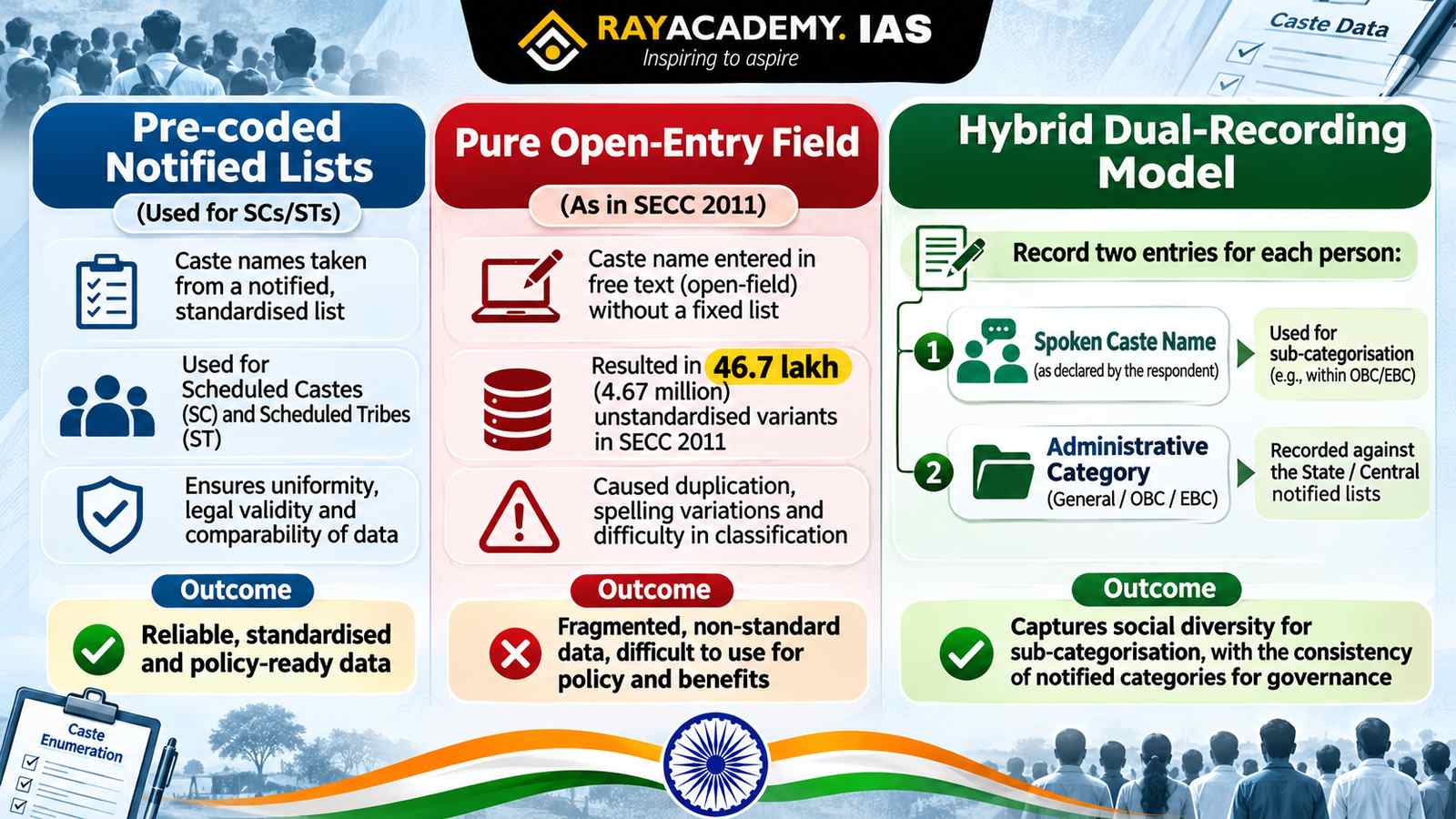
Ahead of the Population Enumeration phase of Census 2027 (scheduled across most of India in February 2027), intense policy and legal debate has emerged over the methodology notified for caste enumeration. Under Question 10 ("SC/ST/Caste") of the notified Population Enumeration schedule, while Scheduled Castes (SCs) and Scheduled Tribes (STs) will be recorded against official notified lists as in every Census since 1951, all other communities—including Other Backward Classes (OBCs)—will be recorded through an open-entry text field without a pre-coded drop-down list.
UPSC Syllabus Mapping:
General Studies Paper I (Indian Society): Salient features of Indian Society, Diversity of India; Social empowerment, communalism, regionalism & secularism; Population and associated issues.
General Studies Paper II (Polity & Social Justice): Indian Constitution—historical underpinnings, evolution, features, amendments, significant provisions and basic structure (Articles 15, 16, 340, 341, 342, 342A); Welfare schemes for vulnerable sections of the population by the State; Mechanisms, laws, institutions and bodies constituted for the protection and betterment of these vulnerable sections.
On October 28, 2026, the Supreme Court of India declined to entertain a plea seeking a pre-loaded OBC drop-down menu in the digital Census application, holding that the technical design of data collection falls within the executive's policy domain and forwarding the petition to the Registrar General and Census Commissioner of India (RGI) for examination. Experts caution that relying solely on open-ended entries without recording the respondent's administrative category risks repeating the data fragmentation of the 2011 Socio-Economic and Caste Census (SECC).
Static-Current Linkage: Constitutional Provisions, Historical Precedents, and Legal Jurisprudence
Understanding the debate around caste enumeration in Census 2027 requires connecting constitutional mandates on backward classes with India's colonial and post-independence census history.
Constitutional & Statutory Architecture
Legislative Competence & Statutory Authority: Under Entry 69 of the Union List (Seventh Schedule), "Census" is an exclusive Union subject. Every decennial census is conducted under the Census Act, 1948 by the Office of the Registrar General and Census Commissioner of India (RGI) under the Ministry of Home Affairs (MHA). Section 15 of the Census Act, 1948 guarantees statutory confidentiality of individual household records.
Constitutional Provisions for Backward Classes:
Articles 15(4), 15(5), and 16(4): Empower the State to make special provisions and reservations for Socially and Educationally Backward Classes (SEBCs), SCs, and STs.
Articles 341 and 342: Authorize the President to notify State-specific lists of Scheduled Castes and Scheduled Tribes.
Article 340 & Article 342A: Article 340 provides for the appointment of a Commission to investigate the conditions of backward classes (under which the Kalelkar Commission, 1953 and Mandal Commission, 1980 were constituted). Article 342A (inserted by the 102nd Constitutional Amendment Act, 2018 and clarified by the 105th Constitutional Amendment Act, 2021) governs the Central List of SEBCs while preserving the power of States and Union Territories to maintain their own State OBC lists.
Historical Evolution: 1931 Census, Ambedkar’s 1932 Analysis, and SECC 2011
1931 Census & Colonial Categorisation: The 1931 Census was the last decennial census to enumerate caste across the entire Indian population, recording 4,147 castes. In his seminal essay From Millions to Fractions, Dr. B.R. Ambedkar documented how shifting definitional criteria before the 1932 Indian Franchise Committee (Lothian Committee) artificially shrank the enumerated population of the "Depressed Classes" in provinces like Bengal and the United Provinces—demonstrating that categorisation methodology directly shapes political representation and welfare.
Constituent Assembly Distinction ("Classes" vs. "Castes"): During Constituent Assembly debates on August 23, 1949, M. Ananthasayanam Ayyangar and Dr. Ambedkar clarified that the phrase "backward classes" was deliberately chosen over "communities" because social and educational backwardness varies region by region and is not determined by birth alone. Consequently, Central and State OBC lists contain nearly 3,000 occupational and regional entries—including non-caste categories such as "local borns" in the Andaman and Nicobar Islands and tea-garden workers in Assam—making a single uniform national caste drop-down menu administratively complex.
SECC 2011 Failure: Conducted outside the Census Act, 1948, the SECC 2011 used an open-ended question that returned 46.7 lakh distinct caste names due to phonetic spelling variations (e.g., Yadav, Yadava, Yaduvanshi), sub-castes, gotras, and surnames—rendering the raw caste data unusable for policymaking and preventing its official release.
Landmark Supreme Court Rulings Driving Data Needs
Indra Sawhney v. Union of India (1992): Upheld 27% OBC reservation, mandated exclusion of the creamy layer, and affirmed the 50% ceiling on vertical reservations unless extraordinary circumstances exist.
State of Punjab v. Davinder Singh (2024): A seven-judge Constitution Bench overruled E.V. Chinnaiah (2004) and permitted States to sub-classify Scheduled Castes based on empirical data showing graded intra-group backwardness.
Prelims Focus: High-Yield Objective Facts
Nodal Authority: Office of the Registrar General and Census Commissioner of India (RGI), functioning under the Ministry of Home Affairs (MHA).
Census 2027 Key Facts:
16th National Census of India (and 8th since Independence); first fully digital Census with mobile app enumeration and an optional online Self-Enumeration Portal.
Two-Phase Schedule: Phase I (Houselisting and Housing Census, April–September 2026) and Phase II (Population Enumeration, February 2027, with reference date March 1, 2027, and October 1, 2026 for snow-bound areas).
Caste Question: Question 10 of the Phase II Population Enumeration schedule records SC/ST status against notified lists and other castes via respondent declaration.
Key Commissions & Surveys:
Mandal Commission (Second Backward Classes Commission, 1980): Identified 3,743 castes and communities as Socially and Educationally Backward Classes using 1931 Census projections.
Justice G. Rohini Commission (2017–2023): Constituted under Article 340 to examine the sub-categorisation of Central List OBCs for equitable distribution of reservation benefits.
Recent State-Level Caste Surveys: Conducted by Bihar (2023) (reporting 63% OBC/EBC share), Telangana (2024–25) (reporting 56.33% backward classes), and Karnataka using pre-coded lists.
Mains Analytical Breakdown
Significance of Accurate Caste Enumeration in Census 2027
Evidence-Based Affirmative Action & Sub-Categorisation: Linking caste data with educational attainment, occupation, and household assets provides the empirical foundation required to implement Justice Rohini Commission recommendations on OBC sub-categorisation and the Supreme Court's SC sub-classification mandate (Davinder Singh, 2024).
Rationalising Creamy Layer and Welfare Targeting: Granular socio-economic indicators enable policymakers to periodically revise creamy layer income/status thresholds and design targeted scholarships, skill missions, and credit schemes for Most Backward Classes (MBCs) and De-notified, Nomadic, and Semi-Nomadic Tribes (DNTs).
Statutory Legitimacy and Pan-India Uniformity: Unlike fragmented State surveys—some of which faced judicial scrutiny over legislative competence—enumeration under the Census Act, 1948 carries indisputable legal validity and nationwide comparability.
Multi-Dimensional Challenges
Administrative & Technical — Risk of Data Fragmentation from Open Entries: Recording caste purely as spoken text without capturing the respondent's administrative category (General, OBC, EBC) risks recreating the SECC 2011 bottleneck, where post-enumeration dictionary matching could not distinguish communities that share a surname across different reservation categories or States.
Federal — Divergence Between Central and State OBC Lists: A single caste may be listed as an OBC in one State, a General category group in a neighbouring State, or included in a State OBC list but excluded from the Central OBC List—making post-hoc classification without state-specific contextual markers highly error-prone.
Social — Reification of Caste Identities vs. Social Cohesion: Sociologists and critics warn that official enumeration can harden caste consciousness and trigger competitive political mobilisation for quota expansion, potentially slowing progress toward Dr. Ambedkar’s constitutional ideal of the annihilation of caste and social harmony (samajik samrasta).
Governance & Legal — Self-Declaration vs. Documentary Verification: Because Census data relies on respondent self-declaration rather than verification of statutory caste certificates, treating raw Census returns directly as proof of reservation eligibility without institutional cross-checks could invite litigation under Article 14.
Ethical & Privacy — Data Protection and Enumerator Bias: Collecting sensitive identity markers alongside Aadhaar and household asset data demands strict adherence to Section 15 of the Census Act, 1948 and the Digital Personal Data Protection (DPDP) Act, 2023, alongside rigorous training to prevent enumerator transcription bias.
Way Forward: Policy and Institutional Roadmap
Adopt a Hybrid Dual-Entry Enumeration Protocol: As recommended by demographic researchers, the RGI should configure the digital Census app to record both the respondent's spoken caste/sub-caste name (preserving granularity for sub-categorisation) and their self-reported administrative category (SC, ST, OBC, or General) mapped to State-specific notified schedules.
Deploy Pre-Validated State-Wise Code Directories: Rather than relying solely on post-enumeration cleanup, integrate State-specific phonetic auto-suggest code directories (drawn from Central and State OBC Commissions and the Anthropological Survey of India’s People of India database) into the enumerator tablet to minimize spelling distortions at the point of entry.
Publish Cross-Tabulated Deprivation Indicators: In line with NITI Aayog’s Multidimensional Poverty Index (MPI) framework, release Census 2027 caste findings cross-tabulated with literacy, higher education, formal employment, landholding, and housing quality—ensuring data drives developmental mobility rather than mere headcount politics.
Institutionalise Periodic Review Mechanisms: Establish a permanent, independent statutory commission under Article 340 to periodically review inclusion, exclusion, and creamy layer criteria based on decennial Census data, fulfilling the judicial mandate in Indra Sawhney (1992).
Strengthen Enumerator Training and Public Awareness: Conduct intensive vernacular training for enumerators and run public awareness campaigns clarifying that Census reporting is strictly confidential under the Census Act, 1948 and distinct from individual caste-certificate issuance.
Value Addition Snippet (Official Historical & Contemporary Benchmarks)
SECC 2011 vs. 1931 Census Benchmark: While the 1931 Census recorded 4,147 castes using structured colonial schedules, the open-ended SECC 2011 generated 46,73,034 (46.7 lakh) raw caste entries—a more than 1,100-fold inflation caused by unstandardized spellings, sub-castes, and clan names.
OBC List Complexity: Across India, Central and State OBC lists encompass roughly 3,000 notified castes and backward communities (up from 3,743 entries identified by the Mandal Commission in 1980 before subsequent revisions and state reorganisations).
Administrative Catchphrase for GS-1 & GS-2: "India must count caste with statistical precision not to perpetuate social hierarchy, but to measure and dismantle structural inequality."
Active Recall Practice Exercises
Prelims Practice Question (Multi-Statement MCQ)
Q. With reference to the Population Census and caste enumeration in India, consider the following statements:
Every decennial Population Census in India since 1951 has been conducted under the Census Act, 1948 by the Office of the Registrar General and Census Commissioner of India under the Ministry of Home Affairs.
The Socio-Economic and Caste Census (SECC), 2011 was conducted as an integral part of the statutory decennial Census under the Census Act, 1948.
Under Article 342A of the Constitution of India, State Governments are empowered to prepare and maintain their own lists of Socially and Educationally Backward Classes (SEBCs) for their own purposes.
How many of the statements given above are correct?
(a) Only one
(b) Only two
(c) All three
(d) None
Correct Answer: (b) Only two
Explanation:
Statement 1 is correct: "Census" falls under Entry 69 of the Union List, and every decennial census since 1951 is governed by the Census Act, 1948, administered by the Registrar General and Census Commissioner of India (RGI) under the Ministry of Home Affairs.
Statement 2 is incorrect: The SECC 2011 was conducted separately outside the Census Act, 1948 through an executive order—coordinated by the Ministry of Rural Development (rural areas) and the Ministry of Housing and Urban Poverty Alleviation (urban areas)—which is why its data lacked the statutory confidentiality and standardization of the decennial Census.
Statement 3 is correct: Following the 105th Constitutional Amendment Act, 2021, Article 342A(3) explicitly empowers every State and Union Territory to prepare and maintain its own list of Socially and Educationally Backward Classes (SEBCs), which may differ from the Central List.
Mains Practice Question (GS Paper I / GS Paper II — 150 Words | 10 Marks)
Q. "While caste enumeration in Census 2027 is vital for evidence-based social justice, its policy utility depends critically on how data is categorized and recorded." Discuss the methodological challenges of open-entry caste enumeration and suggest reforms to ensure reliable data for affirmative action. (150 words)
Model Answer Structure:
Introduction (25 words): Contextualize Census 2027—India’s first full caste count since 1931 under the Census Act, 1948—and the debate over its open-entry caste question for non-SC/ST communities.
Body Part 1 – Methodological Challenges (60 words): Cite the SECC 2011 precedent, where unstandardized open entries yielded 46.7 lakh caste names due to spelling variants, sub-castes, and surnames. Explain how divergence between Central and State OBC lists (nearly 3,000 entries) makes post-enumeration classification error-prone without recording administrative categories.
Body Part 2 – Suggested Reforms (50 words): Recommend a hybrid dual-entry protocol capturing both spoken caste names (for OBC/SC sub-categorisation under Rohini Commission and Davinder Singh frameworks) and State-mapped administrative categories, supported by pre-validated phonetic directories and cross-tabulated socio-economic indicators.
Conclusion (15 words): Conclude that rigorous statistical design transforms caste data into an instrument for substantive equality.
Take this article with you
Save a reading copy for offline study.


