

Tamil Nadu’s industrial water challenge
The sustainability of Tamil Nadu’s industrial water challenge has come under sharp policy focus after NITI Aayog’s Investment Friendliness Index (IFI) (released in July 2026) ranked the State third nationally—behind Gujarat and Maharashtra—while explicitly flagging inadequate industrial water supply in landlocked and rain-shadow districts as a major infrastructure bottleneck.
UPSC Syllabus Mapping:
General Studies Paper I (Geography): Distribution of key natural resources across the world (including South Asia and the Indian subcontinent); factors responsible for the location of primary, secondary, and tertiary sector industries in various parts of the world (including India).
General Studies Paper III (Economy & Environment): Indian Economy and issues relating to planning, mobilization of resources, growth, development and employment; Conservation, environmental pollution and degradation, environmental impact assessment.
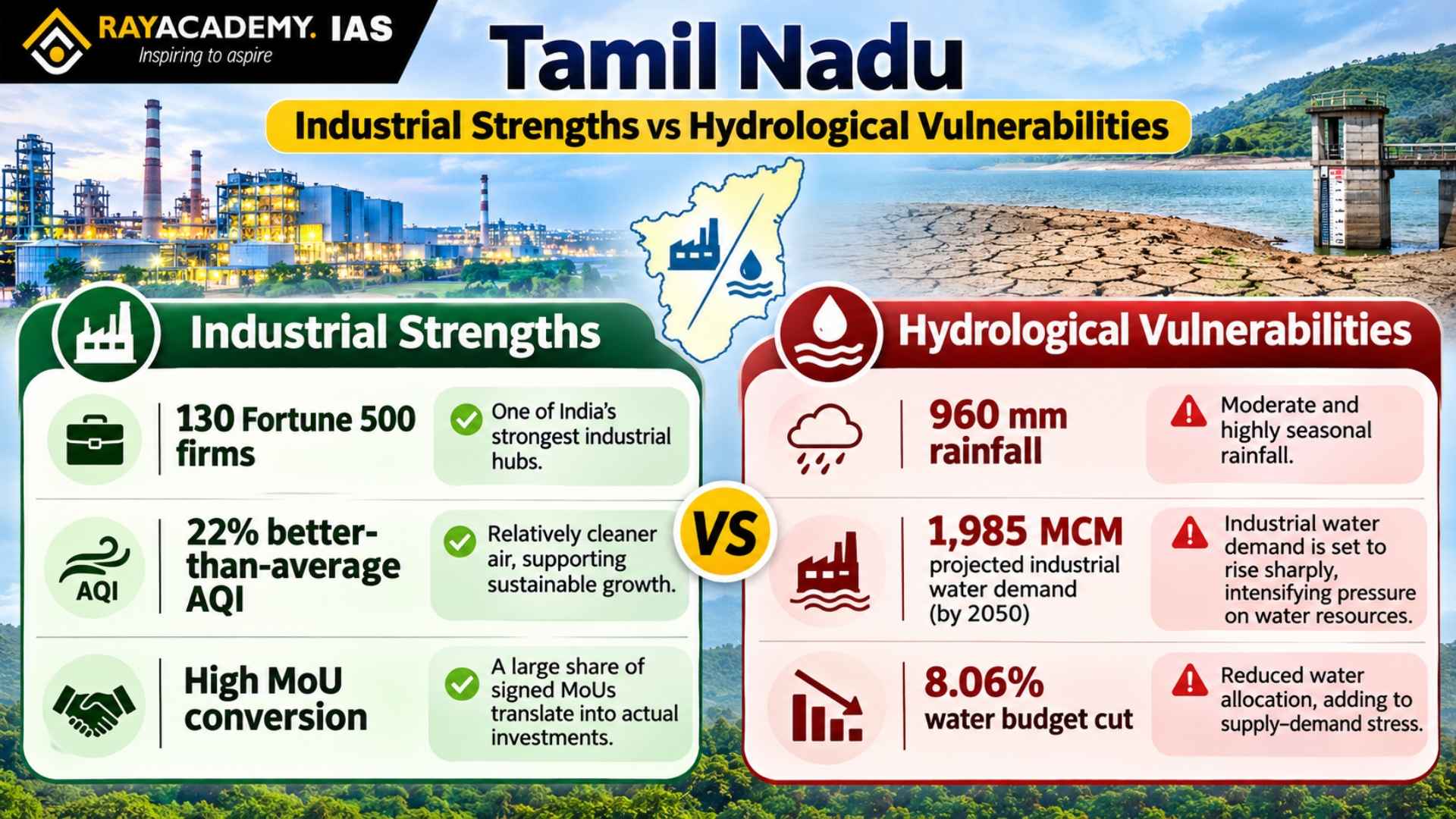
Despite attracting a peak $3.681 billion in Foreign Direct Investment (FDI) in 2024–25 and housing 130 Global Fortune 500 companies across 110 industrial parks, Tamil Nadu accounts for only 3% of India’s water resources. Compounding this structural deficit, the State's Water Resources Department faced an 8.06% budget cut (from ₹10,076 crore to ₹9,264 crore), while the comprehensive Tamil Nadu Water Resources (Regulation, Management and Augmentation) Bill, 2026—passed by the Legislative Assembly in January 2026—still awaits gubernatorial assent.
Static-Current Linkage: Monsoon Geography, Constitutional Federalism, and Water Governance
Understanding how water scarcity constrains industrial siting requires linking physical geography with constitutional water jurisprudence and environmental statutes.
Rain-Shadow Geography and Hydrological Limits
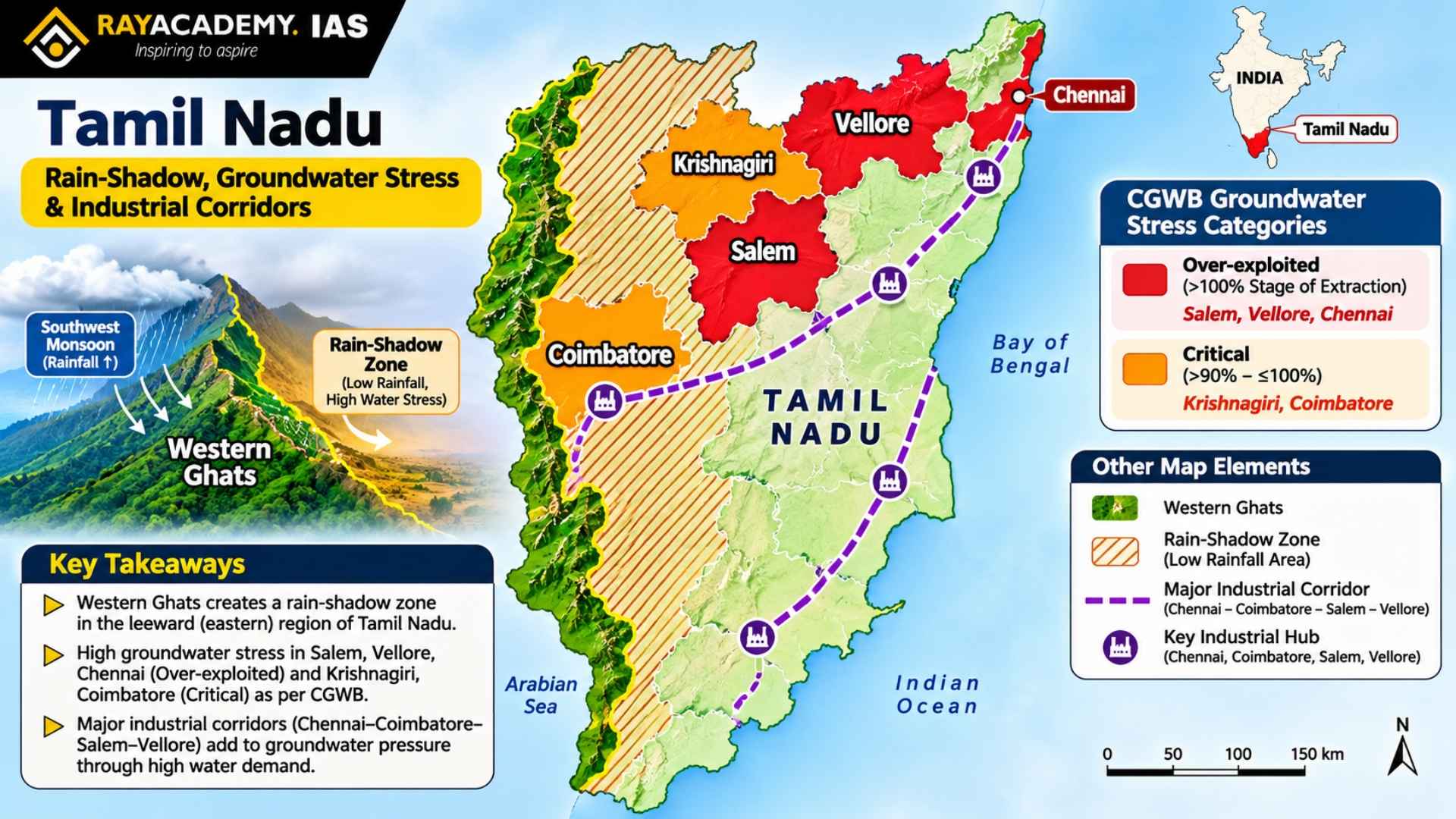
Unlike most of peninsular India, which receives bulk precipitation from the Southwest Monsoon, Tamil Nadu lies predominantly in the rain-shadow region of the Western Ghats. It relies heavily on the Northeast Monsoon (October–December), receiving an average annual rainfall of just 960 mm.
With a surface water potential of 853 TMC (thousand million cubic feet) across 17 major river basins—and an average runoff to the sea of 177.12 TMC—the State's economy has structurally outgrown its natural hydrological reserves. Furthermore, upstream inter-State riparian dependencies (such as the Cauvery basin) and a decadal discharge decline of 4.352 billion cubic metres (BCM) between 2011 and 2021 heighten supply volatility. Tamil Nadu’s Industrial Water Challenge
Constitutional Division of Water and Statutory Frameworks . Tamil Nadu’s Industrial Water Challenge
Seventh Schedule Demarcation: Under Entry 17 of the State List (List II), water supplies, irrigation, canals, drainage, and water storage fall under State jurisdiction, subject to Entry 56 of the Union List (List I), which empowers Parliament to regulate inter-State rivers and river valleys in the public interest.
Article 262: Provides for the adjudication of disputes relating to waters of inter-State rivers or river valleys.
Water (Prevention and Control of Pollution) Act, 1974: Empowers the Central Pollution Control Board (CPCB) and State Pollution Control Boards (SPCBs) to regulate industrial effluent discharge and issue closure orders against polluting units—such as the 28 western Tamil Nadu industries shut down in June 2026.
Gubernatorial Assent (Article 200): Following the repeal of the Tamil Nadu Groundwater (Development and Management) Act in 2013, the State operated in a regulatory vacuum for over a decade. The newly passed Tamil Nadu Water Resources Bill, 2026 seeks to establish the Tamil Nadu Water Resources Management Authority (TNWRMA) under an Integrated Water Resources Management (IWRM) framework, but its operationalization remains stalled pending the Governor’s assent under Article 200.
             TAMIL NADU'S INDUSTRIAL-HYDROLOGICAL PARADOX
   ┌──────────────────────────────────────────────────────────────┐
   │ Economic Strength: 3rd on NITI Aayog IFI; $3.681B FDI;       │
   │ 130 Fortune 500 firms; 42+ operational SEZs                  │
   └──────────────────────────────┬───────────────────────────────┘
                                  ▼
   ┌──────────────────────────────────────────────────────────────┐
   │ Hydrological Deficit: Only 3% of India's water; 960 mm rain; │
   │ Rain-shadow geography; 73.5% overall groundwater extraction  │
   └──────────────────────────────┬───────────────────────────────┘
                                  ▼
   ┌──────────────────────────────────────────────────────────────┐
   │ Governance & Legal Bottlenecks: 2013 Groundwater Act repealed│
   │ 2026 Water Bill awaiting assent; 8.06% water budget cut      │
   └──────────────────────────────┬───────────────────────────────┘
                                  ▼
   ┌──────────────────────────────────────────────────────────────┐
   │ Emerging Investment Risk: Capital flight to rival rain-shadow│
   │ hubs (e.g., Royal Enfield expanding into Rayalaseema, AP)    │
   └──────────────────────────────────────────────────────────────┘
Prelims Focus: High-Yield Objective Facts
Parameter / Institution | Key Facts & Specifications for UPSC Prelims |
Investment Friendliness Index (IFI) | Released by NITI Aayog in July 2026; evaluates States/UTs across 8 pillars. Top 3 States: 1. Gujarat, 2. Maharashtra, 3. Tamil Nadu. |
CGWB Groundwater Categorization | Central Ground Water Board (CGWB) (under Ministry of Jal Shakti) classifies assessment units based on Stage of Extraction: |
Mains Analytical Breakdown
Significance of Water Security for Industrial Competitiveness
Sustaining Decentralised Manufacturing: Unlike states reliant on a single metropolitan hub, Tamil Nadu’s industrial ecosystem—spanning textiles, automobiles, electronics, and power—is spread across 110 industrial parks and over 42 Special Economic Zones (SEZs). Predictable water infrastructure is indispensable to keep interior clusters viable.
Protecting FDI Momentum and Employment: While national FDI declined between 2022–23 and 2023–24 (from $46.03 billion to $44.42 billion), Tamil Nadu’s FDI inflows accelerated to $3.681 billion in 2024–25. Securing industrial water safeguards job creation and strengthens Make in India supply chains.
Adapting to Modern ESG Investment Criteria: Contemporary global capital evaluates environmental, social, and governance (ESG) risks before committing funds. Reliable recycled water and clean river basins act as decisive comparative advantages in attracting green manufacturing.
Multi-Dimensional Challenges
Economic & Fiscal Strain: Industrial water demand in Tamil Nadu is projected to surge from 1,555 MCM (2001) to 1,985 MCM by 2050. Paradoxically, public capital expenditure for the Water Resources Department fell by 8.06% (to ₹9,264 crore), widening the infrastructure deficit. Furthermore, high capital and energy costs make Zero Liquid Discharge (ZLD) systems financially burdensome for Micro, Small, and Medium Enterprises (MSMEs).
Geographical & Spatial Asymmetry: While the statewide groundwater extraction average stands at 73.5%, major manufacturing hubs face acute localized depletion—with Salem, Vellore, and Chennai classified as over-exploited and Krishnagiri and Coimbatore in the critical category. Landlocked interior districts also lack cost-effective access to coastal seawater desalination.
Environmental & Ecological Degradation: Western Tamil Nadu is simultaneously an industrial powerhouse and a hotspot of river pollution. Unchecked industrial effluents degrade surface water bodies, harm agrarian livelihoods, and erode the very ecological base that sustains urban-industrial centers.
Legal & Institutional Vacuum: The 13-year regulatory gap following the 2013 repeal of the State’s groundwater law has enabled unregulated extraction. Delays in enacting the Tamil Nadu Water Resources Bill, 2026 perpetuate fragmented governance across municipal, industrial, and agricultural departments.
Inter-State Competitive Risks: Water constraints are already influencing corporate siting decisions. Royal Enfield’s decision to establish its first manufacturing plant outside Tamil Nadu since 1955 in Rayalaseema, Andhra Pradesh—another rain-shadow belt that invested heavily in water transformation—illustrates how water governance directly shapes regional industrial competitiveness.
Way Forward
Treat Water as Core Industrial Infrastructure: Following NITI Aayog’s Composite Water Management Index (CWMI) framework, State industrial promotion agencies (such as SIPCOT) must integrate water supply, tertiary sewage treatment, and recycling networks into the foundational master planning of every new industrial park rather than treating water as an infinite free good.
Implement Differential, Availability-Linked Water Pricing: Industrial water tariffs should be calibrated to local hydrological stress—charging higher rates in over-exploited interior blocks while incentivizing water-use efficiency per unit of output. Revenues generated should be ring-fenced for local aquifer recharge and tank restoration.
Pair Green Energy with ZLD and Desalination: To overcome the high energy cost of Zero Liquid Discharge (ZLD), coastal desalination, and tertiary wastewater treatment, the State should subsidize dedicated renewable energy (solar/wind) wheeling for Common Effluent Treatment Plants (CETPs), reducing compliance burdens on smaller MSME clusters.
Expedite Statutory Water Governance: Enacting the pending Tamil Nadu Water Resources (Regulation, Management and Augmentation) Bill, 2026 is critical to operationalize Integrated Water Resources Management (IWRM), enforce smart telemetry metering on bulk extractors, and harmonize surface and groundwater regulation.
Adopt Circular Urban-Industrial Water Symbiosis: As advocated by the Mihir Shah Committee Report on Water Reforms, rapidly urbanizing industrial corridors must mandate the reuse of treated municipal sewage for non-potable industrial cooling and processing, freeing up freshwater reserves for drinking and agriculture.
Value Addition for Mains
Historical Administrative Wisdom: As early as the 19th century, John Sullivan, Member of the Governor’s Council overseeing irrigation in the Madras Presidency, warned: "So long as one drop of water is allowed to run waste … we must take the blame to ourselves for not taking our best efforts to prevent the evils of scarcity and famine"—a principle directly applicable to modern industrial wastewater recovery and runoff capture.
National Water Policy & Supreme Court Jurisprudence: Under the Public Trust Doctrine affirmed by the Supreme Court in M.C. Mehta v. Kamal Nath (1997) and State of West Bengal v. Kesoram Industries (2004), the State holds groundwater and river systems as a trustee for the public, prioritizing drinking water and ecological sustenance while regulating commercial extraction sustainably.
Practice Questions for Active Recall
Prelims Practice MCQ
With reference to groundwater assessment and water governance in India, consider the following statements:
According to the Central Ground Water Board (CGWB), an assessment unit is categorized as "Over-Exploited" when its annual groundwater extraction exceeds 100% of the annual extractable groundwater resource.
Under the Seventh Schedule of the Constitution of India, water supplies, irrigation, and water storage fall under the Concurrent List.
Zero Liquid Discharge (ZLD) systems aim to recover industrial wastewater for reuse while eliminating liquid effluent discharge into surface water bodies.
Which of the statements given above are correct?
(a) 1 and 2 only
(b) 2 and 3 only
(c) 1 and 3 only
(d) 1, 2, and 3
Correct Answer: (c) 1 and 3 only
Explanation:
Statement 1 is correct: The CGWB classifies assessment units with a Stage of Ground Water Extraction above 100% as Over-Exploited and those above 90% up to 100% as Critical.
Statement 2 is incorrect: Water supplies, irrigation, canals, drainage, and storage fall under Entry 17 of the State List (List II), subject to Parliament's power over inter-State rivers under Entry 56 of the Union List.
Statement 3 is correct: Zero Liquid Discharge (ZLD) is a closed-loop wastewater treatment process (widely deployed in Tiruppur textile clusters) that recovers up to 90% of water for industrial reuse and prevents river pollution.
Mains Practice Question (GS Paper III — 150 Words | 10 Marks)
"Water must be planned, priced, and governed as core industrial infrastructure rather than treated as an unlimited natural resource." Discuss this statement in the context of rising industrial water stress in India’s rain-shadow manufacturing hubs.
Answer Structure Hints:
Introduction: Contextualize the tension between rapid industrialization and hydrological limits—citing Tamil Nadu’s 3rd rank on NITI Aayog’s Investment Friendliness Index (2026) alongside its 3% share of national water resources and rain-shadow geography.
Body Part 1 (Why Water is Core Infrastructure): Explain how localized groundwater over-exploitation (e.g., Salem, Vellore, Coimbatore), projected industrial demand growth (to 1,985 MCM by 2050), and river pollution inflate operational costs and trigger investment flight (e.g., expansion into Rayalaseema).
Body Part 2 (Policy & Governance Levers): Recommend availability-linked industrial water pricing, integrating green energy to subsidize Zero Liquid Discharge (ZLD) and desalination for MSMEs, reusing treated municipal sewage, and enforcing statutory water regulation.
Conclusion: Conclude with the Public Trust Doctrine and Integrated Water Resources Management (IWRM), emphasizing that long-term industrial competitiveness depends on ecological resilience.
Take this article with you
Save a reading copy for offline study.


