

Madhu Babu Pension Yojana (MBPY) Expansion and Quota Abolition
The social security landscape in Odisha witnessed a major institutional reform with the state government announcing the end of the quota-based system under the Madhu Babu Pension Yojana (MBPY). Under the previous system, newly eligible destitute applicants were often forced to wait for an existing beneficiary to pass away or be removed before securing an approved pension slot.
OPSC Syllabus Mapping: General Studies Paper II (Governance & Social Justice) — Welfare schemes for vulnerable sections of the population by the State and the performance of these schemes; Mechanisms, laws, institutions and bodies constituted for the protection and betterment of these vulnerable sections; Issues relating to poverty and hunger; Digital governance applications, models, successes, limitations, and potential.
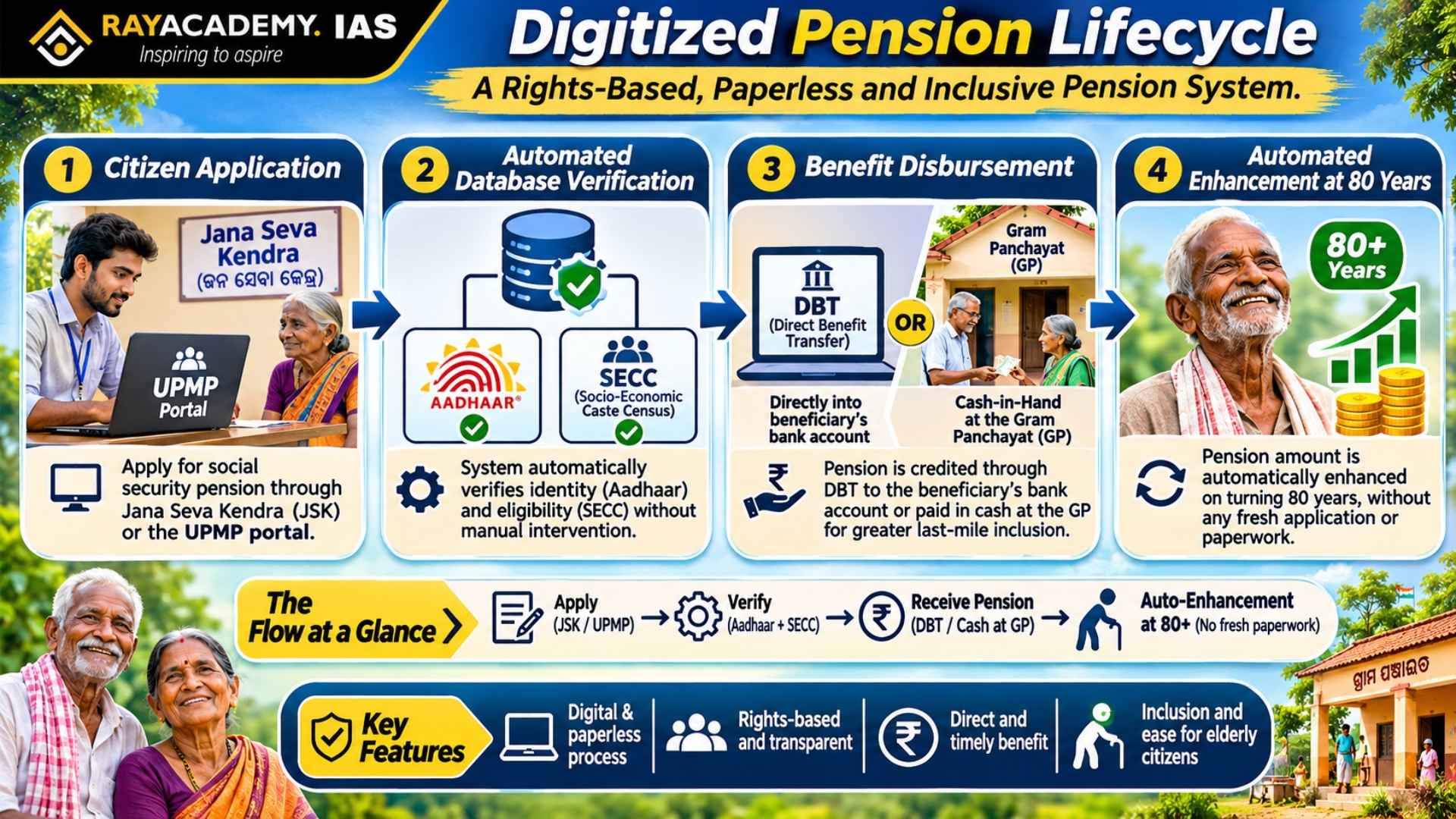
At a state-level event in Baleshwar, Chief Minister Mohan Charan Majhi inducted over 5.05 lakh new beneficiaries into the scheme, expanding the total coverage to 41.8 lakh beneficiaries and claiming complete saturation. The expansion entails an additional annual state exchequer commitment of ₹625 crore. Simultaneously, the state launched the Unified Pension Management Portal (UPMP) to digitize beneficiary registration, biometric verification, and automated lifecycle upgrades (such as increasing pensions to ₹3,500 automatically upon turning 80 years old). Madhu Babu Pension Yojana (MBPY) Expansion and Quota Abolition
Static-Current Linkage: Directive Principles, Rights-Based Welfare, and Digital Social Assistance
For OPSC aspirants, this policy shift connects statutory welfare architecture with constitutional mandates, rights-based jurisprudential evolutions, and public finance management.
Constitutional Mandate: The Welfare State and Article 41
The conceptual bedrock of non-contributory social pensions lies in Part IV of the Indian Constitution:
Article 41 (Directive Principles of State Policy): Mandates that the State shall, within the limits of its economic capacity and development, make effective provision for securing the right to work, to education and to public assistance in cases of unemployment, old age, sickness and disablement, and in other cases of undeserved want.
Article 21 (Right to Life with Dignity): In landmark rulings such as Francis Coralie Mullin v. Administrator, Union Territory of Delhi (1981) and Kapila Hingorani v. State of Bihar (2003), the Supreme Court ruled that the Right to Life is not mere animal existence; it encompasses basic human dignity, including access to food, shelter, and basic livelihood support for elderly and vulnerable persons unable to fend for themselves.
                         THE PARADIGM SHIFT IN SOCIAL WELFARE
   ┌────────────────────────────────────────────────────────────────────────┐
   │ Old Bureaucratic Discretion: Quota / Slot-Based System                 │
   │ • Fixed administrative caps; eligible destitute excluded indefinitely │
   │ • "Waiting for deaths" to secure social security entitlement           │
   └───────────────────────────────────┬────────────────────────────────────┘
                                       ▼
   ┌────────────────────────────────────────────────────────────────────────┐
   │ Rights-Based Saturation Model: Universal Entitlement                   │
   │ • Every verified eligible person receives statutory public assistance  │
   │ • Anchored in Article 41 (DPSP) and Article 21 (Dignity of Life)       │
   └───────────────────────────────────┬────────────────────────────────────┘
                                       ▼
   ┌────────────────────────────────────────────────────────────────────────┐
   │ Digital Public Infrastructure: Unified Pension Management Portal (UPMP)│
   │ • Seamless e-KYC integration (UIDAI, PFMS, IFMS)                      │
   │ • Automated tier enhancement at 80 years without fresh re-applications │
   └────────────────────────────────────────────────────────────────────────┘
The Transition from Discretionary Charity to Entitlement-Based Welfare
Historically, social pensions in India operated under rigid administrative caps where finance departments set physical budget quotas for districts and blocks. Eligible senior citizens, widows, and persons with disabilities were placed on waitlists until vacancies emerged due to natural attrition.
Abolishing discretionary quotas moves India's welfare architecture closer to an entitlement-based model (similar to the National Food Security Act, 2013 and MGNREGA, 2005). Under this paradigm, meeting the statutory vulnerability criteria triggers an automatic legal claim on state resources, eliminating bureaucratic gatekeeping.
Convergence with the National Social Assistance Programme (NSAP)
Social pensions in India are delivered through a dual mechanism:
Centrally Sponsored Scheme: The National Social Assistance Programme (NSAP), administered by the Ministry of Rural Development, provides central contributions for old-age pensions (IGNOAPS), widow pensions (IGNWPS), and disability pensions (IGNDPS) for Below Poverty Line (BPL) households.
State-Funded Top-Ups & Schemes: Because central NSAP contributions have remained stagnant (at ₹200 to ₹500 per month for over a decade), forward-looking states use their own consolidated funds to bridge the shortfall. Odisha’s MBPY operates both as an independent safety net and as a state-funded top-up, harmonizing state and central social security assistance under a single administrative umbrella.
Prelims Focus: High-Yield Objective Facts
Dimension / Parameter | Key Details for OPSC Prelims |
Scheme Name | Madhu Babu Pension Yojana (MBPY) |
Historical Origin | Introduced in January 2008 by merging the Revised Old Age Pension Rules, 1989 and Disability Pension Rules, 1985; named after Utkal Gourav Madhusudan Das. |
Nodal Department | Department of Social Security and Empowerment of Persons with Disabilities (SSEPD), Government of Odisha. |
Beneficiary Base | 41.80 lakh beneficiaries (expanded by 5.05 lakh in November 2026). |
Pension Quantum | • ₹1,000/month: General beneficiaries aged 60–79 years, widows, persons with 40%–59% disabilities. |
• ₹1,200/month: Persons with 60%–79% disability.
• ₹3,500/month: Senior citizens aged 80 years and above and persons with $\ge$80% severe disability. | | Digital Mechanism | Unified Pension Management Portal (UPMP)—integrating Aadhaar-based e-KYC, IFMS, and PFMS for direct benefit disbursement. | | Disbursement Schedule | Designated as Jana Seva Diwas (traditionally disbursed on the 15th of every month across Gram Panchayats and urban local bodies). | | Constitutional Articles | Article 41 (Right to public assistance in old age/sickness) & Article 21 (Right to life with human dignity). |
Mains Analytical Breakdown
Significance of Universalizing Social Pensions
Eradicating Bureaucratic Gatekeeping: Scrapping the rigid ceiling eliminates corrupt patronage networks and local administrative bottlenecks where poor applicants had to wait years for a "death vacancy" to obtain basic sustenance.
Mitigating Old-Age Economic Vulnerability: With rapid urbanization, migration of working-age youth, and the breakdown of traditional joint family safety nets, a regular monthly pension provides indispensable social insurance against destitution.
Empowering Vulnerable Demographics: The inclusion of deserted women, destitute widows, single women, transgender individuals, and persons with disabilities ensures targeted protection against intersectional marginalization.
Streamlining Governance through Digital Portals (UPMP): Automated lifecycle upgrades (e.g., transitioning to ₹3,500 automatically upon turning 80) remove administrative red tape and paperwork, ensuring uninterrupted financial support for the super-elderly.
Multi-Dimensional Challenges
Fiscal Sustainability and Revenue Deficits: Expanding coverage to 41.8 lakh people increases the state's pension liability by ₹625 crore annually. As life expectancy rises and demographic transitions progress, sustained non-contributory payouts place heavy demands on the state’s own tax revenues (OTR).
The "Last-Mile" Exclusion Risk in Pure Digitalization: While the UPMP portal enhances transparency, rural and tribal populations across backward districts face poor broadband connectivity, digital illiteracy, and biometrics authentication failures among elderly laborers with faded fingerprints.
Cash-in-Hand Logistics vs. Direct Benefit Transfer (DBT): Many rural elderly beneficiaries cannot travel long distances to bank branches or Business Correspondents (Bank Mitras). While cash disbursements at Gram Panchayats address mobility barriers, they create logistical overheads and cash-handling risks.
Real Purchasing Power Erosion: Given medical inflation and the rising cost of essential commodities, a base pension of ₹1,000 per month (approx. ₹33 per day) covers only a fraction of basic living expenses unless indexed periodically to the Consumer Price Index (CPI-Agricultural Labourers).
                 STRUCTURAL CHALLENGES IN PENSION GOVERNANCE
  ┌───────────────────────────────┬───────────────────────────────┐
  │ Fiscal & Budgetary            │ Increasing annual commitment  │
  │                               │ without buoyant central match │
  ├───────────────────────────────┼───────────────────────────────┤
  │ Digital & Operational         │ Digital divide; authentication│
  │                               │ errors for elderly fingerprints│
  ├───────────────────────────────┼───────────────────────────────┤
  │ Economic & Inflationary       │ Stagnant ₹1,000 base pension; │
  │                               │ real value eroded by inflation│
  ├───────────────────────────────┼───────────────────────────────┤
  │ Administrative Delivery       │ Balancing cash-at-doorstep    │
  │                               │ with DBT financial integrity  │
  └───────────────────────────────┴───────────────────────────────┘
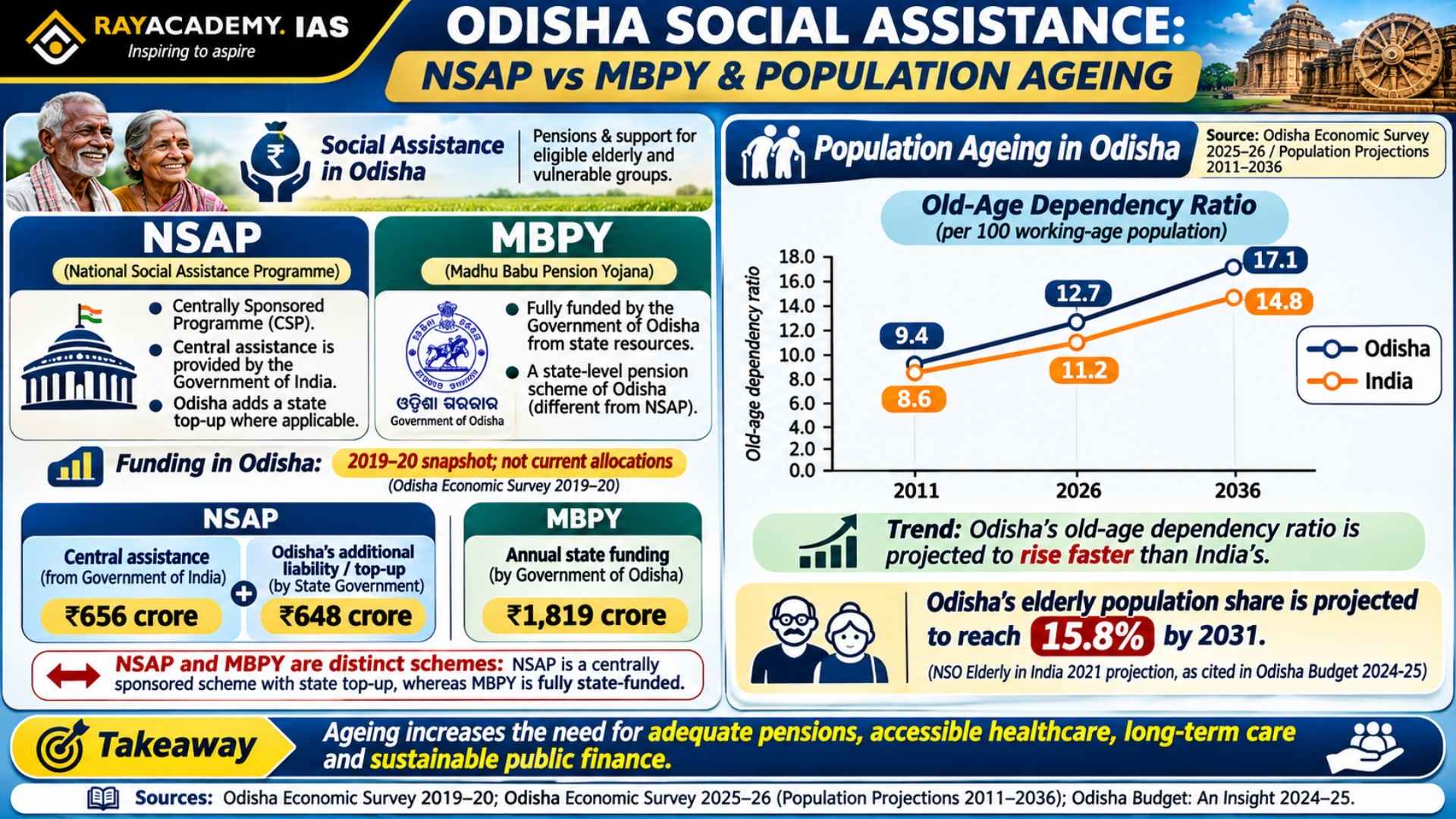
[Image Placeholder 2]Suggested Visual: An analytical infographic contrasting the fiscal share of Central funding (NSAP) vs. State funding (MBPY) for social assistance in Odisha, accompanied by a breakdown of demographic aging trends.Wix Image Alt Text: Comparative chart of state social pension funding vs central NSAP allocation for OPSC Mains GS2 social justice
Way Forward
Adopt Dynamic Inflation Indexation: In line with NITI Aayog recommendations on social protection, baseline monthly pensions should be indexed periodically to the Consumer Price Index for Rural/Agricultural Workers (CPI-AL/RL) to protect real purchasing power from inflationary erosion.
Implement Hybrid "Banking-at-Doorstep" Models: For bedridden individuals and super-senior citizens unable to access digital centers or panchayat offices, state welfare departments must institutionalize doorstep cash delivery through mobile postal banking and Aadhaar-Enabled Payment System (AePS) banking correspondents.
Harmonize Central and State Funding (Revision of NSAP): The Parliamentary Standing Committee on Rural Development has repeatedly urged the Union Government to revise central NSAP contributions (stagnant at ₹200/month since 2006). A 50:50 cost-sharing formula between the Union and States would ease sub-national fiscal strain.
Institutionalize Social Audits and Grievance Redressal (2nd ARC Framework): Under the 2nd Administrative Reforms Commission (ARC) guidelines on social accountability, Gram Sabhas should conduct bi-annual social audits of pension rolls to purge duplicate or deceased entries while ensuring zero wrongful exclusion of genuine destitute persons.
Establish Unified Social Registry Databases: Integrate portal data from the UPMP with broader welfare registries (such as the Public Distribution System, Ayushman Bharat / Gopabandhu Jan Arogya Yojana) to ensure holistic, multi-sectoral coverage for vulnerable elderly households.
Value Addition for Mains
Demographic Projection (UNFPA India Ageing Report): According to the United Nations Population Fund (UNFPA), the proportion of elderly persons (60+ years) in India will double from 10.5% in 2022 to 20.8% by 2050, making universal, non-contributory social pension architectures an essential pillar of long-term economic resilience.
Constitutional Benchmark: In Mohd. Ahmed Khan v. Shah Bano Begum (1985) and reaffirmed in subsequent social security cases, the Supreme Court stressed that the state’s obligation to provide social protection to destitute persons flows directly from the constitutional commitment to build a socialist, egalitarian democracy under the Preamble and Article 38.
Practice Questions for Active Recall
Prelims Practice MCQ
With reference to social security pensions and constitutional provisions in India, consider the following statements:
Under Article 41 of the Constitution, the State is directed to secure public assistance in cases of old age, sickness, and disablement within its economic capacity.
The National Social Assistance Programme (NSAP) is a Central Sector Scheme funded entirely by the Union Government with no operational role for State administrations.
The Madhu Babu Pension Yojana (MBPY) provides an enhanced monthly pension of ₹3,500 for eligible beneficiaries aged 80 years and above.
Which of the statements given above are correct?
(a) 1 and 2 only
(b) 2 and 3 only
(c) 1 and 3 only
(d) 1, 2, and 3
Correct Answer: (c) 1 and 3 only
Explanation:
Statement 1 is correct: Article 41 of Part IV (Directive Principles of State Policy) explicitly directs the State to make effective provision for securing the right to work, education, and public assistance in cases of unemployment, old age, sickness, and disablement within the limits of its economic capacity.
Statement 2 is incorrect: NSAP is a Centrally Sponsored Scheme (administered by the Ministry of Rural Development), where the Union government provides basic financial assistance and State Governments implement the scheme, frequently topping up the pension amount from their own budgets.
Statement 3 is correct: Under the revised structure of the Madhu Babu Pension Yojana, senior citizens aged 80 years and above (as well as persons with $\ge$80% severe disability) receive an enhanced monthly pension of ₹3,500.
Mains Practice Question (GS Paper II — 150 Words | 10 Marks)
"Shifting from quota-restricted welfare schemes to rights-based, saturated social security models is essential to realize the constitutional promise of Article 41, yet it poses substantial fiscal and delivery challenges for sub-national governments." Critically examine this statement in light of recent social pension reforms in Indian states.
Answer Structure Hints:
Introduction: Highlight the constitutional context of Article 41 and the recent transition from bureaucratic quotas to universal saturation models (e.g., Madhu Babu Pension Yojana expanding to 41.8 lakh beneficiaries).
Body Part 1 (Merits of Saturation): Discuss how abolishing waiting lists eliminates bureaucratic discretion, upholds Article 21 human dignity, protects vulnerable demographics (widows, disabled, super-elderly), and uses digital portals (UPMP) for transparent lifecycle tracking.
Body Part 2 (Fiscal & Operational Constraints): Discuss sub-national fiscal stress (recurring budgetary outlays like ₹625 crore/year), stagnant central matching shares under NSAP, inflation erosion of unindexed payouts, and biometric/digital hurdles in rural areas.
Conclusion: Recommend indexing pensions to CPI-AL, reforming the Union-State NSAP funding formula, and instituting doorstep delivery via mobile postal banking to ensure sustainable, dignified social security.
Take this article with you
Save a reading copy for offline study.


