

Supreme Court of India
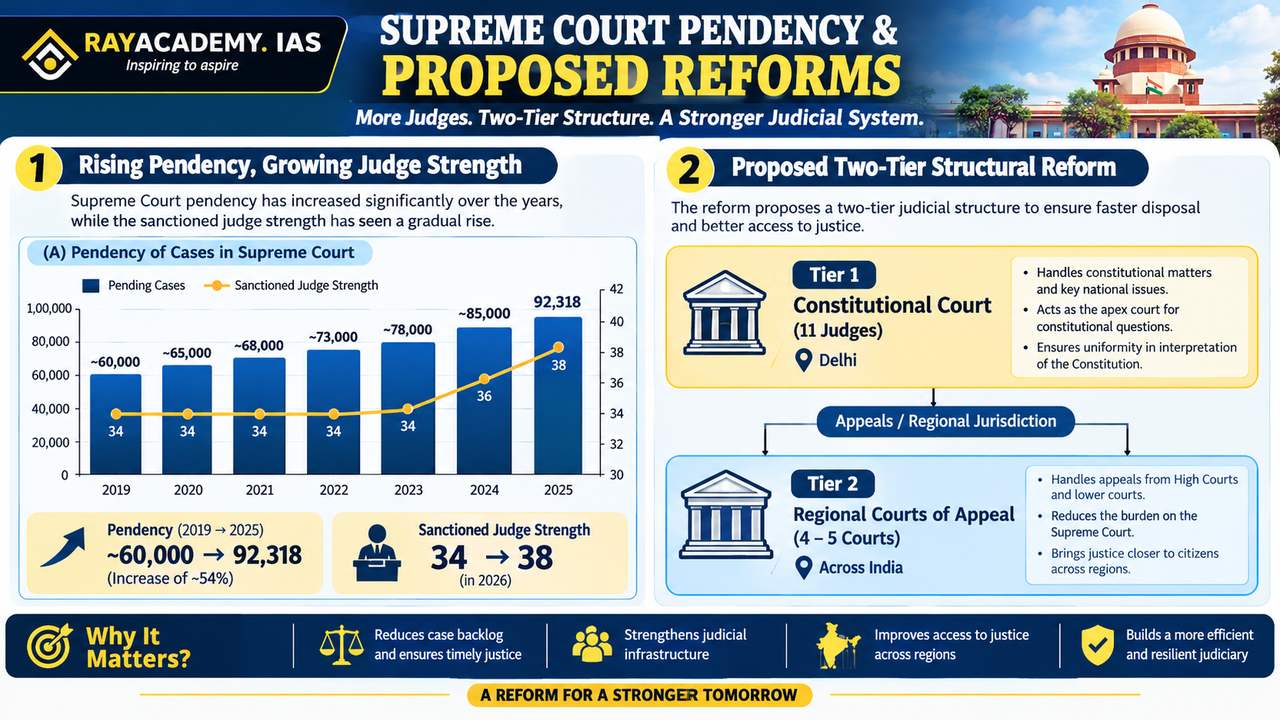
Mounting Pendency & Strength Expansion: Following Parliament’s move in 2026 to raise the sanctioned judicial strength of the Supreme Court of India from 34 to 38 judges, legal scholars and policy analysts have renewed calls to structurally bifurcate the apex court rather than merely adding judges.
UPSC Syllabus Mapping:
General Studies Paper II (Indian Polity & Governance): Structure, organization and functioning of the Executive and the Judiciary; Ministries and Departments of the Government; Dispute Redressal Mechanisms and Institutions; Separation of powers between various organs.
As of the close of 2025, the Supreme Court carried an all-time high backlog of 92,318 pending cases—nearly 10,000 more than the previous year—as fresh filings (75,410) consistently outpaced annual disposals (65,615).
Waning Constitutional Adjudication: Experts point out that the apex court’s docket is overwhelmed by routine Special Leave Petitions (SLPs), causing the number of cases decided by Constitution Benches to drop from an average of 134 per year in the early 1960s to fewer than 10 per year over the last decade.
Static-Current Linkage .Supreme Court Structural Reform
Constitutional Architecture of the Supreme Court (Articles 124–147): Established under Part V (Chapter IV) of the Constitution of India, the Supreme Court serves a dual role as the guardian and final interpreter of the Constitution as well as the highest court of civil and criminal appeal.
Article 130 (Seat of the Supreme Court): Under Article 130, the Supreme Court shall sit in Delhi or "in such other place or places, as the Chief Justice of India may, with the approval of the President, from time to time, appoint." Legal reformers—including the 229th Law Commission Report—have noted that regional benches could potentially be operationalized under Article 130 without requiring a constitutional amendment.
Article 136 (Special Leave Petitions): Intended by the Constituent Assembly as a discretionary, extraordinary residual power to prevent grave miscarriage of justice, Article 136 has evolved into a routine fourth tier of appeal—accounting for over 84% of the Court’s admission docket. In Bihar Legal Support Society v. Chief Justice of India (1986), a Constitution Bench led by Chief Justice P.N. Bhagwati explicitly acknowledged that the Supreme Court was never intended to be an ordinary court of appeal.
Article 145(3) (Constitution Benches): Mandates that any case involving a substantial question of law as to the interpretation of the Constitution must be heard by a minimum Bench of five judges. Because judges remain tied up in two- and three-judge admission benches clearing SLPs, five-judge and larger Constitution Benches sit rarely.Supreme Court Structural Reform
Prelims Focus: High-Yield Objective Facts
Constitutional / Institutional Aspect | Key Facts & Specifications for UPSC Prelims |
Sanctioned Judicial Strength | Originally 8 judges (1 CJI + 7 judges) in 1950; increased periodically by Parliament under Article 124(1)—to 34 in 2019 and 38 in 2026. |
Seat of the Supreme Court | Article 130: Delhi, or such other place(s) appointed by the Chief Justice of India (CJI) with the prior approval of the President. |
Jurisdictions of the Supreme Court | • Original Jurisdiction (Art. 131): Federal disputes (Centre vs. States / Inter-State). |
• Writ Jurisdiction (Art. 32): Enforcement of Fundamental Rights.
• Appellate Jurisdiction (Arts. 132–134): Constitutional, civil, and criminal appeals.
• Special Leave (Art. 136): Discretionary appeal from any court/tribunal (except armed forces tribunals).
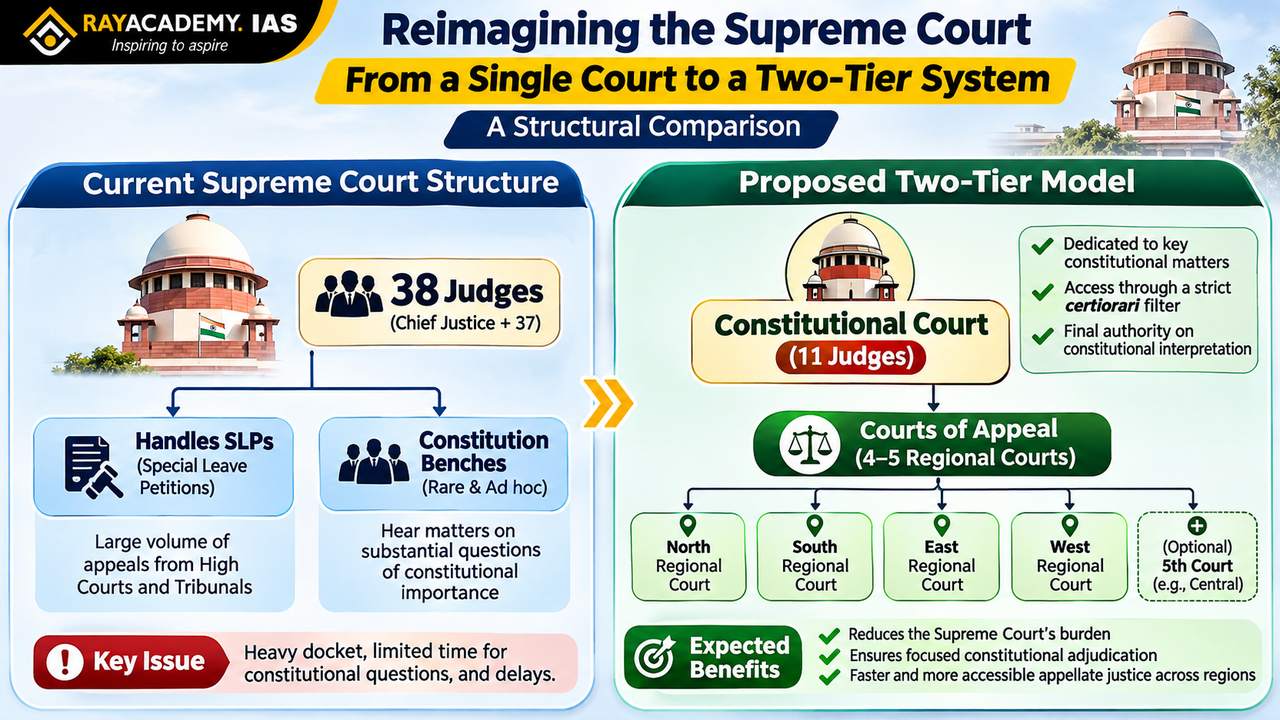
• Advisory Jurisdiction (Art. 143): Presidential reference. | | Law Commission Recommendations | • 125th Report (1988) & 229th Report (2009): Recommended splitting the Supreme Court into a Constitutional Court in Delhi and four regional Cassation Benches (North, South, East, West). | | Global Comparative Models | • United States: 13 Federal Courts of Appeals below a 9-judge Supreme Court.
• South Africa: Separate Constitutional Court (Johannesburg) and Supreme Court of Appeal (Bloemfontein).
• Brazil: Created the Superior Tribunal of Justice (1988) to handle federal appeals, leaving constitutional questions to the Supreme Federal Tribunal. |
Mains Analytical Breakdown
Significance of Bifurcating Constitutional and Appellate Functions
Restoring Constitutional Primacy: Creating a lean Constitutional Court (around 11 judges in Delhi) sitting en banc or in large benches would revive timely adjudication on federalism, Fundamental Rights, and basic structure questions that currently languish for years.
Institutional Specialization & Doctrinal Consistency: Currently, the Supreme Court sits in a dozen small two-judge division benches that frequently deliver conflicting rulings on similar statutory points. Separating ordinary appeals into 4–5 Regional Courts of Appeal ensures consistent, specialized jurisprudence.
Democratizing Access to Justice (Article 39A): Establishing regional appellate benches across geographic zones lowers litigation costs and travel burdens for litigants from southern, eastern, and northeastern states, advancing distributive and spatial justice.
Breaking the Futile Cycle of Judge-Strength Expansion: Increasing judge numbers without structural sorting (from 34 in 2019 to 38 in 2026) has failed to curb backlog because expanded admission capacity simply attracts more filings.
Multi-Dimensional Challenges
Judicial Resistance & Perceived Dilution of Authority: Successive Chief Justices and Full Court resolutions have historically opposed regional benches, arguing that splitting the Court could diffuse its institutional unity, turn regional benches into "lesser venues," and erode the prestige of a single apex judicial voice.
Risk of Creating an Additional Tier of Litigation: Without strict statutory filtering, litigants losing in Regional Courts of Appeal may still attempt to file secondary constitutional appeals before the Constitutional Court in Delhi, inadvertently adding a fifth tier of delay.
Administrative & Infrastructure Bottlenecks: Operationalizing four or five regional appellate courts requires substantial capital expenditure, specialized registry personnel, digital case-management parity, and High Court bar integration.
Political & Federal Sensitivity: Determining the exact regional locations of appellate benches and the regional representation of judges can trigger inter-state political friction if not guided by objective judicial-workload metrics.
Need for Gatekeeping Reforms (Certiorari Discretion): Comparative experience from Brazil’s 2004 judicial reform and the U.S. Supreme Court (which grants certiorari to only ~1% of 7,000 annual petitions) demonstrates that a structural split fails unless paired with strict discretionary filters limiting constitutional appeals strictly to questions of "general public repercussion".
Way Forward
Two-Tier Functional Separation (229th Law Commission & Parliamentary Standing Committee Framework): Implement the 229th Law Commission Report (2009) and the 2023 Parliamentary Standing Committee on Law and Justice recommendations by establishing a dedicated Constitutional Division in Delhi alongside four Regional Appellate Benches (North, South, East, and West).
Invoke Article 130 for Phased Pilot Implementation: As noted in the 229th Report, the Chief Justice of India and the President can initiate regional appellate sittings under Article 130 without waiting for a contentious constitutional amendment, allowing empirical evaluation of case disposal rates.
Institute Strict Gatekeeping Rules for Constitutional Appeals: Amend Supreme Court Rules under Article 145 to restrict direct access to the Constitutional Court strictly to matters involving substantial questions of constitutional law, federal disputes (Article 131), or issues of overarching national repercussion—curbing routine Article 136 SLPs.
Strengthen High Courts and Tribunals as Final Fact-Finding Courts: Enhance the institutional capacity, judicial fill-rate, and infrastructural autonomy of High Courts and specialized tribunals so that ordinary civil, criminal, and service disputes achieve finality at the state/regional level.
Leverage e-Courts Phase III for Virtual Benches: Complement physical regional benches with standardized virtual hearing protocols and AI-assisted docket clustering to minimize geographic barriers and accelerate routine admissions.
Value Addition for Mains
Official Judicial Pendency Benchmark (Supreme Court Registry, 2026): Despite expanding judicial strength from 34 (2019) to 38 (2026), Supreme Court pendency surged from ~60,000 to 92,318 cases by the end of 2025 (with 75,410 fresh filings outstripping 65,615 disposals), while Constitution Bench disposals fell from 134/year (early 1960s) to under 10/year.
Constitutional & Judicial Precedent Anchor: Quoting Chief Justice P.N. Bhagwati in Bihar Legal Support Society (1986)—that the Supreme Court "was never intended to be a regular court of appeal"—alongside Article 39A (Equal Justice and Free Legal Aid) provides a compelling constitutional anchor for structural judicial reform.
Practice Questions for Active Recall
Prelims Practice MCQ
With reference to the constitutional provisions governing the Supreme Court of India, consider the following statements:
Under Article 130 of the Constitution, the Chief Justice of India can appoint places other than Delhi as the seat of the Supreme Court only with the prior approval of the President.
Under Article 145(3), any case involving a substantial question of law as to the interpretation of the Constitution must be heard by a Bench of at least five judges.
Special Leave to Appeal under Article 136 can be granted by the Supreme Court against judgments passed by any court or tribunal in India, including courts constituted under armed forces laws.
Which of the statements given above are correct?
(a) 1 and 2 only
(b) 2 and 3 only
(c) 1 and 3 only
(d) 1, 2, and 3
Correct Answer: (a) 1 and 2 only
Explanation:
Statement 1 is correct: Article 130 states that the Supreme Court shall sit in Delhi or in such other place or places as the Chief Justice of India may, with the approval of the President, appoint.
Statement 2 is correct: Article 145(3) mandates a minimum Bench of five judges (a Constitution Bench) for deciding any case involving a substantial question of law regarding constitutional interpretation.
Statement 3 is incorrect: Article 136(2) explicitly excludes any judgment, determination, sentence, or order passed or made by any court or tribunal constituted by or under any law relating to the Armed Forces.
Mains Practice Question (GS Paper II — 150 Words | 10 Marks)
"Merely increasing the sanctioned strength of judges at the Supreme Court without structurally separating its constitutional and appellate jurisdictions risks enlarging an already overburdened docket." Critically examine the case for establishing regional appellate benches and a dedicated Constitutional Court in India.
Answer Structure Hints:
Introduction: Contextualize the 2026 expansion of Supreme Court strength to 38 judges amid a record backlog of 92,318 cases and declining Constitution Bench output (<10 cases/year).
Body Part 1 (Case for Structural Split): Cite the 229th Law Commission Report, Article 130, and Article 39A—explaining how a lean Constitutional Court in Delhi paired with 4–5 Regional Courts of Appeal restores constitutional focus, eliminates conflicting division-bench rulings, and lowers litigant costs.
Body Part 2 (Counter-Arguments & Safeguards): Address concerns over diluting apex judicial unity or adding another tier of appeal; emphasize pairing regional benches with strict certiorari gatekeeping on Article 136 SLPs (drawing lessons from the U.S. and Brazil).
Conclusion: Conclude that sorting judicial work—rather than merely expanding judge numbers—is vital to uphold constitutional supremacy and timely justice.
Take this article with you
Save a reading copy for offline study.


