

Civilisational Dialogue Forum
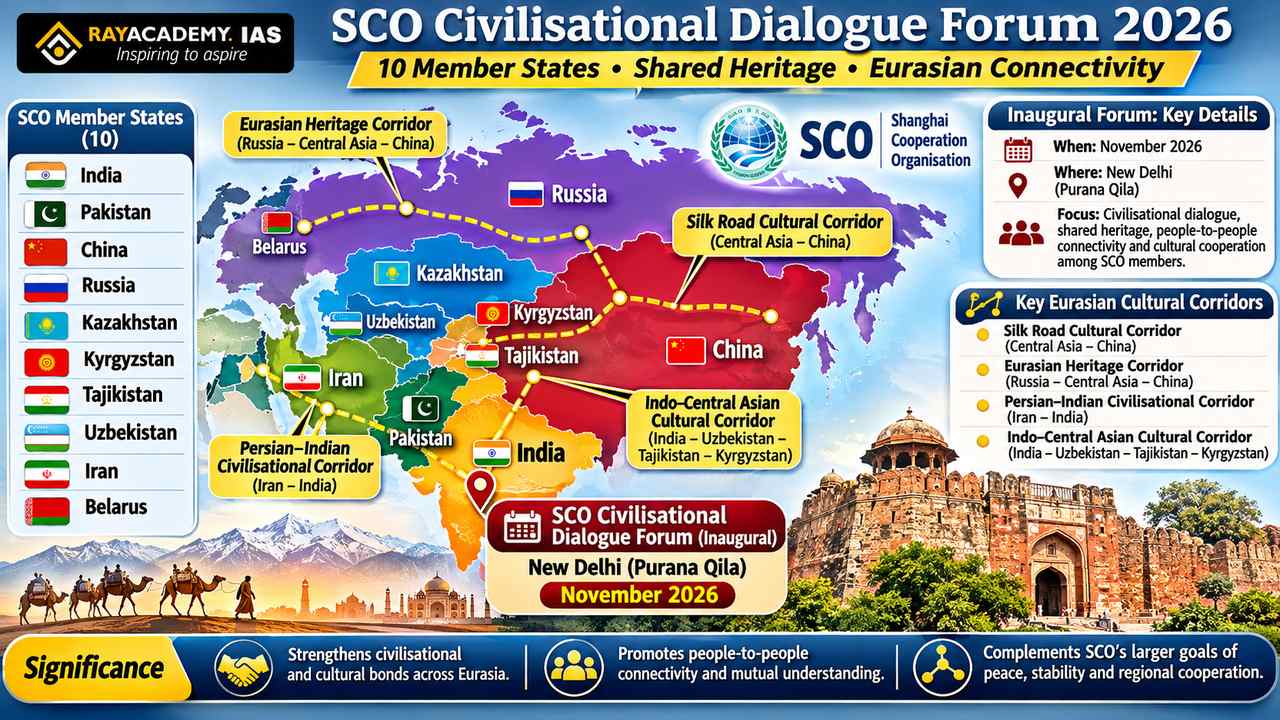
Inaugural SCO Civilisational Dialogue Forum: India is hosting the first Civilisational Dialogue Forum of the 10-nation Shanghai Cooperation Organisation (SCO) at the historic Purana Qila in New Delhi from November 20 to 22, 2026, jointly organized by the Ministry of Culture and the Ministry of External Affairs (MEA).
UPSC Syllabus Mapping:
General Studies Paper II (International Relations): India and its neighbourhood- relations; Bilateral, regional and global groupings and agreements involving India and/or affecting India’s interests; Effect of policies and politics of developed and developing countries on India’s interests.
Union Culture Minister Gajendra Singh Shekhawat confirmed that India invited Pakistan’s Culture Minister Aurangzeb Khan Khichi—marking India’s first ministerial-level invitation to Islamabad since 2023—while expressing hope that Pakistan will participate given their shared civilisational heritage. (Pakistan subsequently nominated Federal Climate Change Minister Musadik Masood Malik to attend).
Firm National Policy After Pahalgam Terror Attack: Simultaneously, the MEA indicated it may deny political clearance to Punjab Chief Minister Bhagwant Singh Mann and state MLAs to attend a bilateral Punjabi cultural conference in Lahore later in November, reiterating India’s strict national policy following the 2025 Pahalgam terror attacks—that "terror and talks cannot go together" bilaterally even as multilateral SCO obligations are fulfilled.
Static-Current Linkage.SCO Civilisational Dialogue
Origin & Evolution of the SCO: Founded in 2001 in Shanghai by six nations (China, Russia, Kazakhstan, Kyrgyzstan, Tajikistan, and Uzbekistan—building on the 1996 Shanghai Five mechanism), the SCO expanded to include India and Pakistan as full members at the 2017 Astana Summit, Iran in 2023, and Belarus in 2024, bringing total full membership to 10 countries.
The "Shanghai Spirit" & Charter Principles: Governed by the SCO Charter (2002), the grouping operates on the "Shanghai Spirit"—emphasizing mutual trust, mutual benefit, equality, consultation, respect for cultural diversity, and pursuit of common development. Under Article 2 of the SCO Charter, bilateral disputes cannot be raised formally on the SCO platform, which explains why India and Pakistan participate in multilateral SCO events despite frozen bilateral ties.
Cultural Diplomacy & Soft Power in Indian Foreign Policy: Proposed by Prime Minister Narendra Modi at the 2025 SCO Tianjin Summit, the SCO Civilisational Dialogue Forum aims to move the bloc beyond purely geopolitical and security deliberations toward civilisational heritage, art and architecture, language and literature, manuscripts, and religious-philosophical traditions—including multinational UNESCO World Heritage nominations.
Constitutional Mandate on Foreign Affairs & Federalism: Under Entry 10 and Entry 14 of the Union List (Seventh Schedule) of the Constitution of India, foreign affairs and participation in international conferences fall exclusively under the Union Government. Consequently, Chief Ministers and State Ministers require mandatory political clearance from the Ministry of External Affairs (MEA) before undertaking official foreign travel.
Prelims Focus: High-Yield Objective Facts
Dimension / Institution | Key Facts & Specifications for UPSC Prelims |
SCO Full Members (10) | Belarus, China, India, Iran, Kazakhstan, Kyrgyzstan, Pakistan, Russia, Tajikistan, and Uzbekistan (India & Pakistan joined in 2017; Iran in 2023; Belarus in 2024). |
SCO Permanent Bodies | • SCO Secretariat: Headquartered in Beijing, China. |
• Regional Anti-Terrorist Structure (RATS): Headquartered in Tashkent, Uzbekistan (coordinates counter-terrorism, separatism, and extremism). | | Official Working Languages | Russian and Chinese (English is frequently used in working-level multilateral forums hosted by India). | | SCO Civilisational Dialogue Forum (2026) | • Dates & Venue: November 20–22, 2026, at Purana Qila, New Delhi.
• Organizers: Ministry of Culture & Ministry of External Affairs (MEA).
• Four Core Themes: Civilisational & cultural expression, art & architecture, language & literature/manuscripts, and religious/philosophical traditions. | | Political Clearance for State Ministers | Regulated by Cabinet Secretariat and MEA guidelines under Entry 10 of the Union List; all State Chief Ministers, Ministers, and MLAs require prior Union political clearance for foreign visits. |
Mains Analytical Breakdown
Significance of the SCO Civilisational Dialogue Forum and Calibrated Diplomacy
Expanding India’s Soft Power & Eurasian Outreach: Hosting the inaugural forum in New Delhi positions India as a civilisational anchor across Central, South, and West Asia—leveraging shared Buddhist, Sufi, Silk Road, and linguistic heritage to deepen people-to-people ties across Eurasia.
De-Hyphenating Multilateral Obligations from Bilateral Ties: Extending a protocol-mandated multilateral SCO invitation to Pakistan while withholding bilateral travel clearance to Lahore demonstrates mature, calibrated statecraft—upholding international host responsibilities without diluting India’s zero-tolerance counter-terrorism doctrine.
Broadening the SCO’s Institutional Mandate: Historically dominated by security and economic agendas, incorporating cultural and manuscript preservation (complementing India’s Gyan Bharatam / National Mission for Manuscripts) diversifies SCO cooperation and strengthens multilateral trust.
Multi-Dimensional Challenges
Security — Persistent Cross-Border Terrorism: As underscored by the MEA’s reference to the 2025 Pahalgam terror attacks, continued state-sponsored cross-border terrorism severely constrains bilateral normalization, making pure cultural diplomacy vulnerable to security shocks.
Geopolitical — Intra-SCO Rivalries & Trust Deficits: Deep strategic divergences within the SCO—including India–China boundary tensions, India–Pakistan hostility, and Russia–West friction—limit the extent to which cultural dialogue can translate into substantive geopolitical convergence.
Federalism — Centre–State Friction Over Foreign Travel Clearances: Denying political clearance to a State Chief Minister (such as Punjab’s CM for a Lahore Punjabi conference) periodically sparks political debate over cooperative federalism and cultural sub-nationalism, even though foreign policy remains an exclusive Union subject.
Historical & Narrative Contestation: While shared pre-1947 civilisational roots offer common ground, competing nationalist historiography over Indus Valley, Gandhara, and medieval heritage often complicates joint cultural curation.
Implementation — Translating Symbolic Forums into Sustained Outcomes: Without institutional follow-through—such as joint archaeological conservation, digital manuscript exchanges, and visa facilitation—cultural forums risk remaining episodic diplomatic events.
Way Forward
Institutionalize Track-II & Academic Heritage Networks: Operationalize permanent SCO working groups for joint digitization of rare manuscripts, conservation of Silk Road and Gandhara heritage, and multinational UNESCO World Heritage nominations to sustain momentum beyond the three-day forum.
Maintain Calibrated Multilateralism with Firm Security Red Lines: Continue separating multilateral host obligations under the SCO Charter from bilateral engagement—ensuring that bilateral normalization with Islamabad remains strictly contingent on verifiable, irreversible action against cross-border terror infrastructure.
Establish Transparent, Objective Guidelines for State Visits (Sarkaria & Punchhi Commission Spirit): While preserving the Union’s exclusive constitutional primacy over foreign affairs (Entry 10, Union List), institutionalize transparent, time-bound MEA consultation protocols with State Governments to minimize Centre–State friction over cultural and diaspora outreach.
Leverage SCO RATS for Counter-Terrorism Synergy: Pair cultural soft-power initiatives with robust security diplomacy inside the SCO Regional Anti-Terrorist Structure (RATS) to build regional consensus against radicalization, terror financing, and cross-border militancy.
Expand Educational & Youth Exchanges Across Eurasia: Utilize ICCR (Indian Council for Cultural Relations) scholarships, Buddhist circuit tourism, and digital cultural repositories to build long-term goodwill among youth across Central Asian SCO republics.
Value Addition for Mains
Institutional & Diplomatic Benchmark (Nov 2026): At the inaugural 10-nation SCO Civilisational Dialogue Forum at Purana Qila, New Delhi (Nov 20–22, 2026), India demonstrated calibrated diplomacy—extending its first multilateral ministerial invitation to Pakistan since 2023 while maintaining firm bilateral red lines post the 2025 Pahalgam terror attack.
Constitutional & Foreign Policy Anchor: India’s approach harmonizes Article 51 (promotion of international peace and friendly relations) with Entry 10 of the Union List (exclusive Union jurisdiction over foreign affairs), operationalizing the civilisational ethos of Vasudhaiva Kutumbakam without compromising national security imperatives.
Practice Questions for Active Recall
Prelims Practice MCQ
With reference to the Shanghai Cooperation Organisation (SCO) and India’s participation in it, consider the following statements:
India and Pakistan became full members of the Shanghai Cooperation Organisation simultaneously in 2017.
The SCO Regional Anti-Terrorist Structure (RATS) is permanently headquartered in Beijing, China.
Under the Seventh Schedule of the Constitution of India, foreign affairs and participation in international conferences fall exclusively within the Union List.
Which of the statements given above are correct?
(a) 1 and 2 only
(b) 1 and 3 only
(c) 2 and 3 only
(d) 1, 2, and 3
Correct Answer: (b) 1 and 3 only
Explanation:
Statement 1 is correct: Both India and Pakistan acceded as full members of the SCO at the 2017 Astana Summit (followed by Iran in 2023 and Belarus in 2024, bringing total membership to 10).
Statement 2 is incorrect: While the SCO Secretariat is located in Beijing, China, the permanent executive committee of the Regional Anti-Terrorist Structure (RATS) is headquartered in Tashkent, Uzbekistan.
Statement 3 is correct: Under Entries 10 and 14 of the Union List (Seventh Schedule), foreign affairs and international conferences fall exclusively within the Union Government’s jurisdiction, requiring State ministers to obtain MEA political clearance for foreign visits.
Mains Practice Question (GS Paper II — 150 Words | 10 Marks)
"Hosting the inaugural SCO Civilisational Dialogue Forum while withholding bilateral cultural travel clearances reflects India’s effort to de-hyphenate multilateral obligations from bilateral security red lines." Analyze the strategic significance and challenges of leveraging cultural diplomacy in India’s neighborhood policy.
Answer Structure Hints:
Introduction: Contextualize India hosting the inaugural SCO Civilisational Dialogue Forum in New Delhi (Nov 2026) and inviting Pakistan per multilateral norms while maintaining bilateral restraint post the 2025 Pahalgam terror attacks.
Body Part 1 (Strategic Significance): Highlight soft-power outreach across Eurasia, shared pre-1947 civilisational heritage, advancing SCO Charter principles, and demonstrating diplomatic maturity by fulfilling host obligations without conceding security red lines.
Body Part 2 (Challenges): Discuss cross-border terrorism constraints, intra-SCO geopolitical rivalries, Centre–State friction over MEA political clearances (Entry 10, Union List), and competing historical narratives.
Conclusion: Conclude that calibrated multilateralism—combining cultural soft power with firm counter-terrorism deterrence under SCO RATS—best safeguards India’s regional interests.
Take this article with you
Save a reading copy for offline study.


