

Quadrilateral Security Dialogue
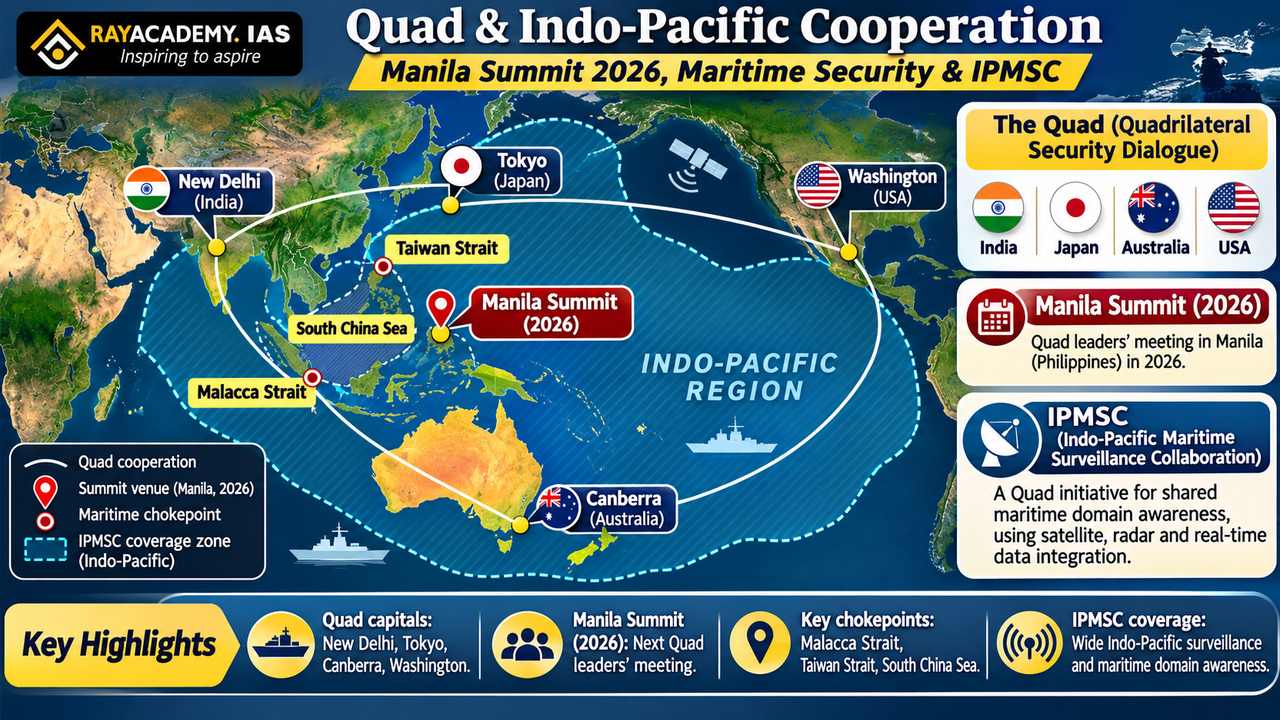
Revival of Leader-Level Quad Diplomacy: The leaders of the Quadrilateral Security Dialogue (Quad)—India, Australia, Japan, and the United States—are scheduled to convene in Manila, Philippines, in November 2026 on the sidelines of the 49th ASEAN Summit, following an announcement by U.S. Secretary of State Marco Rubio at the G20 Foreign Ministers’ Meeting in Atlanta.
UPSC Syllabus Mapping:
General Studies Paper II (International Relations): Bilateral, regional and global groupings and agreements involving India and/or affecting India’s interests; Effect of policies and politics of developed and developing countries on India’s interests.
This gathering marks the first leader-level Quad summit since the 2024 Wilmington Summit—and the first attended by U.S. President Donald Trump in his second term as well as Japanese Prime Minister Sanae Takaichi since assuming office.
Symbolic Venue & Strategic Reassurance: Holding the summit in Manila—rather than in a Quad member state—reinforces the grouping’s commitment to ASEAN centrality while sending a calibrated signal against unilateral maritime coercion in the South China Sea.
Static-Current Linkage. Quad Leaders’ Summit
Evolution of the Quad (2004–2026): Originating as an ad-hoc humanitarian Tsunami Core Group following the December 2004 Indian Ocean tsunami, the Quad was formally conceptualized in 2007 by Japanese Prime Minister Shinzo Abe as the "Confluence of the Two Seas" (Indian and Pacific Oceans). After a decade-long hiatus due to diplomatic sensitivities toward Beijing, it was revived in 2017 in Manila and elevated to the Head-of-State/Government Summit level in 2021.
Informal Minilateral Architecture: Unlike NATO or the European Union, the Quad is an informal, non-treaty strategic partnership without a permanent secretariat, standing bureaucracy, or mutual defense clause. Its cohesion depends on regular ministerial dialogues (five meetings across 2025–2026 in Washington, New Delhi, Manila, and Atlanta) and functional public-goods working groups.
Indo-Pacific Maritime Surveillance Collaboration (IPMSC): Launched in New Delhi in May 2026 following the Quad Foreign Ministers’ Meeting, the IPMSC upgraded the earlier Indo-Pacific Partnership for Maritime Domain Awareness (IPMDA, 2022)—integrating commercial satellite data, radio-frequency tracking, and dark-vessel detection across the Indian Ocean, Southeast Asia, and Pacific Islands.
United Nations Convention on the Law of the Sea (UNCLOS), 1982: The Quad’s normative foundation rests on upholding a rules-based maritime order, freedom of navigation and overflight, and peaceful dispute resolution under UNCLOS—directly countering expansive territorial claims and the 2016 Permanent Court of Arbitration ruling in the South China Sea.
Prelims Focus: High-Yield Objective Facts
Dimension / Initiative | Key Facts & Specifications for UPSC Prelims |
Quad Member States | Australia, India, Japan, and the United States (4 maritime democracies). |
Chronology of Leaders’ Summits | • 2021: Virtual (March) & Washington D.C. (September) |
• 2022: Tokyo (May)
• 2023: Hiroshima (May, sidelines of G7)
• 2024: Wilmington, Delaware (September)
• 2026: Manila, Philippines (November, sidelines of 49th ASEAN Summit) | | IPMSC (Launched May 2026) | Indo-Pacific Maritime Surveillance Collaboration (launched in New Delhi); upgrades IPMDA to bolster real-time maritime domain awareness and combat Illegal, Unreported, and Unregulated (IUU) fishing. | | Complementary Minilaterals | • JAI Trilateral: Japan–Australia–India defense and strategic dialogue (recently convened in Cebu, Philippines).
• AUKUS: Trilateral security pact between Australia, the UK, and the US (nuclear-powered submarines & advanced tech; currently under U.S. policy review).
• SQUAD: Informal defense grouping of Australia, Japan, the Philippines, and the US. | | Japan’s OCEAN Framework | One Cooperative Effort Among Nations (OCEAN)—Japan’s strategic initiative to deepen post-war security partnerships across the Indo-Pacific. |
Mains Analytical Breakdown
Significance of the Manila Summit and Quad Continuity
Overcoming Strategic Turbulence & Preserving Momentum: Despite bilateral trade/political frictions and a pause in leader-level summits during 2025, continuous operational synergy—spanning critical minerals, submarine cables, AI, and maritime surveillance—demonstrates that the Quad has matured beyond summitry alone.
Reinforcing ASEAN Centrality: Hosting the summit in Manila alongside the ASEAN Summit directly counters narratives that the Quad seeks to sideline ASEAN. It aligns Quad public goods with the ASEAN Outlook on the Indo-Pacific (AOIP) and supports the Philippines amid persistent maritime friction with China.
Reassuring Regional Allies on U.S. Indo-Pacific Engagement: The summit provides President Trump an essential platform to articulate his second-term Indo-Pacific strategy and reaffirm deterrence in key flashpoints like the Taiwan Strait and the East and South China Seas.
Advancing India’s Act East & MAHASAGAR Vision: For India, an active, non-military Quad strengthens maritime security in the eastern Indian Ocean and Western Pacific while diversifying strategic partnerships without entering rigid military alliances.
Multi-Dimensional Challenges
Geopolitical — Uncertainty Over U.S. Strategic Bandwidth: Washington’s preoccupation with the Russia-Ukraine war, West Asia hostilities, and transatlantic burden-sharing within NATO—alongside a White House review of AUKUS—has created apprehension among regional partners regarding the consistency of U.S. commitment.
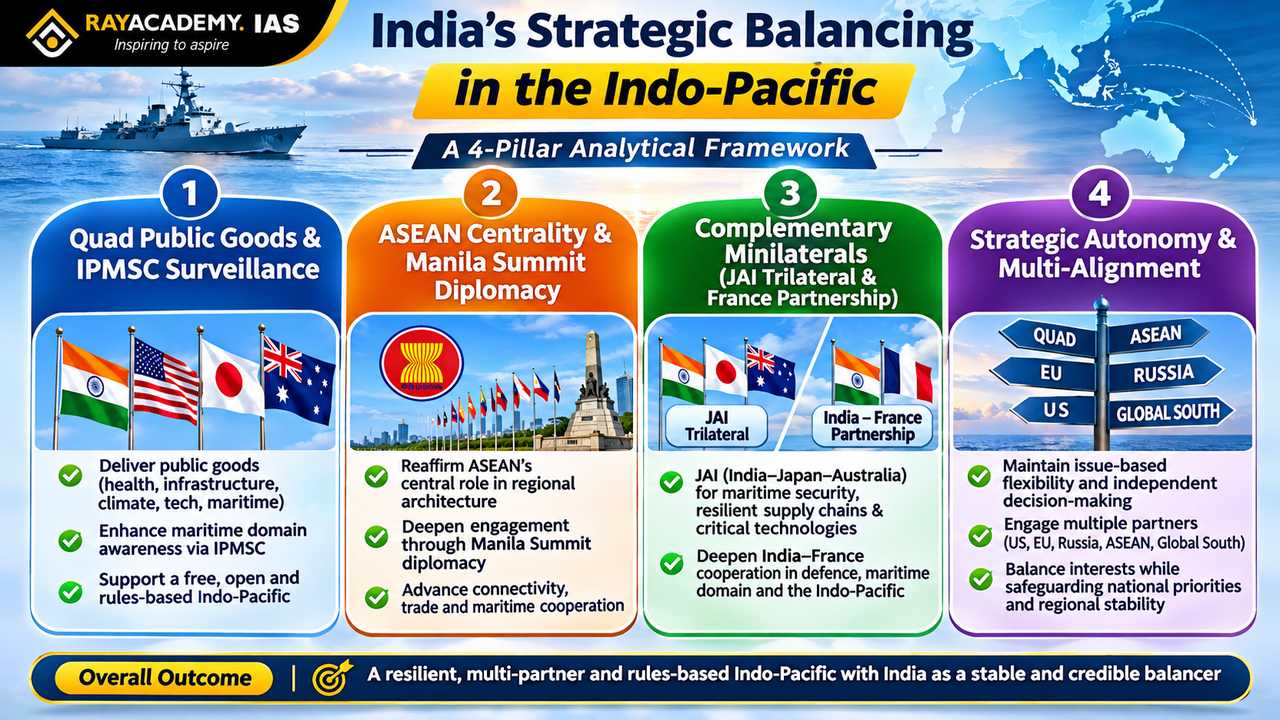
Strategic — Divergent Threat Perceptions & Bilateral Priorities: While the U.S., Japan, and Australia are treaty allies integrated into a shared Pacific security architecture, India pursues multi-alignment and strategic autonomy, balancing Quad cooperation with continental border management with China and historic ties with Russia.
Institutional — Absence of Permanent Secretariat & Bureaucracy: Because the Quad lacks an institutional secretariat, sustaining momentum across leadership transitions requires high political bandwidth; any domestic political distraction in one capital can stall summit schedules (as seen in 2025).
Diplomatic — Managing ASEAN Skepticism & Beijing’s Pushback: Several ASEAN members remain cautious of bloc politics and economic retaliation from China, which characterizes the Quad as an "Indo-Pacific NATO" aimed at containment.
Economic — Infrastructure & Supply-Chain Financing Gap: Delivering tangible alternatives to China’s Belt and Road Initiative (BRI) in port connectivity, clean energy, and critical minerals requires mobilizing private capital at a pace that public grants alone have struggled to match.
Way Forward
Institutionalize Working-Level Continuity: Establish designated national Quad coordinators and shared digital project-tracking dashboards across all four foreign ministries so functional initiatives (like IPMSC, Quad Infrastructure Fellowship, and Open RAN telecom networks) advance uninterrupted regardless of electoral cycles.
Harmonize Complementary Minilateral Networks: Synchronize Quad maritime domain awareness with overlapping regional groupings—such as the JAI (Japan–Australia–India) trilateral, India–Philippines defense cooperation, and European Indo-Pacific partners like France—to build a networked, resilient security architecture.
Prioritize Tangible Economic Security & Critical Mineral Supply Chains: Operationalize joint financing vehicles (involving India’s EXIM Bank, US DFC, JBIC, and Australia’s EFA) to fund critical mineral processing, subsea fiber-optic cables, and green-energy supply chains across Southeast Asia and Pacific Island states.
Embed Initiatives Within ASEAN-Led Mechanisms: Channel Quad disaster-resilience, climate-finance, and maritime capacity-building programs through the East Asia Summit (EAS) and ASEAN Regional Forum (ARF) to dispel regional fears of great-power polarization.
Maintain Strategic Autonomy with Calibrated Deterrence: For India, continue leveraging the Quad as a force multiplier for maritime security and technological indigenization while retaining diplomatic flexibility in continental and Global South forums (BRICS, SCO, G20).
Value Addition for Mains
Institutional & Geopolitical Benchmark (2026): Despite missing a leader-level summit in 2025, the Quad maintained diplomatic continuity through five Foreign Ministers’ meetings across 2025–2026 and upgraded maritime security via the Indo-Pacific Maritime Surveillance Collaboration (IPMSC) in May 2026—culminating in the November 2026 Manila Summit on the sidelines of the ASEAN Summit.
Foreign Policy Doctrine Anchor: India’s participation exemplifies “Multi-Alignment” and “Pluri-lateralism”—operationalizing Article 51 (promotion of international peace and security and respect for international law/UNCLOS) alongside India’s Indo-Pacific Oceans Initiative (IPOI) and MAHASAGAR maritime vision.
Practice Questions for Active Recall
Prelims Practice MCQ
With reference to the Quadrilateral Security Dialogue (Quad) and Indo-Pacific security architecture, consider the following statements:
The Quad is a formal treaty-based collective defense alliance with a permanent secretariat headquartered in Manila.
The Indo-Pacific Maritime Surveillance Collaboration (IPMSC), launched in 2026, builds upon the Indo-Pacific Partnership for Maritime Domain Awareness (IPMDA) to enhance maritime tracking across the region.
Japan’s One Cooperative Effort Among Nations (OCEAN) framework aims to deepen its security alignment with partner countries in the Indo-Pacific.
Which of the statements given above are correct?
(a) 1 and 2 only
(b) 2 and 3 only
(c) 1 and 3 only
(d) 1, 2, and 3
Correct Answer: (b) 2 and 3 only
Explanation:
Statement 1 is incorrect: The Quad is an informal, non-treaty strategic diplomatic grouping of four democracies (Australia, India, Japan, and the U.S.) with no permanent secretariat or mutual defense obligation. Manila is the host venue for the November 2026 Leaders’ Summit on the sidelines of the ASEAN Summit.
Statement 2 is correct: Launched in New Delhi in May 2026, the IPMSC upgraded the IPMDA framework to strengthen shared maritime surveillance and domain awareness across the Indo-Pacific.
Statement 3 is correct: Under the OCEAN (One Cooperative Effort Among Nations) framework, Japan has sought to reshape its post-war security posture by deepening defense and strategic cooperation with Indo-Pacific partners.
Mains Practice Question (GS Paper II — 150 Words | 10 Marks)
"While shifting U.S. global priorities and divergent threat perceptions have tested the political cohesion of the Quad, its functional public-goods agenda and alignment with ASEAN centrality continue to anchor Indo-Pacific stability." Critically examine the challenges confronting the Quad and evaluate its strategic relevance for India.
Answer Structure Hints:
Introduction: Contextualize the November 2026 Quad Leaders’ Summit in Manila (on the sidelines of the ASEAN Summit) as a vital reset following the 2025 summit pause.
Body Part 1 (Key Challenges): Highlight U.S. bandwidth constraints (Russia-Ukraine, West Asia, NATO burden-sharing, AUKUS review), absence of a permanent secretariat, ASEAN sensitivities, and differing threat perceptions between U.S. treaty allies and India’s multi-alignment posture.
Body Part 2 (Strategic Relevance for India): Emphasize maritime domain awareness (IPMSC), upholding UNCLOS against South China Sea coercion, supply-chain resilience in critical minerals, and reinforcing ASEAN centrality without formal alliance entanglements.
Conclusion: Conclude that institutionalizing working-level deliverables and harmonizing complementary minilaterals (like JAI) will sustain the Quad as a pillar of a free, open, and inclusive Indo-Pacific.
Take this article with you
Save a reading copy for offline study.


