

United States Trade Representative
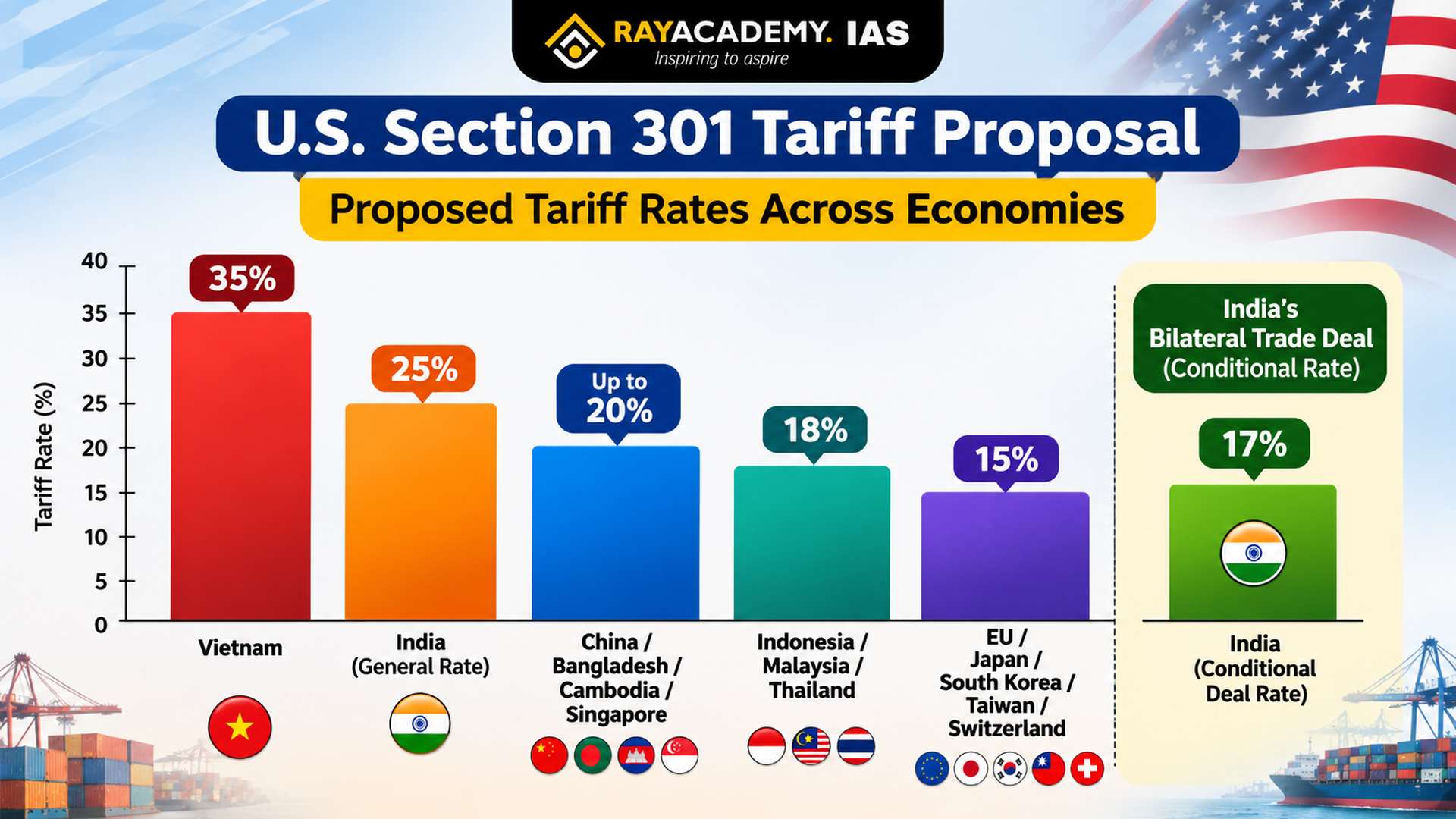
On November 25, 2026, the Office of the United States Trade Representative (USTR) proposed a 25% ad valorem tariff on Indian goods following a Section 301 investigation into alleged structural excess capacity in manufacturing across 14 major economies. This represents the second-highest proposed duty among the targeted nations, trailing only Vietnam's 35% levy.
UPSC Syllabus Mapping:
General Studies Paper II (International Relations): Bilateral, regional and global groupings and agreements involving India and/or affecting India’s interests; Effect of policies and politics of developed and developing countries on India’s interests.
General Studies Paper III (Indian Economy): Indian Economy and issues relating to planning, mobilization of resources, growth, development and employment; Effects of liberalization on the economy, changes in industrial policy and their effects on industrial growth.
Crucially, the USTR order stipulates that the tariff could drop to 17% if New Delhi and Washington conclude a reciprocal bilateral trade agreement responsive to the investigation's findings. India’s Ministry of Commerce and Industry firmly rejected the allegation of having structural overcapacity in any sector, while reaffirming its commitment to constructive negotiations toward an early trade deal.
Static-Current Linkage: Section 301, WTO Jurisprudence, and Industrial Policy. Tariff on India
Understanding the U.S. tariff action requires connecting domestic American trade statutes with multilateral World Trade Organization (WTO) principles and India's constitutional-economic framework.
Legal Mechanics of Section 301 of the U.S. Trade Act of 1974
Section 301 of the Trade Act of 1974 empowers the USTR to investigate and retaliate against foreign acts, policies, or practices deemed "unreasonable or discriminatory" that burden or restrict U.S. commerce. Unlike anti-dumping duties or countervailing duties (CVDs)—which target specific products sold below fair value or directly subsidised—Section 301 operates as a broad, unilateral executive instrument.
In March 2026, the USTR initiated two parallel probes into trading partners: one concerning forced labour (which resulted in a 10% tariff on India in July 2026) and a second targeting structural excess manufacturing capacity. The newly proposed 25% tariff is net of existing Section 301 tariffs, meaning importers would pay the higher applicable rate rather than a cumulative stack.
Multilateral Trade Rules and WTO Compliance
Under Article I (Most-Favoured-Nation treatment) and Article II (Schedules of Concessions) of the General Agreement on Tariffs and Trade (GATT) 1994, WTO members cannot unilaterally raise tariffs above bound rates or discriminate between trading partners without exhausting the Dispute Settlement Body (DSB) mechanism.
Unilateral Section 301 tariffs bypass the WTO dispute settlement framework, which has already been severely weakened by the paralysis of the WTO Appellate Body since 2019. For India, this highlights the growing friction between multilateral rules-based trade and unilateral geoeconomic statecraft.
Domestic Industrial Policy and Constitutional Mandate
The USTR report specifically flagged India’s industrial expansion frameworks—such as Make in India and the Production Linked Incentive (PLI) scheme—alongside directed lending norms as contributors to global overcapacity in steel, solar, medical devices, pharmaceuticals, and electronics.
From an Indian policy perspective, state-supported industrialization aligns with Article 38 and Article 39(b)-(c) of the Directive Principles of State Policy (DPSP), which mandate the State to promote economic welfare, build domestic manufacturing resilience, and reduce import dependence on non-market economies.
Prelims Focus: High-Yield Objective Facts
Nodal Indian Ministry: Ministry of Commerce and Industry (Department of Commerce), Government of India.
Investigating Foreign Authority: Office of the United States Trade Representative (USTR), operating under the Executive Office of the U.S. President.
Statutory Provision: Section 301 of the U.S. Trade Act of 1974 (distinct from Section 232 of the Trade Expansion Act of 1962, which deals with national security threats).
Targeted Economies (14 Affirmative Findings): India (25%), Vietnam (35%), China, Bangladesh, Cambodia, Singapore (up to 20%), Indonesia, Malaysia, Thailand (18%), and the European Union, Japan, South Korea, Switzerland, Taiwan (15%).
Key Sectoral Exemptions & Exposures: While India's two largest export categories to the U.S.—generic pharmaceuticals and smartphones—have been granted exemptions in the preliminary annex, labour-intensive sectors such as textiles and apparel, gems and jewellery, marine products (shrimp), solar modules, and medical devices face direct exposure.
Procedural Timeline: Written public comments are due by January 5, 2027, followed by public hearings at the U.S. International Trade Commission (USITC) on January 25, 2027, before final duty enforcement.
Mains Analytical Breakdown
Strategic and Economic Significance for India
Relative Competitive Advantage Under a Bilateral Deal: If India secures a reciprocal trade deal capping tariffs at 17%, Indian exporters would gain a 1 to 3 percentage point tariff advantage over key Asian manufacturing rivals—including Indonesia, Malaysia, and Thailand (18%), as well as Bangladesh, Cambodia, China, and Vietnam (20%–35%). This could accelerate China-Plus-One supply chain diversification toward India.
Protection of Core Export Pillars: The exemption of generic drugs (which supply roughly 40% of U.S. generic demand) and smartphones insulates India's highest-value merchandise exports and preserves bilateral healthcare and digital supply chain interdependence.
Catalyst for Domestic Structural Reforms: External scrutiny of logistics bottlenecks, factor market rigidities, and regulatory compliance provides momentum for India to accelerate domestic ease of doing business and quality-control standards.
Multi-Dimensional Challenges
Economic Vulnerability of Labour-Intensive MSMEs: Imposing a 25% tariff on textiles, garments, gems and jewellery, and seafood directly threatens Micro, Small, and Medium Enterprises (MSMEs), which operate on thin profit margins and employ millions of semi-skilled workers, potentially triggering localized employment shocks.
Geopolitical Friction and Strategic Autonomy: Washington’s demand that India align its industrial subsidies, directed lending (Priority Sector Lending), and foreign investment screening with U.S. determinations tests India’s strategic autonomy and sovereign policy space to pursue developmental industrial policy.
Political and Livelihood Sensitivities in Bilateral Talks: Concluding a reciprocal trade deal requires navigating sensitive Indian red lines, particularly Washington's push for market access in genetically modified (GM) agricultural crops and dairy products, which could adversely impact small and marginal Indian farmers.
Environmental and Clean Energy Transition Risks: Tariffs on Indian solar photovoltaic modules complicate bilateral clean-energy cooperation and threaten the financial viability of domestic renewable manufacturing ecosystems built under the PLI scheme.
Ethical and Rules-Based Trade Concerns: Coercive unilateralism undermines the normative legitimacy of multilateralism, placing developing economies at an asymmetric disadvantage when negotiating with larger markets outside WTO dispute settlement safeguards.
Way Forward: Policy and Institutional Roadmap
Calibrated Bilateral Trade Diplomacy: As recommended by the NITI Aayog Strategy for New India @ 75, India should pursue an early, balanced Bilateral Trade Agreement (BTA) that locks in the lower 17% tariff ceiling while ring-fencing sensitive agricultural and dairy livelihoods through tariff-rate quotas (TRQs) rather than blanket market opening.
Evidence-Based Counter-Narrative at USITC Hearings: The Department of Commerce and export promotion councils must submit granular capacity-utilization data during the January 2027 USITC hearings to demonstrate that India’s PLI incentives address domestic infrastructure deficits rather than creating export-dumping overcapacity.
Export Market Diversification: To reduce over-reliance on the U.S. market (which accounts for nearly 18% of India's merchandise exports), India must expedite Free Trade Agreements (FTAs) with the European Union and the United Kingdom, while operationalizing trade corridors with West Asia and Latin America.
Strengthening WTO Dispute Settlement Advocacy: India should collaborate with like-minded G20 and Global South nations to push for the restoration of a two-tier WTO Appellate Body and establish plurilateral transparency norms regarding industrial subsidies.
Enhancing MSME Competitiveness: Implementing the 2nd Administrative Reforms Commission (ARC) principles on regulatory simplification and expanding the Remission of Duties and Taxes on Exported Products (RoDTEP) scheme will help labour-intensive sectors absorb external tariff shocks.
Value Addition Snippet (Economic Survey & RBI Data)
Bilateral Trade Weight: According to the Economic Survey and Ministry of Commerce trade statistics, the United States remains India’s largest trading partner, accounting for roughly 17.7% of India's total merchandise exports and generating a consistent bilateral merchandise trade surplus of over $35 billion for India.
Manufacturing Share: The Reserve Bank of India (RBI) KLEMS database highlights that India’s manufacturing sector contributes approximately 17% of Gross Value Added (GVA)—far below the threshold associated with global structural overcapacity, providing strong empirical backing for New Delhi's rebuttal of USTR claims.
Active Recall Practice Exercises
Prelims Practice Question (Multi-Statement MCQ)
Q. With reference to "Section 301 of the U.S. Trade Act of 1974" and international trade governance, consider the following statements:
Section 301 authorizes the Office of the United States Trade Representative (USTR) to impose unilateral trade sanctions on foreign countries whose practices burden or restrict U.S. commerce, even without prior authorization from the World Trade Organization (WTO).
Unlike anti-dumping duties, which require proof of product-specific price discrimination, Section 301 investigations can target systemic industrial policies and structural capacity across multiple sectors.
Under the General Agreement on Tariffs and Trade (GATT) 1994, bilateral tariff concessions negotiated under a reciprocal trade deal automatically violate the Most-Favoured-Nation (MFN) principle without any legal exceptions.
How many of the statements given above are correct? (a) Only one
(b) Only two
(c) All three
(d) None
Answer: (b) Only two
Explanation:
Statement 1 is correct: Section 301 of the Trade Act of 1974 grants broad statutory authority to the USTR to investigate and take retaliatory tariff action unilaterally against perceived unfair trade practices, independent of WTO rulings.
Statement 2 is correct: Anti-dumping duties are narrowly governed by the WTO Anti-Dumping Agreement and target specific goods exported below normal value. In contrast, Section 301 allows broad macroeconomic scrutiny of industrial subsidies, labour standards, and capacity utilization.
Statement 3 is incorrect: While Article I of GATT 1994 mandates MFN treatment, Article XXIV of GATT explicitly provides an exception permitting countries to form Free Trade Areas (FTAs) or Customs Unions that grant preferential tariff rates to bilateral partners, provided substantially all trade is covered.
Mains Practice Question (150 Words | 10 Marks)
Q. "Unilateral tariff actions under domestic trade statutes challenge both multilateral trade governance and the developmental policy space of emerging economies." Discuss in the context of the proposed U.S. Section 301 tariffs on India and suggest a balanced diplomatic and economic response. (150 words)
Model Answer Structure:
Introduction (25 words): Contextualize the USTR’s proposed 25% Section 301 tariff on India over alleged structural excess capacity, alongside the conditional 17% rate tied to a bilateral trade deal.
Body – Dual Impact (65 words):
Multilateral Governance: Unilateral duties bypass WTO Dispute Settlement mechanisms and erode Most-Favoured-Nation (MFN) norms.
Developmental Policy Space: Targeting India’s PLI schemes and directed lending constrains state-led industrialization vital for employment generation and supply chain resilience. Labour-intensive MSMEs (textiles, jewellery, seafood) face acute margin pressure.
Way Forward (45 words): Expedite a calibrated Bilateral Trade Agreement to secure the 17% competitive tariff edge while protecting sensitive farm/dairy sectors; submit empirical capacity-utilization data at USITC hearings; and diversify exports via EU/UK FTAs.
Conclusion (15 words): Conclude on aligning domestic industrial competitiveness with rules-based global trade diplomacy.
Take this article with you
Save a reading copy for offline study.


