

On this page
SCO Civilisational
Inauguration of First SCO Civilisational Dialogue Forum: On November 20, 2026, Prime Minister Narendra Modi inaugurated the three-day First Shanghai Cooperation Organisation (SCO) Civilisational Dialogue Forum (November 20–22, 2026) at the historic Purana Qila in New Delhi, jointly hosted by the Ministry of Culture and the Ministry of External Affairs (MEA).
OPSC Syllabus Mapping:
General Studies Paper II (International Relations): Bilateral, regional and global groupings and agreements involving India and/or affecting India’s interests; India and its neighbourhood- relations; Effect of policies and politics of developed and developing countries on India’s interests.
General Studies Paper I (Indian Heritage & Culture): Indian culture will cover the salient aspects of Art Forms, Literature and Architecture from ancient to modern times (Eurasian Silk Route linkages, Buddhist heritage, and shared architectural traditions).
Cultural Connect as Guarantor of Peace: Invoking the Indian civilisational ethos of Vasudhaiva Kutumbakam ("the whole world is one family"), Prime Minister Modi emphasized that cultural connectivity and shared civilisational heritage serve as the strongest guarantees of global peace amid ongoing geopolitical conflicts.
image_f5509e.png
High-Level Pakistani Participation Post-May 2025 Conflict: Pakistan’s Federal Minister for Climate Change and Environmental Coordination, Musadik Masood Malik, led Islamabad’s delegation in New Delhi—marking the first visit by a Pakistani minister to India in over three years and the first since the four-day military confrontation in May 2025 (Operation Sindoor).
Static-Current Linkage: Institutional Evolution of SCO and Cultural Diplomacy
Genesis and Expansion of the Shanghai Cooperation Organisation (SCO)
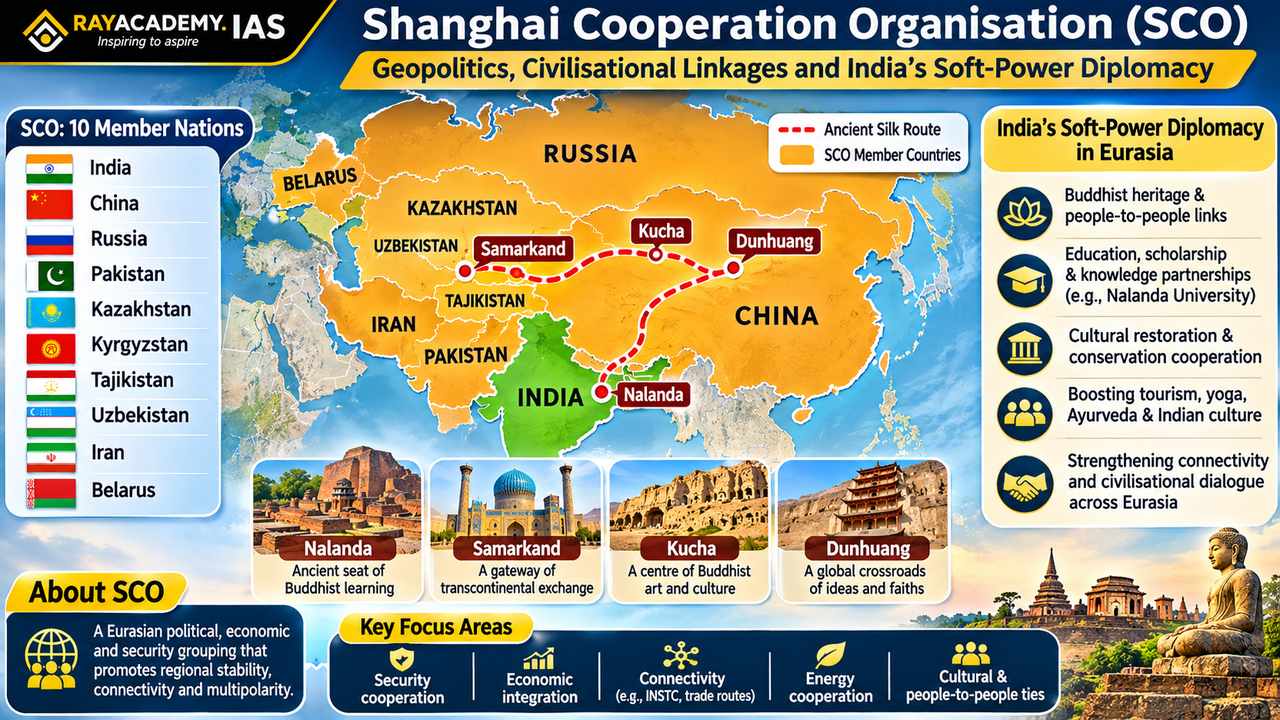
Originating from the Shanghai Five mechanism (1996), the Shanghai Cooperation Organisation (SCO) was formally established on June 15, 2001, in Shanghai by six founding members: China, Russia, Kazakhstan, Kyrgyzstan, Tajikistan, and Uzbekistan. It currently comprises 10 full member states:
2001 Founders: China, Russia, Kazakhstan, Kyrgyzstan, Tajikistan, Uzbekistan.
2017 Expansion (Astana Summit): India and Pakistan admitted as full members.
2023 Expansion: Iran admitted as the ninth member.
2024 Expansion (Astana Summit): Belarus admitted as the tenth full member.
Genesis of the Civilisational Dialogue Forum
The SCO Civilisational Dialogue Forum stems from Prime Minister Modi’s proposal at the 2025 SCO Summit in Tianjin, China, to institutionalize a dedicated platform celebrating Eurasia’s shared cultural and historical roots, which was subsequently endorsed in the Bishkek Declaration. The inaugural conclave features the ASTITVA archaeological exhibition (tracing Delhi’s continuous history from 1200 BCE to 1200 CE) and four thematic sessions covering performing arts, textiles, culinary traditions, manuscripts, and monastic trails.
Historical Silk Route and Civilisational Linkages
Eurasia is bound by centuries-old cross-cultural exchanges predating modern Westphalian borders:
Buddhist Monastic & Knowledge Networks: Transmission of ideas and texts via Nalanda, Kucha, and Dunhuang through scholars and monks like Faxian, Xuanzang, Yijing, and Kumarajiva.
Art, Music, and Architectural Syncretism: Cross-pollination between Central Asian Maqam and Indian Raga traditions, Sufi musical heritage (Qawwali), and Timurid garden aesthetics from Samarkand and Herat inspiring the Charbagh architectural style.
Prelims Focus: High-Yield Objective Facts
Permanent Bodies of SCO:
SCO Secretariat: Headquartered in Beijing, China.
Regional Anti-Terrorist Structure (RATS): Headquartered in Tashkent, Uzbekistan; coordinates counter-terrorism, anti-separatism, and anti-extremism intelligence among member states.
Official Languages of SCO: Russian and Chinese.
Venue Significance – Purana Qila (Old Fort), New Delhi: Built primarily by Afghan ruler Sher Shah Suri (as Shergarh) and Mughal Emperor Humayun (as Dinpanah) on the banks of the Yamuna, standing atop ancient Indraprastha archaeological layers dating back to the Painted Grey Ware (PGW) culture (~1000 BCE).
image_f5509e.png
SCO Cultural & Tourist Capital Initiative: Launched during India’s SCO Presidency (2022–23), under which Varanasi (Kashi) was designated as the first-ever SCO Cultural and Tourist Capital (2022–23), followed by Almaty (2023–24) and Qingdao (2024–25).
India’s Diplomatic Posture on the Forum: Hosted as a multilateral SCO obligation; the MEA clarified that no bilateral talks were scheduled with Pakistan and India’s core positions—including keeping the Indus Waters Treaty in abeyance until cross-border terrorism ceases—remain unchanged.
Mains Analytical Breakdown
Strategic Significance of Civilisational Diplomacy in SCO
Soft Power as a Stabilizing Instrument: In an era marked by geopolitical fragmentation, war in Ukraine, and West Asian instability, cultural diplomacy creates low-friction channels for people-to-people (P2P) connectivity, reinforcing India’s image as a Vishwa Bandhu (global friend).
image_f5509e.png
Deepening Central Asian Outreach ("Connect Central Asia"): By highlighting shared Buddhist, Sufi, and Silk Route heritage, India counters unilateral connectivity narratives in Eurasia and strengthens cultural goodwill across the five Central Asian Republics without triggering zero-sum security competition.
Upholding Multilateral Norms Despite Bilateral Friction: Extending a standard multilateral invitation to all SCO members—including Pakistan—demonstrates India’s maturity as a responsible regional power that separates multilateral treaty obligations from bilateral diplomatic red lines.
Harnessing Digital Tools for Heritage Preservation: Leveraging 21st-century digital technologies (AI-assisted manuscript translation, virtual museum archives) democratizes access to ancient Eurasian texts and engages younger generations.
Multi-Dimensional Challenges and Geopolitical Realities
1. Limits of Soft Power Against Hard Security Dilemmas
Terrorism and Trust Deficit: While shared heritage fosters academic and artistic goodwill, cultural dialogue alone cannot resolve entrenched hard-security disputes—most notably state-sponsored cross-border terrorism, which led to the April 2025 Pahalgam terror attack and the May 2025 military escalation.
2. Internal Contradictions Within the SCO
Asymmetric Geopolitical Alignments: The 10-member SCO encompasses diverse strategic orientations—ranging from Russia and China’s anti-Western posture to India’s multi-alignment and Quad partnerships—creating friction over connectivity projects like the China-Pakistan Economic Corridor (CPEC), which infringes upon India’s sovereignty in Pakistan-occupied Kashmir (PoK).
3. Domestic Political Sensitivities
Public and Political Pushback: High-profile visits by Pakistani ministers to multilateral summits in India inevitably generate domestic political debate over the principle that "terror and talks cannot go together", narrowing diplomatic room for maneuver.
Way Forward
Institutionalize an SCO Digital Heritage & Manuscript Grid: Operationalize PM Modi’s vision of using Artificial Intelligence and digital archiving to create an open-access Eurasian Civilisational Repository linking Indian institutions (like the National Mission for Manuscripts and Nalanda University) with Central Asian academies.
Operationalize Buddhist and Sufi Tourism Circuits: Connect India’s Swadesh Darshan Buddhist and Sufi circuits with Central Asian heritage hubs through simplified e-Tourist Visa regimes and direct air connectivity under the International North-South Transport Corridor (INSTC) framework.
Maintain Firm Security Guardrails Within Multilateralism: Continue upholding the SCO Charter and RATS counter-terrorism mandate while keeping bilateral normalization strictly contingent on verifiable, irreversible cessation of cross-border terrorism.
Expand Track-II Academic and Youth Exchanges: Institutionalize annual SCO Young Scholars Fellowships and archaeological joint excavations to build durable epistemic communities across Eurasia.
image_f5509e.png
Value Addition for Mains Answers
PM Modi’s Key Quote (November 20, 2026): "Indian culture has taught us Vasudhaiva Kutumbakam—the whole world is our family. Our desire for our own well-being is deeply rooted in global well-being, and cultural connect is the biggest guarantee of global peace."
image_f5509e.png
Pakistan Minister’s Remark on Shared Heritage: "Singularity does not require dialogue; it requires a monologue. Dialogue is about diversity. Cultures and civilisations cut across boundaries."
image_f5509e.png
Foreign Policy Concept: India’s participation in SCO cultural diplomacy exemplifies Civilisational Statecraft—deploying pluralistic heritage and soft power to shape Eurasian norms while safeguarding sovereign hard security interests.
Practice Questions for Active Recall
Prelims Practice MCQ
With reference to the Shanghai Cooperation Organisation (SCO) and the First SCO Civilisational Dialogue Forum (2026), consider the following statements:
The First SCO Civilisational Dialogue Forum was hosted by India at Purana Qila in New Delhi in November 2026.
image_f5509e.png
India and Pakistan became full members of the SCO at the Astana Summit in 2017, while Iran and Belarus joined subsequently to take total membership to ten.
The Regional Anti-Terrorist Structure (RATS) of the SCO is permanently headquartered in Beijing, China.
Which of the statements given above is/are correct? A. 1 and 2 only
B. 2 and 3 only
C. 1 and 3 only
D. 1, 2 and 3
Correct Answer: A
Explanation:
Statement 1 is correct: Prime Minister Narendra Modi inaugurated the First SCO Civilisational Dialogue Forum at Purana Qila, New Delhi (November 20–22, 2026).
image_f5509e.png
Statement 2 is correct: Founded by six nations in 2001, the SCO admitted India and Pakistan in 2017, followed by Iran (2023) and Belarus (2024), making it a 10-nation grouping.
image_f5509e.png
Statement 3 is incorrect: While the SCO Secretariat is located in Beijing, China, the Regional Anti-Terrorist Structure (RATS) is permanently headquartered in Tashkent, Uzbekistan.
Mains Practice Question (GS Paper II – 150 Words / 10 Marks)
"Cultural diplomacy can cushion geopolitical friction, yet it cannot substitute for hard-security trust." Discuss in the context of India hosting the First SCO Civilisational Dialogue Forum (2026) and its broader Eurasian diplomacy.
Answer Structure Hint:
Introduction: Contextualize the inauguration of the First SCO Civilisational Dialogue Forum in New Delhi (November 2026) anchored in Vasudhaiva Kutumbakam and shared Silk Route heritage.
image_f5509e.png
Body: Examine the value of cultural statecraft (fostering P2P ties across Central Asia, preserving shared Buddhist/Sufi/architectural heritage, and honoring multilateral SCO obligations despite Pakistani participation post-May 2025 conflict). Balance this with structural limitations (unresolved cross-border terrorism, sovereignty concerns over CPEC, and divergent great-power alignments within the SCO).
image_f5509e.png
Conclusion: Suggest pairing digital heritage cooperation and Track-II academic exchanges with uncompromising counter-terrorism norms under SCO-RATS.
Take this article with you
Save a reading copy for offline study.


