

On this page
Supreme Court Reaffirms Expert Body Jurisdiction
: On November 20, 2026, a Supreme Court Bench headed by Justice Vikram Nath dismissed applications filed by the State of Tamil Nadu seeking directions to Karnataka to release an alleged shortfall of 11.719 TMC (thousand million cubic feet) of Cauvery water on a pro-rata basis at Biligundulu during the 2026–27 water year.
OPSC Syllabus Mapping:
General Studies Paper II (Indian Polity & Governance): Functions and responsibilities of the Union and the States, issues and challenges pertaining to the federal structure, devolution of powers and finances up to local levels and challenges therein; Separation of powers between various organs, dispute redressal mechanisms and institutions; Statutory, regulatory and various quasi-judicial bodies.
Deference to CWMA and CWRC: The Apex Court held that disputed hydrological shortfall assessments must be adjudicated by the statutory expert machinery—the Cauvery Water Management Authority (CWMA) and the Cauvery Water Regulation Committee (CWRC)—which review basin conditions every 15 days.
Curbing Frequent Inter-State Litigation: Noting that the June–May water cycle was still underway and subsequent rainfall had partially offset earlier deficits, the Court cautioned States against rushing to the judiciary to challenge technical decisions of statutory river authorities.
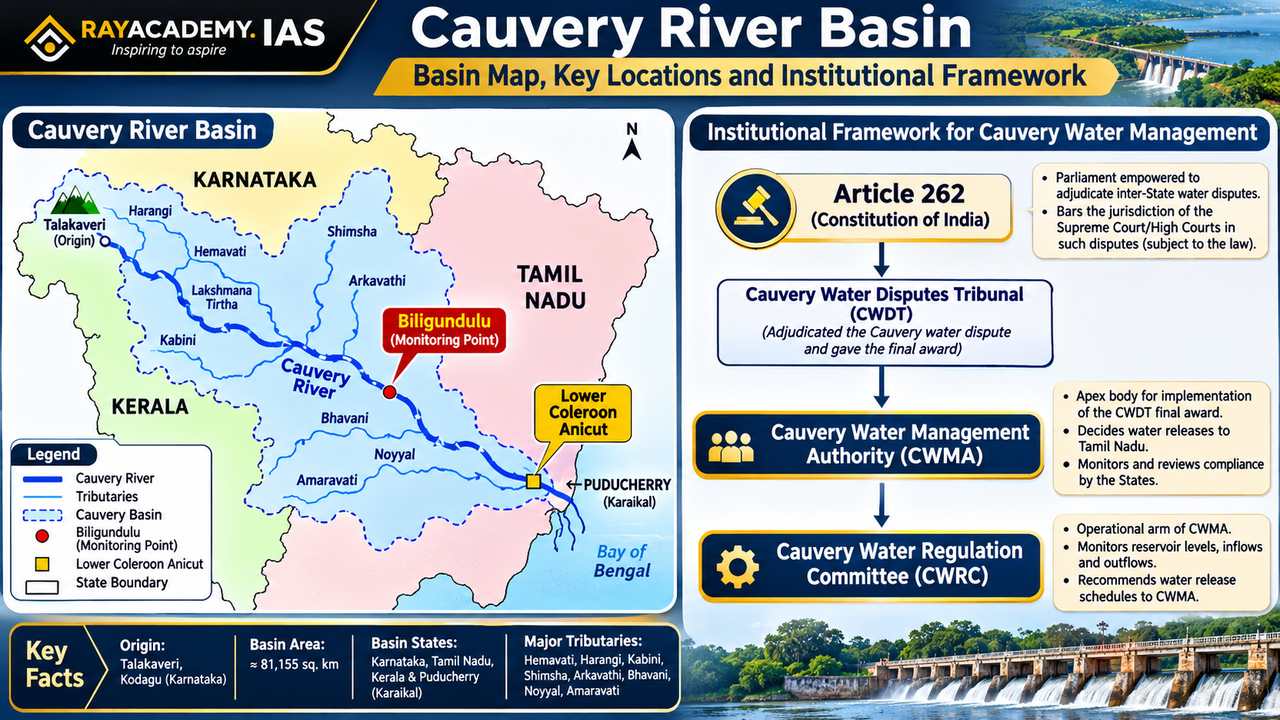
Static-Current Linkage: Constitutional, Statutory, and Judicial Framework
Constitutional Provisions on Inter-State Water Governance
Entry 17 of the State List (Seventh Schedule): Empowers State Legislatures to legislate on "Water, that is to say, water supplies, irrigation and canals, drainage and embankments, water storage and water power", subject to the provisions of Entry 56 of the Union List.
Entry 56 of the Union List (Seventh Schedule): Authorizes Parliament to regulate and develop inter-State rivers and river valleys to the extent declared by Parliament to be expedient in the public interest.
Article 262 of the Constitution: Explicitly empowers Parliament to provide by law for the adjudication of any dispute or complaint with respect to the use, distribution, or control of the waters of any inter-State river or river valley. Crucially, Article 262(2) allows Parliament to bar the jurisdiction of the Supreme Court and all other courts in respect of such disputes.
Statutory Framework: Inter-State River Water Disputes (ISRWD) Act, 1956
Enacted under Article 262, the ISRWD Act, 1956 establishes Water Disputes Tribunals upon a State’s request when negotiations fail. Under Section 11 of the Act, neither the Supreme Court nor any other court can exercise original jurisdiction over a water dispute referred to a Tribunal. However, the Supreme Court has consistently held that it retains appellate jurisdiction under Article 136 (Special Leave Petition) to examine whether a Tribunal exceeded its jurisdiction or violated principles of natural justice, as well as enforcement jurisdiction over final awards.
Evolution of the Cauvery Award and CWMA (2007–2018)
CWDT Final Award (2007): Constituted in 1990, the Cauvery Water Disputes Tribunal (CWDT) assessed the total annual yield at 740 TMC (at 50% dependability at Lower Coleroon Anicut) and allocated 419 TMC to Tamil Nadu, 270 TMC to Karnataka, 30 TMC to Kerala, and 7 TMC to Puducherry, alongside 10 TMC for environmental protection and 4 TMC for inevitable escapage into the sea.
Supreme Court Modification (2018): In February 2018, the Supreme Court declared the Cauvery a national asset belonging to no single State, slightly modifying the shares to 404.25 TMC for Tamil Nadu (plus 10 TMC groundwater allowance in the delta) and 284.75 TMC for Karnataka (accounting for Bengaluru’s drinking water needs), while keeping Kerala (30 TMC) and Puducherry (7 TMC) unchanged.
Cauvery Water Management Scheme, 2018: Pursuant to the 2018 judgment, the Union Government notified this scheme under Section 6A of the ISRWD Act, 1956, creating a two-tier regulatory mechanism: the apex Cauvery Water Management Authority (CWMA) and the technical Cauvery Water Regulation Committee (CWRC).
Prelims Focus: High-Yield Objective Facts
Origin and Course of River Cauvery: Rises at Talakaveri in the Brahmagiri Hills (Kodagu district, Karnataka) in the Western Ghats and flows southeastward through Karnataka and Tamil Nadu to drain into the Bay of Bengal at Poompuhar (forming a fertile delta often called the "Garden of Southern India").
Major Tributaries of Cauvery:
Left Bank: Harangi, Hemavati, Shimsha, Arkavathy.
Right Bank: Lakshmana Tirtha, Kabini, Suvarnavathi, Bhavani, Noyyal, Amaravati.
Key Monitoring & Hydraulic Points:
Biligundulu: The central inter-State gauging/measuring station operated by the Central Water Commission (CWC) on the Karnataka–Tamil Nadu border where Karnataka’s monthly stipulated releases are verified.
Lower Coleroon Anicut: Located in Tamil Nadu, serving as the reference point for assessing the basin's 740 TMC total yield at 50% dependability.
Statutory Nature of CWMA: A permanent body created by the Central Government under Section 6A of the Inter-State River Water Disputes Act, 1956, headquartered in New Delhi, with representation from the Union Government and all four basin States/UTs.
Mains Analytical Breakdown
Significance of the Supreme Court’s Ruling
Reinforcing Institutional Autonomy of Expert Bodies: By refusing to micromanage 15-day release schedules, the Supreme Court upheld the doctrine of separation of powers and institutional legitimacy of technical regulators (CWMA and CWRC), preventing judicial overreach into complex hydrological modeling.
Curbing "Forum Shopping" and Endless Litigation: Repeated interlocutory applications during ongoing monsoon cycles paralyze executive water management. The ruling establishes a vital precedent discouraging riparian States from bypassing statutory dispute-resolution forums.
Promoting Dynamic, Real-Time Basin Management: Recognizing that the water year runs from June to May and monsoonal inflows fluctuate dynamically, the Court validated adaptive, fortnightly monitoring by the CWRC over rigid mid-season judicial mandates.
Multi-Dimensional Challenges in Inter-State Water Governance
1. Ambiguity in "Distress-Sharing" Formula
Absence of a Quantified Pro-Rata Matrix: While the 2018 Supreme Court judgment mandated that riparian States share water deficits proportionately (pro-rata) during distress years of deficient rainfall, neither the Tribunal nor the CWMA has codified a mathematically unambiguous distress-sharing formula. Consequently, upper and lower riparian States routinely clash over whether releases should occur only after upstream reservoirs fill or strictly in monthly instalments.
2. Political Federalism and Electoral Compulsions
Securitization and Politicization of Water: In both Karnataka and Tamil Nadu, Cauvery water is deeply tied to agrarian livelihoods and regional identity. Political parties frequently weaponize water shortages for electoral mobilization, undermining the spirit of cooperative federalism and pushing State governments toward adversarial litigation.
3. Infrastructural Flashpoints (Mekedatu Reservoir Row)
Trust Deficit Over Upstream Storage: Karnataka’s proposed Mekedatu balancing reservoir (48 TMC capacity) near the Tamil Nadu border remains a major bone of contention. While Karnataka asserts it is meant for Bengaluru’s drinking water and hydropower without altering Tamil Nadu’s share, Tamil Nadu fears enhanced upstream storage capacity will allow Karnataka to manipulate the timing of flows during lean monsoons.
4. Climate Change and Agrarian Water-Use Inefficiency
Ecological & Cropping Mismatch: Erratic southwest and northeast monsoons are increasing the frequency of hydrological distress years, while continued cultivation of water-intensive crops (such as multi-season paddy and sugarcane) in semi-arid zones exacerbates demand-supply friction.
Way Forward
Codify a Transparent Distress-Sharing Formula: The CWMA and Central Water Commission (CWC) should urgently formulate an objective, algorithm-driven pro-rata distress-sharing protocol linked to real-time reservoir inflows, soil moisture, and rainfall anomalies to eliminate arbitrary mid-season disputes.
Operationalize the ISRWD (Amendment) Framework: In line with the Sarkaria Commission and Punchhi Commission recommendations on Centre-State relations, India should transition toward a single, permanent Inter-State River Water Disputes Tribunal with strict statutory timelines and a centralized National Water Informatics Centre (NWIC) telemetry grid.
Shift Toward Basin-Wide Demand Management: Drawing on NITI Aayog’s Composite Water Management Index (CWMI) and the Mihir Shah Committee Report, both States must incentivize micro-irrigation (drip/sprinkler), crop diversification away from water-guzzling paddy, and conjunctive use of surface and groundwater.
Depoliticize Disputes via Joint Basin Councils: Institutionalize structured, non-partisan River Basin Organizations (RBOs) under the proposed River Basin Management Bill framework, bringing together agronomists, ecologists, and farmer representatives from both States to build grassroots riparian trust.
Value Addition for Mains Answers
Key Allocation Data (2018 SC Award out of 740 TMC): Tamil Nadu: 404.25 TMC (+ 10 TMC groundwater); Karnataka: 284.75 TMC; Kerala: 30 TMC; Puducherry: 7 TMC; Environmental Flows: 10 TMC; Inevitable Escapage to Sea: 4 TMC.
Constitutional & Judicial Quote: In State of Karnataka v. State of Tamil Nadu (2018), the Supreme Court affirmed: "Waters of an inter-State river pass through the territories of several States; such waters cannot be considered as the exclusive property of any single riparian State, for rivers are a national asset."
Practice Questions for Active Recall
Prelims Practice MCQ
With reference to the constitutional and statutory framework governing inter-State river water disputes in India, consider the following statements:
Article 262 of the Constitution empowers Parliament to bar the jurisdiction of the Supreme Court in respect of any dispute relating to the waters of an inter-State river or river valley.
The Cauvery Water Management Authority (CWMA) was established as a constitutional body directly under Article 263 of the Constitution.
Under the 2018 Supreme Court verdict on the Cauvery water dispute, Karnataka was allocated a larger annual share of water than Tamil Nadu.
Which of the statements given above is/are correct? A. 1 only
B. 1 and 2 only
C. 2 and 3 only
D. 1, 2 and 3
Correct Answer: A
Explanation:
Statement 1 is correct: Under Article 262(2) of the Constitution, Parliament may by law provide that neither the Supreme Court nor any other court shall exercise jurisdiction in respect of any inter-State river water dispute (enacted via Section 11 of the ISRWD Act, 1956).
Statement 2 is incorrect: The CWMA is a statutory body notified by the Central Government in 2018 under Section 6A of the Inter-State River Water Disputes Act, 1956, not a constitutional body under Article 263 (which deals with the Inter-State Council).
Statement 3 is incorrect: Out of the total 740 TMC yield, the 2018 Supreme Court judgment allocated 404.25 TMC to Tamil Nadu and 284.75 TMC to Karnataka, making Tamil Nadu’s share larger.
Mains Practice Question (GS Paper II – 150 Words / 10 Marks)
"Frequent judicial recourse in inter-State river water disputes often reflects institutional deficits in technical regulation and cooperative federalism." Discuss in light of the Supreme Court’s recent ruling on the Cauvery water dispute and suggest reforms for durable basin governance.
Answer Structure Hint:
Introduction: Cite Article 262 and contextualize the Supreme Court’s November 2026 dismissal of Tamil Nadu’s plea seeking 11.719 TMC additional Cauvery water, wherein the Court reaffirmed the authority of the CWMA and CWRC.
Body: Analyze why States repeatedly approach the judiciary despite statutory tribunals—absence of a codified pro-rata distress-sharing formula during weak monsoons, regional electoral pressures, and trust deficits over upstream projects like Mekedatu. Highlight how judicial deference strengthens expert regulators while identifying needed reforms (codified distress-sharing protocols, permanent single-tribunal reform per Sarkaria/Punchhi Commissions, real-time CWC telemetry, and basin-wide crop/water-use efficiency).
Conclusion: Conclude with the Supreme Court’s doctrine of rivers as national assets requiring collaborative, ecological, and depoliticized governance.
Take this article with you
Save a reading copy for offline study.


