

On this page
- Understand what the Prelims actually tests
- Start with a realistic preparation timeline
- Choose limited sources and revise them often
- Make current affairs useful, not endless
- Use previous years’ questions as your compass
- Build a weekly study routine that you can sustain
- Do not ignore CSAT
- Practise mock tests in the right way
- Revise more than you read
- Take care of exam temperament
- FAQ
- The best preparation is simple and repeated
The UPSC Prelims can look simple on paper: two objective papers, one day, multiple-choice questions. Yet most serious aspirants know the real challenge is not the format. It is the range of the syllabus, the unpredictability of questions, and the pressure of making smart choices under time limits.
A strong plan for UPSC CSE Prelim 2027 should do three things well. It should build conceptual clarity, train elimination skills, and keep revision at the centre of preparation. Reading more is not enough. The goal is to remember what matters, apply it quickly, and avoid avoidable mistakes.
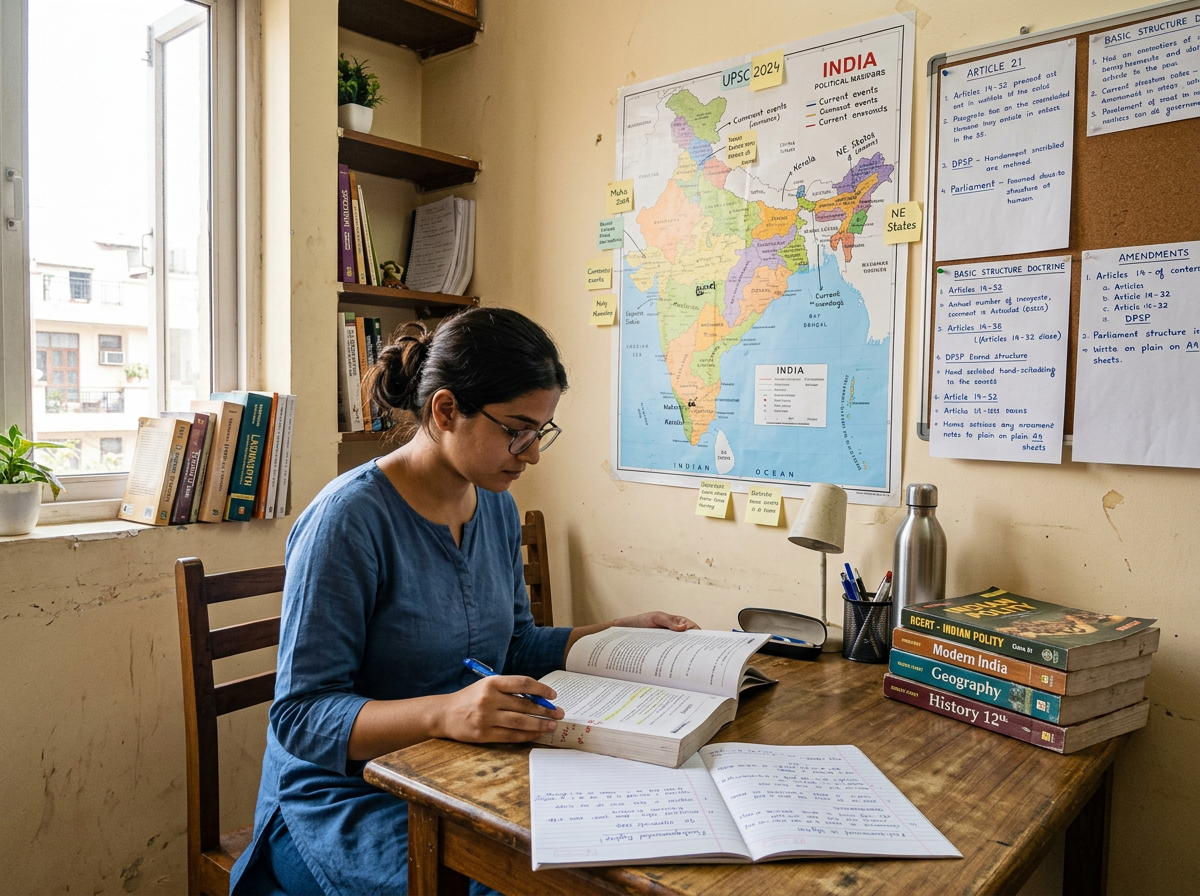
Understand what the Prelims actually tests
Before making a timetable, understand the nature of the exam.
The Civil Services Preliminary Examination has two papers:
Paper | Nature | What it tests |
General Studies Paper I | Counts for Prelims cut-off | History, polity, economy, geography, environment, science, current affairs, and related areas |
CSAT Paper II | Qualifying paper | Comprehension, reasoning, basic numeracy, decision-making, and analytical ability |
CSAT is qualifying in nature, and candidates need to score the minimum qualifying marks prescribed by UPSC. General Studies Paper I decides whether a candidate clears Prelims, subject to clearing CSAT.
Prelims is not a memory test alone. It tests:
Conceptual clarity
Current affairs awareness
Ability to connect static topics with recent developments
Elimination skills
Accuracy under stress
Judgement on which questions to skip
For example, in polity, reading the Constitution articles is useful. But the exam may ask a question that needs understanding of appointments, powers, procedures, or institutional roles. In environment, it may not ask only definitions. It may test whether a species, treaty, habitat, or conservation body has been understood in context.
Start with a realistic preparation timeline
For 2027, the most useful approach is to divide preparation into phases. A long plan prevents panic, but only if each phase has a clear job.
Phase one builds the base
This phase should focus on NCERTs, standard books, and basic notes. The aim is not to finish everything quickly. The aim is to understand the subjects in a way that later revision becomes easy.
Use this phase for:
NCERTs for history, geography, polity basics, economy basics, and environment
One standard source per major subject
Short notes only where needed
Basic newspaper reading
Simple weekly revision
Avoid the mistake of collecting many books. For Prelims, one well-revised source is better than five half-read sources.
Phase two adds current affairs and testing
Once the basics are in place, start solving topic-wise questions. This phase should include previous years’ questions and sectional tests.
Use it for:
Previous years’ UPSC Prelims questions
Topic-wise MCQs after each subject
Monthly current affairs revision
Mapping practice for geography and international relations
CSAT practice at least once or twice a week
This is where preparation becomes exam-oriented. When a question goes wrong, ask why. Was it a fact you did not know, a concept you misunderstood, or an option you failed to eliminate?
Phase three is for revision and full tests
The final months before Prelims should not be used for fresh book hunting. This is the time to revise, test, analyse, and correct weaknesses.
Use it for:
Multiple revisions of core subjects
Full-length mock tests
Previous years’ papers in timed conditions
Current affairs consolidation
CSAT full-paper practice
Error notebook revision
By this stage, the aim is not to know everything. The aim is to improve the score range and reduce silly errors.
Choose limited sources and revise them often
The most common trap in UPSC preparation is source overload. Aspirants often feel that every topper’s booklist must be followed. That creates confusion.
A simple source plan works better.
Polity
Use one standard book and connect it with current developments. Focus on the Constitution, Parliament, executive, judiciary, federalism, constitutional bodies, non-constitutional bodies, and local government.
Polity questions often reward clarity. Do not mug up isolated lines. Understand who does what, who appoints whom, and what process applies in each case.
History and culture
For ancient and medieval history, focus on basic themes, terms, art forms, literature, religion, and important developments. For modern history, build a strong timeline from the decline of older powers to independence.
Modern history is often more predictable than other areas, but it still needs revision. Make simple timelines for movements, acts, committees, and organisations.
For art and culture, do not try to master everything in one go. Revise architecture, painting, dance, music, literature, religion, and UNESCO-related topics in small cycles.
Geography
Geography needs both concepts and maps. Physical geography becomes easier when basic ideas such as winds, pressure belts, ocean currents, rainfall, soil, and landforms are clear.
For Indian geography, link rivers, mountains, minerals, agriculture, climate, and industries with maps. Map work is not optional. It improves retention and helps in elimination.
Economy
Economy preparation should begin with basic terms. Inflation, fiscal deficit, monetary policy, balance of payments, taxation, banking, and budget-related concepts appear often in different forms.
Do not read economy like a dictionary. Connect concepts with current affairs. If the news mentions inflation, understand who measures it, what causes it, and how policy responds.
Environment and science
Environment has become a major part of Prelims preparation. Study ecology basics, protected areas, species, climate change, pollution, biodiversity, and international conventions.
Science and technology should be prepared through current affairs, with basic understanding. Focus on space, defence, biotechnology, health-related technologies, energy, and digital technologies when they appear in the news.
Make current affairs useful, not endless
Current affairs can become a daily burden if there is no system. Reading the newspaper for hours does not automatically improve Prelims performance. The skill is to identify what may matter for the exam.
Good current affairs preparation includes:
Reading one reliable newspaper or daily news summary
Making short notes only for exam-relevant issues
Revising monthly compilations
Linking news with static subjects
Practising MCQs based on current topics
For example, if a national park appears in the news, do not stop at the news item. Check its state, rivers nearby, major species, protected area status, and location on the map.
If a new government scheme is discussed, focus on the ministry, target group, basic purpose, funding pattern if relevant, and any unique feature. Avoid memorising long paragraphs that are unlikely to be tested.
Current affairs becomes powerful only when it is connected with static knowledge.
Use previous years’ questions as your compass
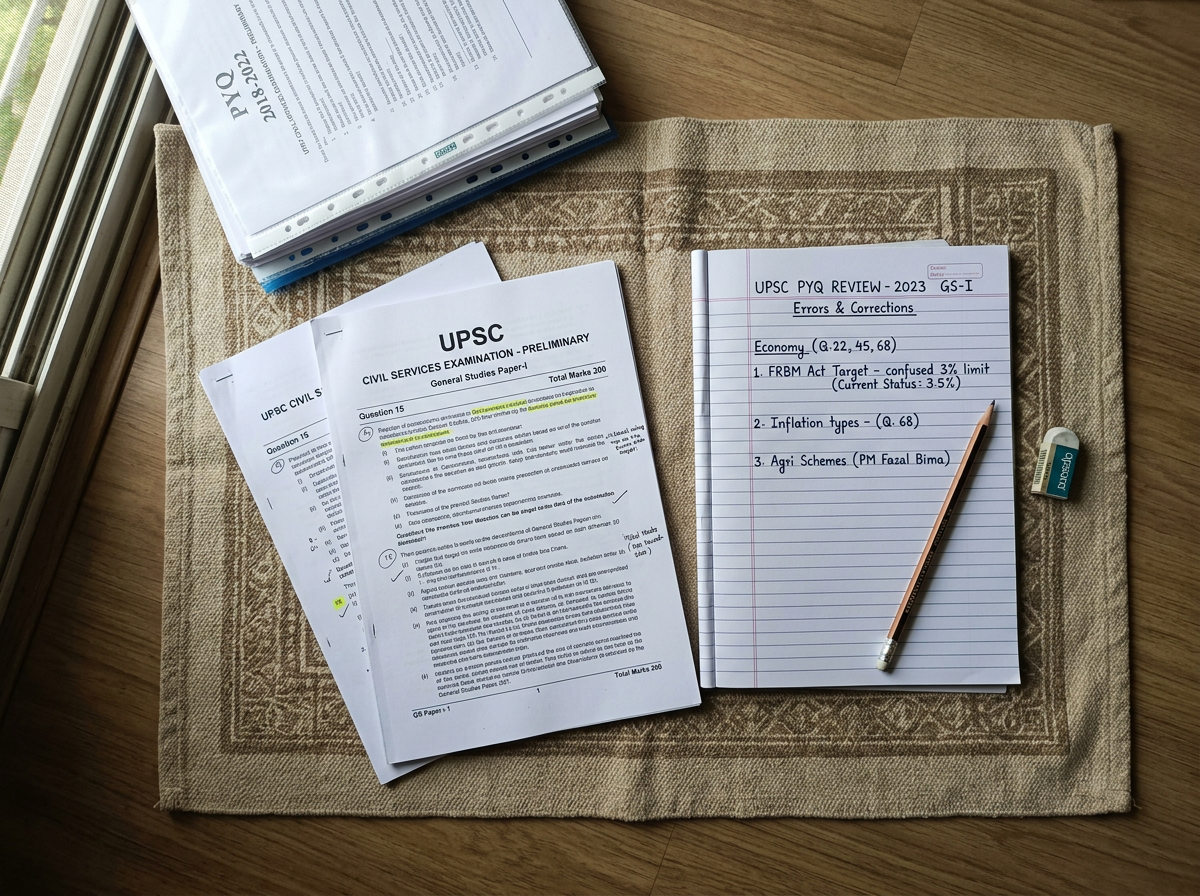
Previous years’ questions are not just practice material. They show how UPSC frames options, mixes facts with concepts, and tests judgement.
Start using previous years’ papers early. Do not wait until the entire syllabus is complete.
When reviewing a previous year question, check:
Which subject it belongs to
Whether it is static, current, or mixed
Which option was easiest to eliminate
What concept UPSC tested
Whether your source covered it
Whether you made a knowledge error or a logic error
This analysis changes the way you study. You begin to notice patterns. You learn that some questions need direct knowledge, while others can be solved by careful elimination.
For instance, extreme words such as “always”, “only”, and “all” may sometimes signal a doubtful statement, but this is not a fixed rule. UPSC also sets traps for people who use shortcuts blindly. Treat elimination as a skill, not a trick.
Build a weekly study routine that you can sustain
A routine should be strict enough to create discipline and flexible enough to survive real life. A perfect timetable that collapses in ten days is not useful.
A balanced weekly routine may include:
Task | Frequency |
Static subject study | 5 to 6 days a week |
Current affairs | Daily or 5 days a week |
Revision | 2 to 3 fixed slots a week |
MCQ practice | 3 to 5 sessions a week |
CSAT | 1 to 2 sessions a week at first, more if weak |
Full test | Later stage, usually weekly |
Daily targets should be measurable. “Study polity” is vague. “Revise fundamental rights and solve 30 MCQs” is better.
Keep one light buffer slot every week. Use it for missed topics, test analysis, or rest. Without buffers, backlog grows fast and creates stress.
Do not ignore CSAT
Many aspirants focus heavily on General Studies and treat CSAT as easy. That can be risky. CSAT may be qualifying, but failure in CSAT ends the attempt regardless of the General Studies score.
Start with a basic diagnostic test. Check whether comprehension, reasoning, or numeracy needs work.
If CSAT is comfortable, maintain practice. If it is weak, build it gradually with:
Reading comprehension passages
Basic arithmetic
Logical reasoning
Data interpretation
Timed practice sets
Full CSAT papers closer to the exam
CSAT preparation should not be left for the final month. It needs calm practice, especially for candidates who have been away from mathematics for years.
Practise mock tests in the right way
Mock tests help only when followed by analysis. Writing test after test without review creates false confidence.
After every mock test, divide mistakes into categories:
Mistake type | What it means | What to do |
Knowledge gap | You did not know the fact or concept | Add it to revision notes |
Conceptual error | You misunderstood the topic | Re-read the core source |
Guessing error | You attempted without enough basis | Improve question selection |
Silly mistake | You misread or rushed | Slow down and mark keywords |
Repeated error | Same topic keeps going wrong | Schedule focused revision |
Track your scores, but do not obsess over one test. Look for trends across several tests. A single high score does not guarantee success, and a single low score does not mean failure.
The main purpose of mock tests is to improve exam behaviour. You learn how many questions to attempt, when to skip, how to manage time, and how to stay calm when the paper feels unfamiliar.
Revise more than you read
Revision is the real difference between passive preparation and exam-ready preparation. The Prelims syllabus is too large to retain through one reading.
Use layered revision:
First revision within a week of studying a topic
Second revision after a few weeks
Third revision through MCQs and short notes
Final revision through condensed notes, maps, and error logs
Keep notes short. If notes become as long as the book, they lose their purpose.
A good final revision file may include:
Polity articles and bodies
History timelines
Geography maps and facts
Economy definitions and current links
Environment species, parks, and conventions
Science and technology current topics
Common mistakes from mock tests
The error notebook is especially useful. It shows your personal weak areas, not someone else’s list.
Take care of exam temperament
Prelims preparation is not only academic. It also tests patience. There will be weeks when scores do not improve. There will be topics that feel dry. There may be mock tests that feel unfair or too difficult.
A calm routine helps. Sleep, basic exercise, and regular breaks are not luxuries. They support memory and decision-making.
During the final phase, avoid comparing daily progress with others. Different candidates have different starting points, strengths, and time availability. Compare your current performance with your previous performance.
The exam hall rewards clarity and composure. If a question is unfamiliar, do not panic. Read it again, evaluate the options, and skip it if needed. A skipped bad question is better than a negative mark earned through panic.
FAQ
When should I start preparing for UPSC CSE Prelims 2027?
Start as early as possible, especially if you are new to the syllabus. A 12 to 18 month window gives enough time for basic books, current affairs, revision, CSAT, and mock tests.
How many hours should I study daily for Prelims?
Quality matters more than a fixed number. Many serious aspirants study for 6 to 8 focused hours, while working candidates may manage fewer hours with a tighter plan. The key is consistency, revision, and test practice.
Are NCERT books enough for UPSC Prelims?
NCERTs are useful for building the base, but they are usually not enough on their own. Use them with standard subject books, current affairs, previous years’ questions, and mock tests.
How many mock tests should I take before Prelims?
There is no magic number. Take enough tests to improve accuracy, timing, and question selection. A smaller number of well-analysed tests is better than many tests taken without review.
Should I prepare for Mains along with Prelims?
In the early stage, yes. Many subjects overlap, and Mains preparation improves conceptual clarity. In the final few months before Prelims, shift the focus strongly towards objective questions, revision, and CSAT.

The best preparation is simple and repeated
A successful Prelims plan does not need to be dramatic. It needs to be steady.
Build the basics. Read current affairs with purpose. Solve previous years’ questions. Practise CSAT. Take mock tests, analyse them honestly, and revise more than you read.
The syllabus will still feel large, and some questions will still surprise you. That is normal. The aim is not to know every fact. The aim is to prepare so well that you can handle uncertainty with judgement, accuracy, and calm.
Take this article with you
Save a reading copy for offline study.


